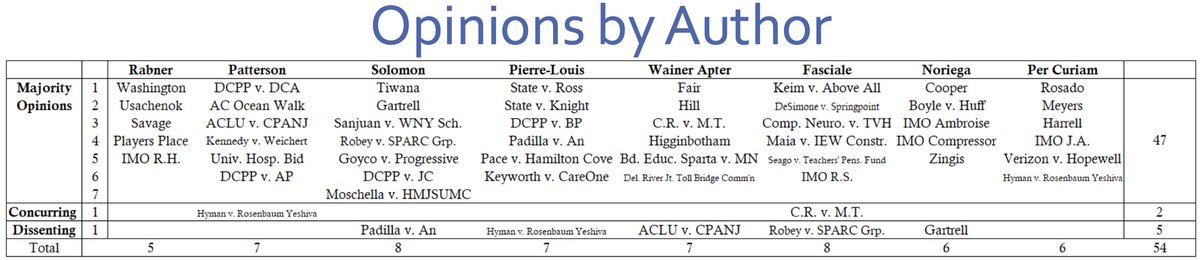
I usually do a big thread for my annual SCONJ stats. But I'm very late with the 2023-24 term, so just dropping it here with some screen shots.
Summary: the Court is in transition and it was a quiet term by the metrics I follow.
https://t.co/pkRydzuN2j
There's still one outstanding opinion from the 2024-25 term, but so far Rabner has been in the majority in every decision in which he participated. (So has Patterson.)
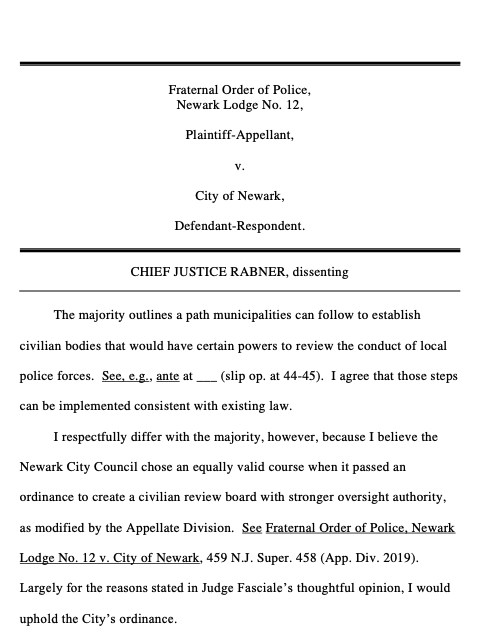
It has been over five years (August 19, 2020) since Chief Justice Rabner wrote a dissenting opinion.
In that time, he has cast 5 dissenting votes in argued cases, joining 3 Pierre-Louis dissents (Allen, Olenowski II, Hyman) and 2 Albin dissents (Szemple, Coleman v. Martinez).
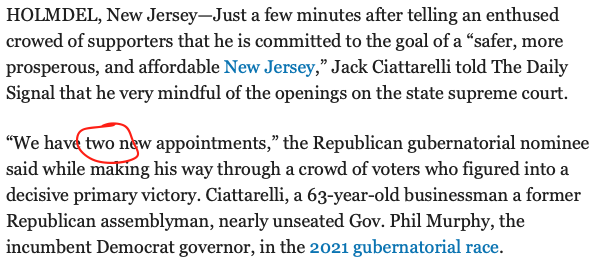
In a debate earlier this year, Ciattarelli said that the next governor gets to appoint the chief justice. But Rabner doesn't hit mandatory retirement until June 2030, six months after the governor elected in 2029 takes office.
New Jersey GOP gubernatorial candidate Jack Ciattarelli says he will eliminate sanctuary cities in the state if elected. @wakeupnj@MattRooneyNJ#elections2025 https://t.co/IcAotCSkT9
If you count Murphy appointees up for tenure in the next term, then it’d be 4 (Patterson, Pierre-Louis, Wainer Apter, and Fasciale), so that doesn’t work either.
Neither does counting a hypothetical second term, because that would be 3 retirements (Rabner, Patterson, Fasciale).
@jeffmongiello That's a good point. I had been thinking about timing purely in the sense of the litigation process, but the investigation pause would also explain the dip.
The NJ Supreme Court heard two arguments in criminal cases this week. That used to be a pretty mundane and typical thing to happen, but the last time the Court heard two non-consolidated criminal arguments in a single sitting was November 2023.
So maybe LaVecchia and Albin, who wrote regularly and passionately in criminal cases, found criminal cases generally more interesting than the new justices do in the aggregate?
It could just be a statistical blip, but it’s something I’m keeping my eye on.
Rule 2:12-4 allows certification “if the interest of justice requires.”
One retired justice often says that this really means “if the interest of A justice requires,” meaning that if you snag the interest of the right justice, that justice can shoulder through a cert grant.
To my knowledge, this morning's argument in Kratovil is the first time that Justice Patterson presided over oral arguments.
Unless there's an undecided case from this term I missed, the last time Rabner didn't participate in an argument was Acoli v. Parole Board in Jan 2022.
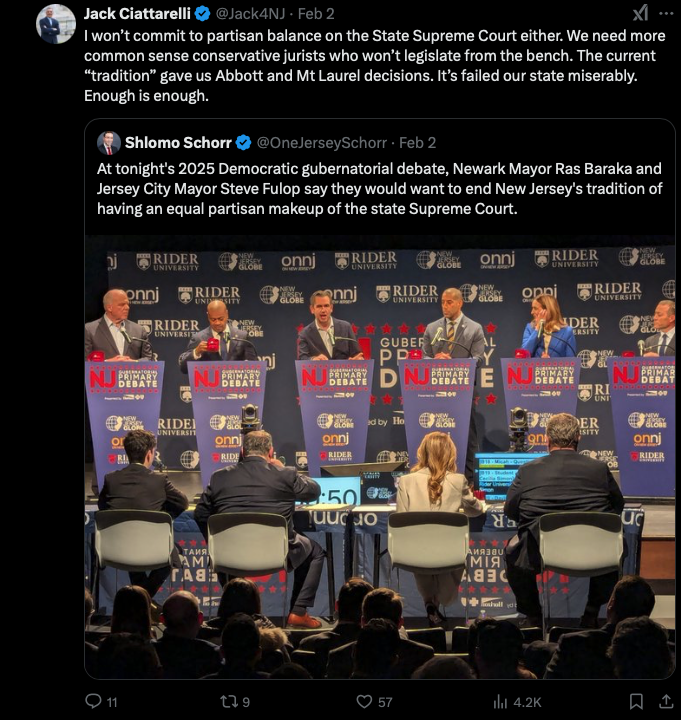
@eaconner@jmaxmann Partisan balance isn't a uniform prerequisite to respect, but in NJ, it has been a feature for as long as the Court has existed. And partisan balance has enhanced the Court's standing.
Like I said, if it ain't broke don't fix it. And I haven't seen anyone explain what's broke.
This is immensely disappointing.
Partisan balance on the NJ Supreme Court predates the 1947 Constitution and has been a magnificent success.
Unlike elected political branches, the Court derives legitimacy from public acceptance that its decisions were fair and reached justly.
Despite partisan balance, the Court has seen a wide array of judicial philosophies to fit the ideologies of their appointing governors. No one is saying you must appoint someone unfit.
But partisan balance serves an important legitimizing symbol for the state’s unelected branch.
The partisan balance brings out what is best in the NJ Supreme Court: a roughly even mix of Republicans and Democrats collaboratively analyzing the law and reaching unified outcomes on the State's most pressing legal issues.
Quite simply, if it ain’t broke, don’t fix it.