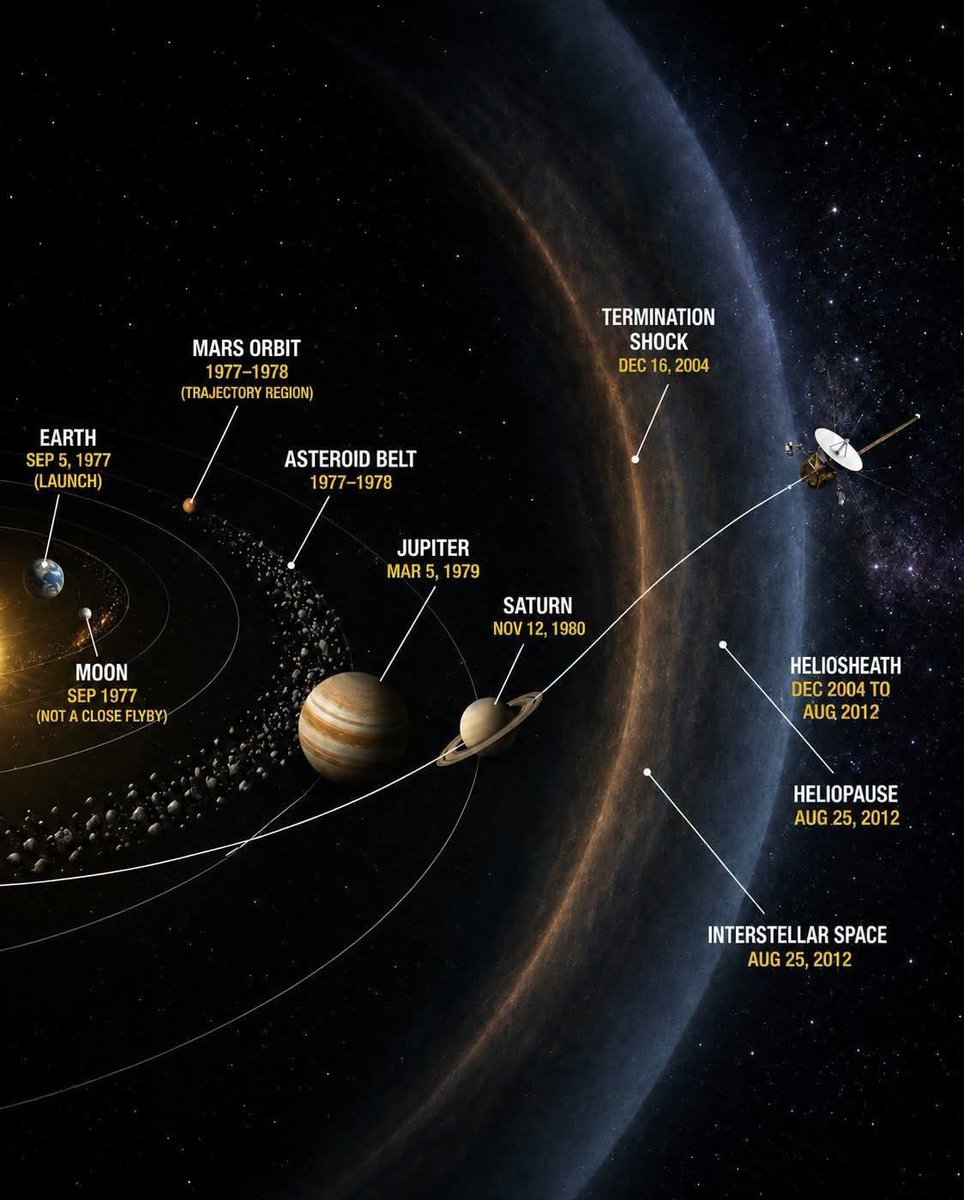
On Sept. 5, 1977, Voyager 1 began a journey that made history. It flew past Jupiter (1979) and Saturn (1980), using their gravity to speed outward. In 2004 it crossed the termination shock, and on Aug. 25, 2012, it became the first spacecraft to enter interstellar space. Nearly 50 years after launch, Voyager 1 is still traveling between the stars, carrying humanity's Golden Record from a tiny world called Earth.
🌍 The Sun Exists Inside Earth? The Truth About Our Planet’s Core!
Deep beneath our feet lies a world that feels almost impossible to imagine. 🌎
Earth’s inner core is about the size of Pluto and reaches temperatures close to the surface of the Sun — around 5,000–6,000°C. ☀️🔥
But here’s the real mystery: If Earth’s core is as hot as the Sun’s surface, why doesn’t our planet turn into a ball of fire? 🤔
The answer lies in incredible pressure, layers of rock, and the complex science that keeps our planet alive.
🌋 Is Earth’s core the greatest natural engine in the universe, or is there something even more mysterious hidden beneath our feet?
What do you think? Share your thoughts!
#EarthCore #PlanetEarth #ScienceFacts #AmazingFacts #UniverseMysteries
✨ How Big Are Stars? And Are We Really Good at Understanding "Big"? 🌌
We think our Sun is huge—and it is, holding about 1.3 million Earths inside it. But compared to some stars, it's actually quite small.
☀️ Sun – 1×
✨ Sirius – 2×
🟠 Pollux – 9×
🔴 Arcturus – 25×
🔵 Rigel – 79×
🔴 Betelgeuse – 700×
🔥 Antares – 883×
🌌 Stephenson 2-18 – ~2,150× (currently the largest known star)
Here's the debate: Do you think Stephenson 2-18 will remain the largest known star, or will future discoveries reveal an even bigger giant? 🤔
#Astronomy #Space #Universe #Stars #Sun #Cosmos #Science #Astrophysics #SpaceFacts #DidYouKnow
Magnificent 😃
The James Webb Space Telescope (JWST) has revealed Saturn in a way never seen before, using powerful infrared vision to uncover hidden details within the gas giant’s atmosphere. In these remarkable observations, Saturn’s iconic rings shine brilliantly while the planet itself appears unusually dark because methane gas absorbs much of the reflected sunlight. Beyond the stunning contrast, scientists discovered mysterious dark spots, intricate cloud structures, and glowing auroral activity near the poles, revealing a far more dynamic and complex world than previously understood. These groundbreaking images are helping astronomers unlock new secrets about Saturn’s weather, atmospheric chemistry, and the evolution of giant planets throughout our Solar System. 🪐🔭✨
The Sun compared to the stars Vega, Arcturus, and Rigel.
Vega (α Lyrae) is a blue star located in the constellation Lyra.
Arcturus (α Boötis) is the brightest star in the Northern Hemisphere's sky. It is an orange giant with a luminosity 110 times that of the Sun.
Rigel (Beta Orionis) is the brightest star in the constellation Orion and the seventh-brightest star in the night sky.
A brief history of Quantum computers 👇
1905: Albert Einstein explains the photoelectric effect and suggests that light consists of quantum particles or photons
1924: Max Born uses the term quantum mechanics for the first time
1925: Werner Heisenberg, Max Born, and Pascual Jordan formulate matrix mechanics, the first formulation of quantum mechanics
1925-1927: Niels Bohr and Werner Heisenberg develop the Copenhagen interpretation, one of the earliest and most common interpretations of quantum mechanics
1930: Paul Dirac publishes The Principles of Quantum Mechanics, a standard textbook on quantum theory
1935: Albert Einstein, Boris Podolsky, and Nathan Rosen publish a paper highlighting the counterintuitive nature of quantum superposition and arguing that quantum mechanics is incomplete
1935: Erwin Schrödinger develops a thought experiment involving a cat that is simultaneously dead and alive, and coins the term “quantum entanglement”
1944: John von Neumann publishes Mathematical Foundations of Quantum Mechanics, a rigorous mathematical framework for quantum theory
1957: Hugh Everett proposes the many-worlds interpretation of quantum mechanics, which suggests that every possible outcome of a quantum measurement actually occurs in a parallel universe
1961: Rolf Landauer shows that erasing a bit of information dissipates a minimum amount of energy, known as Landauer’s principle
1965: John Bell proves that quantum entanglement cannot be explained by any local hidden variable theory, known as Bell’s theorem
1973: Alexander Holevo proves that n qubits cannot carry more than n classical bits of information, known as Holevo’s theorem or Holevo’s bound
1980: Paul Benioff proposes a model of a quantum Turing machine, a theoretical device that can perform any computation using quantum mechanical principles
1981: Richard Feynman suggests that simulating quantum systems would require a new type of computer based on quantum mechanics
1982: David Deutsch generalizes Benioff’s model and proposes the concept of a universal quantum computer
1984: Charles Bennett and Gilles Brassard develop a protocol for quantum key distribution, which allows two parties to securely exchange cryptographic keys using quantum states
1985: David Deutsch and Richard Jozsa devise an algorithm that can solve a specific problem faster than any classical algorithm, known as the Deutsch-Jozsa algorithm
1991: Artur Ekert proposes another protocol for quantum key distribution based on quantum entanglement, known as the E91 protocol
1992: David Deutsch and Richard Jozsa extend their algorithm to handle multiple inputs, known as the Deutsch-Jozsa algorithm
1994: Peter Shor discovers an algorithm that can factor large numbers in polynomial time using a quantum computer, known as Shor’s algorithm
1996: Lov Grover invents an algorithm that can search an unsorted database in square root time using a quantum computer, known as Grover’s algorithm
1997: Isaac Chuang, Neil Gershenfeld, and Mark Kubinec demonstrate the first implementation of Shor’s algorithm using nuclear magnetic resonance (NMR) techniques
2000: David DiVincenzo proposes five criteria for building a practical quantum computer, known as the DiVincenzo criteria
2001: IBM researchers implement Grover’s algorithm using NMR techniques and achieve a modest speedup over classical algorithms
2007: D-Wave Systems claims to have built the first commercial quantum computer, but its validity is disputed by many experts
2019: Google announces that it has achieved quantum supremacy by performing a calculation on a 53-qubit quantum processor that would take a classical supercomputer thousands of years to complete
2020: IBM demonstrates that its 65-qubit quantum processor can perform calculations beyond the reach of any classical computer
📷 An IBM QC photographed by James Estrin
NASA has captured powerful dust storms moving across the surface of Mars. These storms can reshape the landscape, reduce visibility, and reveal how active the Red Planet's weather can be.
#Mars#NASA#Space
☀️ Sunlight is an "emanation" with a 100,000-year delay
A photon born in the Sun's core does not travel directly to the surface. Inside the star, it constantly collides with particles, getting absorbed and re-emitted in a process known as a random walk.
Because of this, the energy's journey outward takes about 100,000 years. Yet, once it leaves the Sun's surface, the light takes only about 8 minutes to reach Earth.
So, the sunlight on your face is energy that began its journey from the star's interior long before the dawn of modern civilization.
Around 240 BC, the Greek mathematician Eratosthenes calculated the Earth's circumference using just a stick and the length of its shadow, with impressive accuracy.
The Non-Traversable Bridge Einstein Found Inside Gravity
Einstein’s equations not only describe gravity as a force but as the shape of Spacetime as well.
In 1935, Einstein and Rosen found that the Schwarzschild solution could be written in a way that reveals something astonishing:
Two separate exterior regions of Spacetime joined by a bridge-like throat
Rᵤᵥ = 0
This became known as the Einstein-Rosen Bridge.
It is often called a Wormhole, but the classical Einstein-Rosen bridge is not a science-fiction tunnel. In the standard Schwarzschild geometry, it is non-traversable. The throat does not remain open long enough for ordinary travel from one region to the other.
Its real power is mathematical.
It shows that General Relativity is not merely about objects moving through space. The theory allows Spacetime to have global structure such as different regions, horizons, extensions, and hidden connections that are not visible from one local patch alone.
The Einstein-Rosen bridge is one of the earliest glimpses of that deeper idea.
Gravity is geometry.
And sometimes, geometry has two worlds joined by a throat.
#Astrophysics #GeneralRelativity #Einstein #BlackHole #Spacetime #Cosmology #Gravity #Wormhole #Mathematics #Physics
Incredible video of a supernova remnant in motion!
It took 25 years to create this animation, showing how Kepler's Supernova (SN 1604) changes and expands over time!
This data was collected by the Chandra X-ray telescope (blue tones). The X-ray data was superimposed on visible-light images obtained by the Pan-STARRS observatory.
The first gravitational waves ever directly observed were produced by two colliding black holes. In a fraction of a second, the merger unleashed 3.6×10⁴⁹ watts of power, exceeding the combined luminosity of every star in the observable universe.
NASA shares clearest image ever captured of hexgonal storm raging on Jupiter's South Pole.
How this configuration remains stable is a mystery to this day and scientists are still looking for answers.
Imagine a structure so vast that light itself would take 10 BILLION years to cross it.Astronomers have found one of the largest known structures in the observable universe: the Hercules–Corona Borealis Great Wall. They discovered this cosmic behemoth by mapping powerful gamma-ray bursts — the brightest explosions in the cosmos — using them as cosmic beacons to reveal where matter is massively clustered across incomprehensible distances.But here’s the part that breaks cosmology: According to the standard model, the universe should look roughly the same everywhere on the largest scales. Yet this colossal wall stretches far bigger than our theories comfortably allow — challenging everything we thought we knew about how structure forms in the https://t.co/AnpMSLNlyE our understanding of the universe incomplete? Are even larger structures still hiding out there? The Hercules–Corona Borealis Great Wall is a humbling reminder: no matter how advanced our science gets, the universe still loves to surprise us. Every discovery shows just how small we are in the grand scheme… and how breathtakingly extraordinary it all is. If this blew your mind, share it with a fellow space lover!
Electrons are so identical that if you swap one electron with another anywhere in the universe, nothing changes—they are fundamentally indistinguishable.
This led physicist John Wheeler to propose the mind-bending idea that all electrons might actually be the same single electron, traveling back and forth through time to appear everywhere at once.
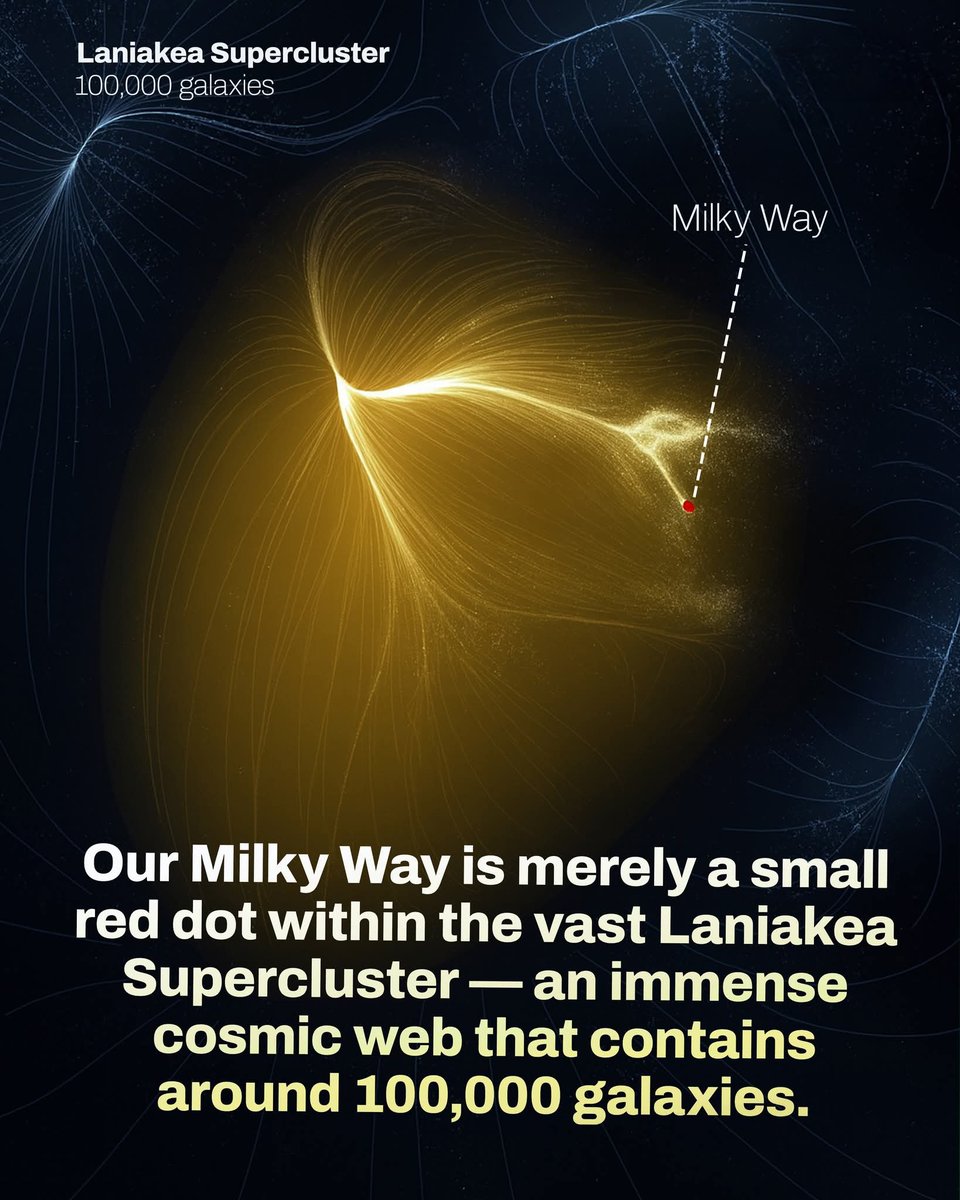
Our Milky Way rests deep inside the Laniakea Supercluster — a colossal cosmic web stretching across 500 million light-years. Within this immense structure, gravity guides the motion of roughly 100,000 galaxies, all flowing together toward a region known as the Great Attractor. The tiny red dot marking our galaxy shows just how small we are in this vast interconnected system. Every glowing filament in this map represents streams of galaxies moving through space, bound by invisible cosmic forces. The Laniakea Supercluster shows that even our entire galaxy is just one thread in the universe’s grand design.