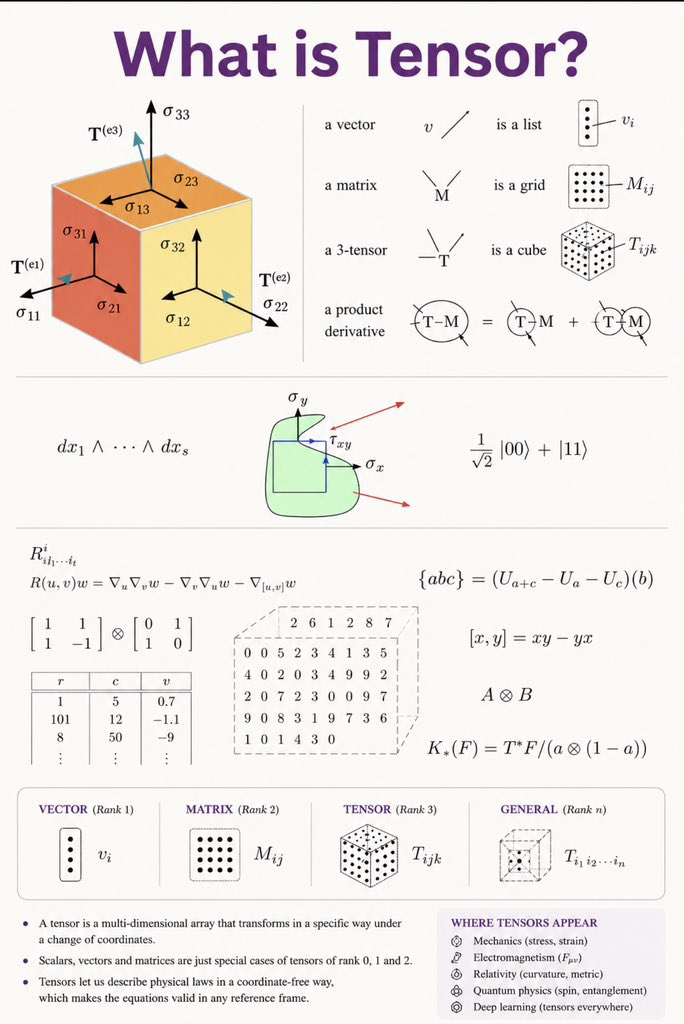
people often think tensors are just bigger matrices.
they’re not.
a matrix is one kind of tensor, just as a vector is another. tensors are the broader idea. they’re mathematical objects that represent relationships across multiple dimensions while preserving those relationships even when you change your coordinate system. that’s why physicists care much more about how a tensor transforms than how it’s stored in memory. the array of numbers is just one representation. the underlying object is independent of your choice of coordinates.
this is what makes tensors so powerful. the stress inside a bridge, the curvature of spacetime, the electromagnetic field, the inertia of a robot arm, and the activations inside a neural network can all be described using tensors. at first glance these seem like completely unrelated problems. mathematically, they’re variations of the same language. tensors let you describe quantities that have direction, interaction, and structure in a way that remains consistent regardless of your point of view.
the deeper lesson is that mathematics evolves by abstraction. numbers describe single values. vectors describe direction. matrices describe transformations. tensors describe relationships in arbitrarily many dimensions. each step isn’t about making mathematics more complicated. it’s about building a language capable of describing a richer reality. that’s why once you understand tensors, you start seeing the same mathematical structure hiding underneath robotics, computer vision, quantum mechanics, relativity, continuum mechanics, and deep learning.
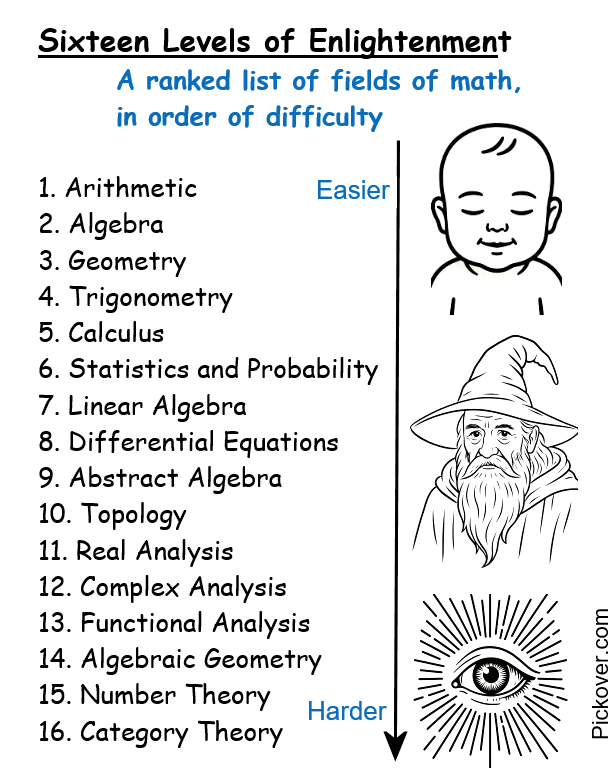
- Sixteen Levels of Enlightenment -
A ranked list of fields of math, in order of difficulty to master and understand. (Explanations below.) This is meant to spark debate and reflection. Of course, difficulty is highly subjective and depends on your background, interests, and how deeply you go. The fields are deeply interconnected, basic topics feed into advanced branches, and areas like number theory span multiple levels.
1. Arithmetic
• Difficulty: Low
• Why: Focuses on basic operations (+, -, ×, ÷). It’s the foundation of math, intuitive for most, but mastering it requires understanding number properties and basic problem-solving.
2. Algebra
• Difficulty: Low to Moderate
• Why: Builds on arithmetic with variables and equations. Note: Linear algebra and abstract algebra each have their own dedicated entries below.
3. Geometry
• Difficulty: Moderate
• Why: Involves spatial reasoning, proofs, and theorems (e.g., Euclidean geometry). Analytical geometry and topology require more abstraction, but basic geometry is accessible with visualization skills. Note: Algebraic geometry has its own dedicated entry below.
4. Trigonometry
• Difficulty: Moderate
• Why: Focuses on triangles, angles, and periodic functions. Concepts like sine, cosine, and identities are manageable but require memorization and algebraic proficiency. Often taught as part of precalculus rather than a standalone advanced field.
5. Calculus
• Difficulty: Moderate to High
• Why: Introduces limits, derivatives, and integrals, requiring a solid grasp of algebra and trigonometry. Multivariable calculus and real analysis ramp up the rigor with abstract concepts.
6. Statistics and Probability
• Difficulty: Moderate to High
• Why: Descriptive statistics is intuitive, but probability theory and inferential statistics involve complex concepts like distributions and hypothesis testing. Advanced topics (e.g., Bayesian methods) demand strong analytical skills. Note: measure-theoretic probability is significantly more advanced and sits closer to real analysis.
7. Linear Algebra
• Difficulty: High
• Why: Deals with vectors, matrices, and linear transformations. While computational aspects are straightforward, understanding abstract vector spaces and eigenvalues requires a leap in conceptual thinking.
8. Differential Equations
• Difficulty: High
• Why: Solving equations involving derivatives (e.g., ODEs, PDEs) requires calculus and linear algebra. Partial differential equations and nonlinear systems are particularly challenging due to their complexity and applications.
9. Abstract Algebra
• Difficulty: Very High
• Why: Studies algebraic structures like groups, rings, and fields. Highly abstract, it demands strong logical reasoning and comfort with proofs, often a steep learning curve for students.
10. Topology
• Difficulty: Very High
• Why: Explores properties of spaces preserved under continuous deformations. Concepts like open sets and compactness are abstract and require a deep understanding of set theory and analysis.
11. Real Analysis
• Difficulty: Very High
• Why: Rigorous study of real numbers, sequences, and functions. It formalizes calculus with proofs, requiring precision and a strong grasp of logic and set theory.
12. Complex Analysis
• Difficulty: Very High
• Why: Extends analysis to complex numbers, involving analytic functions and contour integrals. While some find it more intuitive than real analysis, it builds on advanced calculus and topology.
13. Functional Analysis
• Difficulty: Extremely High
• Why: Studies vector spaces with topological structure (e.g., Banach and Hilbert spaces). It combines analysis, linear algebra, and topology, demanding fluency in all three.
14. Algebraic Geometry
• Difficulty: Extremely High
• Why: Combines abstract algebra and geometry to study solutions to polynomial equations. Its abstraction and reliance on advanced algebra and topology make it formidable.
15. Number Theory
• Difficulty: Extremely High
• Why: Focuses on properties of numbers, especially integers (e.g., prime numbers). Elementary number theory is accessible, but advanced topics like analytic or algebraic number theory require deep knowledge of analysis and algebra.
16. Category Theory
• Difficulty: Extremely High
• Why: Highly abstract, it generalizes structures across mathematics (e.g., sets, groups, topologies). Its conceptual depth and broad prerequisites make it one of the most challenging fields.
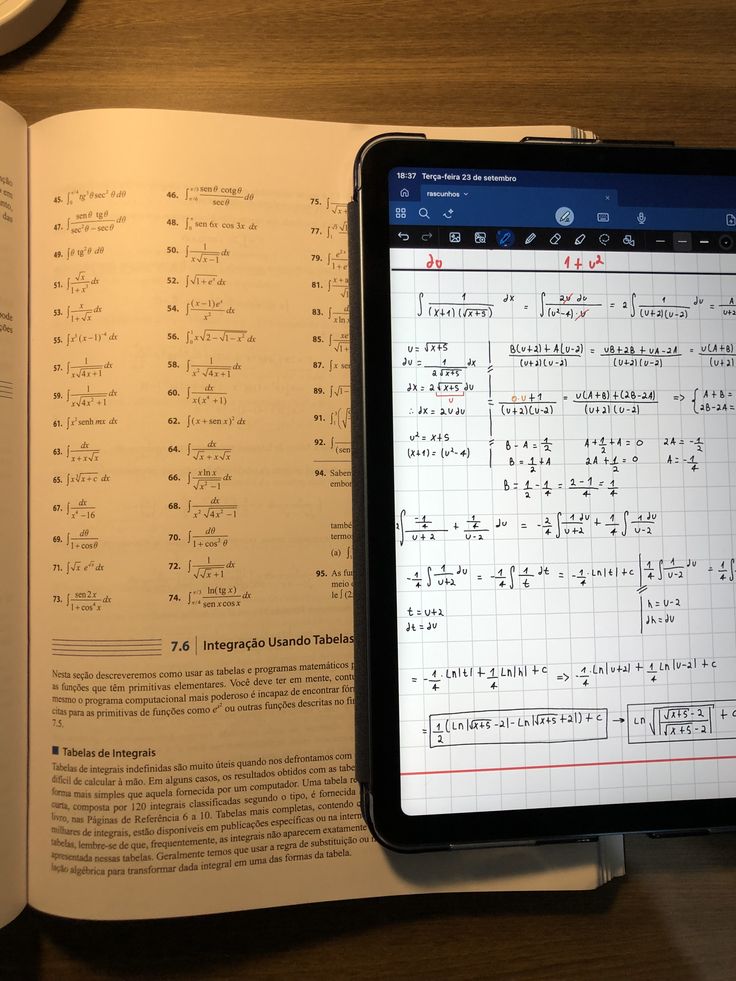
study calculus. seriously.
not because it’s “academic” but because it rewires how you see the world.
• limits → teach you how things behave at the edge
• derivatives → measure change, motion, growth
• integrals → accumulation, area, total effect
• differential equations → how real systems evolve over time
once you see the world in rates of change and accumulation, everything looks different. physics makes sense. control theory makes sense. even economics starts clicking.
and don’t wait for a classroom to save you.
• pick a textbook
• watch lectures
• solve problems by hand
• struggle alone until it hurts
self learning is slow at first. then it compounds.
no one is coming to structure your mind for you.
If you need to brush up your math skills - or gain new ones - this collection of courses is for you.
It's a list of more than 220 of the top online math courses from the 60 best universities in the world.
You can learn about linear algebra, differential equations, vector calculus, statistics and probability, and lots more.
https://t.co/c7TtiP2ZxF
According to the 30 years of experience of Physicist Federico Faggin Mathematics is created by consciousness so we cannot explain consciousness with mathematics.
Webflow is a tool that helps you design & build websites without writing any code yourself.
And in this course, you'll learn how to use it by creating a landing page.
It covers using CSS Grid and Flexbox, responsiveness, SEO optimization, and lots more.
https://t.co/Pbg5AJL8QG
Give me the chance to change your life for the better and setup a lasting career path for you.
If you have an android phone, just download this AltSchoolGO app, signup & wait for Monday.⭐️
RT & Reply “done” here once you have the app so I’ll DM you on Monday.
TECH
TECH