Why I believe $TIBBIR is destined to be the next 1B runner
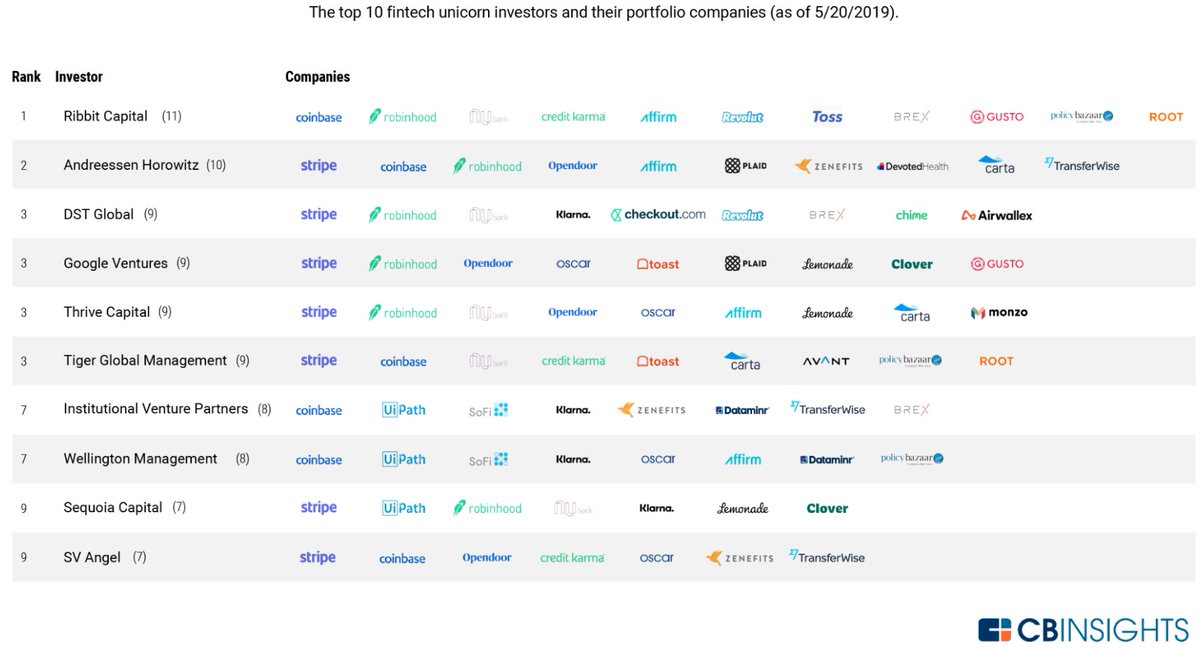
Tibbir is a stealth launch by @RibbitCapital , a top VC. They are the vcs behind Coinbase and Robinhood (see picture 2). The problem they are solving is fintech infrastructure where institutions and banks would adopt (see picture 3). Tibbir is also the leading token from on virtuals.
Ribbit capital recently dropped a 41 page token letter. They're very recently rebranded their website on Oct 16 2025 and rebranded their LinkedIn on Oct 24, 2025 (tibbir gets that tradfi and web2 inflow ty)
https://t.co/kGyailkUTk
catchup on tibbir rebranding lore here, his x content on tibbir were great reads to build conviction^
https://t.co/CTg4w8WOOF
Great read on Ribbit Capital, the VC^
https://t.co/kTTmoYWx0x
website with 41 page token letter^
Personally been accumulating above 320m - 370m and got much more bullish on LinkedIn rebranding that pushed me over.
TLDR: $TIBBIR is positioned really well as:
- The leading base/virtuals token from Ribbit Capital (a top vc),
- $VIRTUAL strength
- Fintech/payments focused for AI
- Coinbase taking mindshare from purchasing Cobie's platform (good for base)
- current x402 ai payments meta, and
- recent rebranding targeting web2 money
- 41 page token letter
- It's about time a 1b macap onchain runner hits.
My plan for the next few months, and how I'm going to capitalise on making a fuck tonne of money if it plays out.
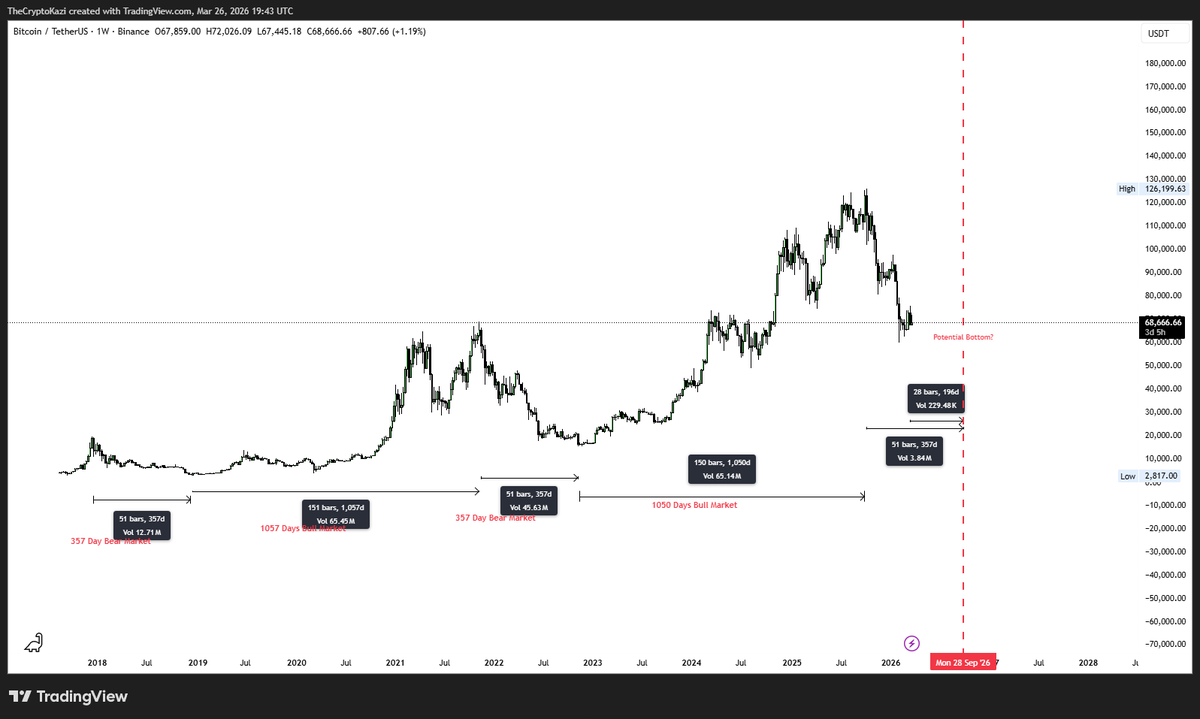
According to previous data, Bull markets last approximately 1050 Days, which in the case of the previous months, has been true. We topped around that exact mark.
Now, if we're looking at bear markets, both have literally been 357 exact.
We're currently 161 days into this bear market, leaving another 196 days of a typical bear market.
Does this mean sell everything and fuck off?
No. It actually means quite the opposite. Around 210 days into a bear market, you usually find a low, which tends to be the "range low" of the bear market. This typically gets tested a few times, providing for great accumulation opportunities.
With the geopolitical situation, I do think we have a final leg down loading on BTC, but that should be the macro bottom of this bearish cycle, and giving us a relative low to keep as a "accumulation low" before the next bull run.
What does this mean?
Honestly, it can be taken two ways.
First, I don't think lowcaps will be too affected overall, once Bitcoin finds a bottom. Some might even have relative strength against nukes, as we've seen over the past few days. Most projects we're holding, I think if they were to perform, they will regardless of what Bitcoin does.
However, the main thing I want you guys to do is pick 2-3 larger cap coins that you want to accumulate for the next bullrun, as these will probably have the most "safe" R/R when you're accumulating.
For me personally, I've chosen $VIRTUAL and $XMR.
Why?
$VIRTUAL because I'm personally very very bullish on the entire ecosystem and once we do find a proper low in the market I'm going to be aping in HEAVY on lowcaps on Virtuals. I think Robotics and AI on Base and Virtuals hasn't even shown us 10% of the true capabilities we're going to see.
$XMR because it's the only digital private money. There's 9 figure Bitcoin whales I've spoken to, who have been accumulating $XMR for years now. They literally say to me *"This tech is exactly why I invested in Bitcoin. This is what Bitcoin is meant to be"*.
When it comes to lowcaps, I'm still taking a lot of these projects as trades. I don't really go in too heavy unless I genuinely believe it's a massive opporunity that will have a good ROI.
The real question is, how do you actually accumulate the bottom?
To be honest, don't overcomplicate it. Most times we see a capitulation wick across the board, that's usually the bottom. Now we've had one at 60K, so you can use that as a base to build long term position on large cap alts.
There's 2 strategies you can use. Daily DCA, or creating a clean range and keeping bids at the range lows over the next few weeks.
I've already personally been buying $XMR and $VIRTUAL as I've been saying, as I believe they're multi year holds regardless.
When I start sharing gems, most people will have given up.
Trust me, I've seen it every single cycle. The people that have stuck around know how crazy our entries get at peak bear market lows. We've caught plenty of 100X+ plays, even a 10,000X from bear market entries.
The reason I haven't shared a long term holds is because I know exactly what those bear market lows feel like. As shit as the market is, we haven't hit that yet, but we are nearly there.
I know it's been a tough few months, but when the time comes again, we will absolutely crush the markets and make a stupid amount of money.
Remember, you haven't lost, until you've given up. Just hang in, and your future self will thank you.
THEY DID IT.
The SEC and CFTC just dropped a landmark document that officially classifies crypto assets.
They're actually telling us which crypto assets are securities and which ones aren't - by name!
THIS IS SOMETHING GENSLER REFUSED TO DO
(he focused on prosecuting crypto out of existence)
This rule doc gives crypto many of the benefits of the clarity bill - it lifts us out of the gray market - it gives every asset a path.
It's almost like the Clarity act just passed by way of regulator.
(of course, the actual clarity act will harden all this into legislation and make it irreversible in the event we get another Gensler, we still want it)
This rule says there's 5 categories for crypto assets:
1) Digital Commodities - assets tied to a functional, decentralized crypto system (e.g., BTC, ETH, SOL, XRP, ADA, DOGE). Not securities. (yes, they name them on page 14)
2) Digital Collectibles - NFTs, meme coins, artwork tokens, in-game items. Not securities (fractionalized collectibles may be an exception).
3) Digital Tools - membership tokens, credentials, domain names (e.g., ENS). Not securities.
4) Stablecoins - payment stablecoins under the GENIUS Act are not securities. Other stablecoins, it depends.
5) Digital Securities - tokenized versions of traditional securities. Like tokenized stocks. Always securities.
Amazing! This makes so much sense I can't believe it's coming from a regulator.
No more enforcement threats to Ethereum developers and crypto exchanges.
How about the Howey test?
More common sense! If an issuer makes specific promises of managerial efforts from which buyers expect profits, the offering is a security until those promises are fulfilled. Then it's a commodity. The asset itself was never the security, the deal around it was. (E.g. XRP was a security pre launch, became a commodity after).
How about stuff like staking and mining?
Mining? Not a securities transaction.
Staking? Also not a securities transaction, that includes custodial and liquid staking even with LSTs!
How about wrapping BTC? Not a securities transaction.
Airdrops? NOT SECURITIES. NO MORE GEO BANS PROTECTING AMERICANS from free airdrops.
Remember this is a joint doc from the SEC and CFTC, They're actually cooperating on this, no internal strife, this is binding to both.
SEC regulates $80-100 trillion assets
CFTC regulates $5-10 trillion assets
Both of the world's largest capital markets are showing us that crypto assets are here to stay and they're welcome alongside traditional assets.
Every country will follow.
This is the biggest move toward legitimacy I've seen in all my time in crypto. Maybe bigger than the genius act since is covers all crypto assets.
Well done @MichaelSelig and @SECPaulSAtkins.
And especially well done to the indefatigable @HesterPeirce. Her fingerprints are all over this, couldn't have happened without her eight years of principles-based curiosity.
Billionaire Investor Chamath believes copper is the best investment for 2026
He says that we will have a 70% supply shortage with no alternatives
What is your favorite copper stock?
Honestly the best thing I ever did for myself as a trader was study the history of markets. Especially today as narrative and emotion rules all, you need to learn how humans will react…cycles are predictable when they are based on human emotion as the stocks might change but the people never do.
My top 5 books to nail this down:
1. Baruch: My Own Story by Bernard Baruch
2. The Alchemy of Finance by George Soros
3. A Man for All Markets by Edward O. Thorp
4. Fortune’s Formula by William Poundstone
5. The Great Game by John Steele Gordon
I’ll be writing an article later in the week detailing some of the lessons from these books, but really it boils down to understanding that humans, when faced with similar circumstances, will act in similar ways. Reading these books will give you so many examples from history that are directly applicable to the situations we seem to be experiencing almost every day in these markets
talked to a guy who's been trading 23 years and manages $40M
asked him what separates traders who survive from traders who blow up
his answer surprised me
it wasn't strategy. it wasn't discipline. it wasn't psychology.
"bet sizing. that's it. that's the whole game."
here's what he explained:
THE THESIS:
"I've seen hundreds of traders come through. good ones. smart ones. talented ones."
"90% of the ones who blew up didn't blow up from bad trades. they blew up from bad sizing on normal trades."
"a 1R loss at proper size is nothing. a 1R loss at 10x proper size is account death."
THE EXAMPLES:
he walked me through case studies:
TRADER A:
- excellent strategy, 58% WR
- consistently profitable for 2 years
- had a "high conviction" trade
- sized up 5x normal position
- trade lost
- drawdown was 23% instead of 5%
- psychology cracked
- revenge traded the next week
- blew the account in 8 days
"he didn't blow up from a bad trade. he blew up from a big trade."
TRADER B:
- mediocre strategy, 51% WR
- survived for 11 years
- never sized above 0.8% per trade
- took the same size on every trade
- no "high conviction" sizing
- compounded slowly but never blew up
"he's worth $4M now. started with $50k. just never killed himself with size."
THE RULE:
"every trader who blows up violates the same rule"
"they size based on CONVICTION instead of MATH"
"'this one feels right' so they go bigger"
"'I'm on a winning streak' so they go bigger"
"'I need to make it back' so they go bigger"
"conviction is how you justify stupid sizing"
THE DATA:
he showed me internal research:
traders who sized based on conviction:
- average survival time: 2.4 years
- account explosion rate: 74%
traders who sized mathematically (same size every trade):
- average survival time: 8.3 years
- account explosion rate: 12%
"it's not even close. variable sizing kills traders."
THE MATH:
he broke down why "high conviction" sizing is stupid:
"let's say you're 60% accurate on normal trades"
"let's say you're 70% accurate on 'high conviction' trades"
"sounds good right? go bigger on the 70% trades?"
"wrong. here's why:"
"at 60% accuracy with 1% risk, a 4-loss streak costs you 4%"
"at 70% accuracy with 5% risk, a 4-loss streak costs you 20%"
"and 4-loss streaks happen even at 70% accuracy"
"you FEEL more confident but the math doesn't justify the size increase"
THE SOLUTION:
"how do you size then?"
"same size every trade. no exceptions."
"what about when you're really confident?"
"same size. confidence isn't accuracy."
"what about when the setup is perfect?"
"same size. perfect setups lose 40% of the time."
"what about when you're on a winning streak?"
"same size. streaks end."
"every trade gets the same respect. the 'boring' ones and the 'perfect' ones."
THE IMPLEMENTATION:
his rules for position sizing:
1. calculate your base risk (0.5-2% depending on account size and edge)
2. that's your risk on EVERY trade
3. never size up. ever.
4. if you want more money, scale accounts/capital. don't scale risk.
"I've been trading 23 years. I've never taken a trade above 2% risk. not once."
"my biggest winners and my 'meh' trades got the same size"
"I'm not trying to hit home runs. I'm trying to not strike out."
THE TRUTH:
retail traders think they need big trades to make big money
professionals know big trades make big losses
the traders managing real money all size conservatively
they make money through VOLUME of good trades not SIZE of individual trades
if you're varying your position size based on "conviction":
you're already on the path to blowing up
it's just a matter of when
same size
every trade
no exceptions
that's how you survive
Amazing read! Do agree with working in different environments. Definitely feel more productive working at cafes when trying to lock in at other work, away from the trade station.
Everyone's sharing that "Long Degeneracy" article and nominating it for article of the year with 20m views. I just got around to reading it…overall, I get it. It's well written, emotionally resonant, and captures something real about generational anxiety. I like the author, I subscribe to their stuff… talented Quant.
But nobody's pushing back, so let me while I watch my kids at the pool.
My main pushback is this: the article is a suicide note dressed up as investment advice. I REFUSE to hand my agency to "the house." The moment you accept "the game is rigged so I might as well gamble," you've surrendered. You've quit on the process that actually works because someone convinced you it doesn't. There are no easy buttons. No shortcuts. No magic money options. There is only learning, sacrifice, and continual grit.
It tells a generation they're prisoners. Then it sells them a lottery ticket and calls it freedom. Then it tells YOU to invest in the prison.
That's not analysis. That's despair with a ticker symbol.
The author spends 2000 words empathizing with young people as "prisoners" trapped by a broken economy… then tells you to invest in the platforms extracting fees from their desperation. "Long Coinbase, long DraftKings, long the casinos."
Read that again. The thesis is: a generation is so economically desperate they're turning to gambling, most will lose, and YOU should profit by owning the house.
You can't weep for the prisoners and then sell shares in the prison. Pick one.
4 points I want to make....
Pushback 1: "Closed" is doing a lot of work
The claim that traditional wealth building is "closed, not difficult" is asserted, not proven. The boomer vs millennial wealth stat is misleading… it compares 65 year olds to 35 year olds. Of course boomers hold more wealth. They've been alive longer.
Housing is brutal in coastal cities. But median home prices in most US metros are still accessible to dual income households. "Wages up 8% while housing doubled" has no timeframe and cherry picks the comparison. Real wages post 2020 have actually grown.
Is it harder than it was? Yes. Is the game "fundamentally broken"? That's a much bigger claim requiring a much longer discussion.
Pushback 2: Negative EV doesn't become rational just because you feel stuck
The core logical move is: "if you're trapped anyway, a 5% chance of escape beats 100% certainty of stagnation."
But gambling doesn't leave you "still stuck." It makes most participants actively worse off. That 5% moonshot comes paired with a 95% chance of losing your savings, your rent money, your runway.
The author admits "most people lose" then hand waves it because gamblers "understand the odds." But understanding bad odds while taking them isn't rationality. It's emotional capitulation wearing economic language as a costume.
This isn't a generation finding a path out. It's a wealth transfer mechanism moving money FROM desperate young people TO platform operators.
Pushback 3: The article accidentally reveals the real problem
The author admits social media has "repositioned the zeroth line" so people earning $150k feel poor. Admits the algorithm ensures "you never feel like you've arrived." Admits basic needs are met and there's "cognitive bandwidth" for existential questions.
But wait. If the problem is FEELING trapped due to infinite upward comparison rather than BEING trapped… gambling doesn't fix that. You could 10x your net worth and the algorithm will still show you someone richer.
The "Maslow trap" section accidentally confesses: this generation isn't imprisoned. They're dissatisfied. These are different problems.
Pushback 4: I don’t have enough FAITH to live in a world without God
This is the part nobody wants to hear.
The entire thesis rests on a materialist assumption: your life's meaning is determined by your net worth, your house, your access to experiences. If you can't get those things, you're "imprisoned." If you can, you're "free."
That's spiritual poverty masquerading as economic analysis.
Jesus said it plain: "What does it profit a man to gain the whole world and forfeit his soul?" The author's answer is apparently "at least you beat the algorithm."
My BIGGEST problem with the article isn't economic. It's theological. It assumes the highest human need is "self actualization" through financial success. That Maslow's hierarchy is the truth about human nature. That if you can't afford the vacation and the house, you're missing what makes life worth living.
That's not wisdom. That's the prosperity gospel without the gospel. No thanks.
The reason this generation feels trapped isn't because housing costs went up. It's because they've been handed a worldview where meaning comes from consumption, identity comes from status, and hope is a betting slip. When you build your life on that foundation, of course you feel imprisoned. The cell is interior.
Real freedom isn't financial. It never was. The peace that passes understanding doesn't require a Polymarket account. Eternity is a LONG time.
So what's the alternative?
First: Exit the comparison machine. The author correctly identifies social media as manufacturing infinite dissatisfaction. The answer isn't to gamble your way to a moving target. It's to stop letting an algorithm define your "zeroth line." Your reference class should be your actual life, not curated highlights from 8 billion people. Delete the apps. Touch grass. Go to church. Give yourself to something BIGGER than your net worth.
Second: Skill acquisition still compounds. The article mocks "getting better at your job" as boomer advice. But the same young people pouring hours into memecoin research could pour those hours into skills that compound. The difference is skills don't have a house edge. Coding, sales, writing, trades… these translate into income whether the market is up or down. AI is changing which skills matter but it's not eliminating the returns to expertise. It's concentrating them.
Third: Asymmetric bets exist outside casinos. If you want convexity, build something. Start a business. Create content. Ship a product. The difference between entrepreneurship and gambling is you're building equity in something that can compound, not burning capital on negative EV.
Fourth: Anchor your identity somewhere the market can't touch. If your sense of self rises and falls with your portfolio, you're a slave. If your hope depends on a moonshot, you have no hope. The man who knows who he is in Christ doesn't need a 100x to feel like his life matters. He's already free. That's not copium. That's the only foundation that doesn't move.
The real trap
The article's framing is seductive because it offers absolution. You're not making bad decisions. You're rationally responding to a broken system. The house always wins but at least you're playing.
The framing IS the trap.
The economy is harder than it was. Housing costs are real. AI anxiety is real. But "harder" isn't "impossible," and the author's solution… becoming a customer of fee extracting platforms or an investor in them… doesn't help the people he claims to sympathize with.
It helps the house.
Here's what actually works.
-Wake up early. Get after it. Be Relentless.
-Spend less than you earn. No excuses.
-Acquire skills that compound. Every single day. Stack them.
-Build things you own. Equity, not lottery tickets.
-Get your body right. Discipline starts physical.
-Get your soul right with the Lord. My closeness with the Lord has grown MORE in trials and tribulations than any fancy car.
-Exit the comparison machine. The algorithm is not your friend. It's your enemy.
-Find your people. Real ones. In person. Build a family. Build a group you trust.
-Serve something bigger than yourself.
-Pray. Not as a last resort. As a first principle. Daily.
-The path is painful. The path is boring. The path requires years of work that nobody will clap for.
But it's the path that works.
The casinos will keep taking their vig. The gurus will keep selling hope. The algorithms will keep showing you what you don't have.
Let them.
You are not a prisoner. You are not a degenerate. You are not a customer.
You are a free human being with a soul that matters and a life to build.
So build it through active faith, aggressive patience, and a mindset geared towards eternity and not your bank account.