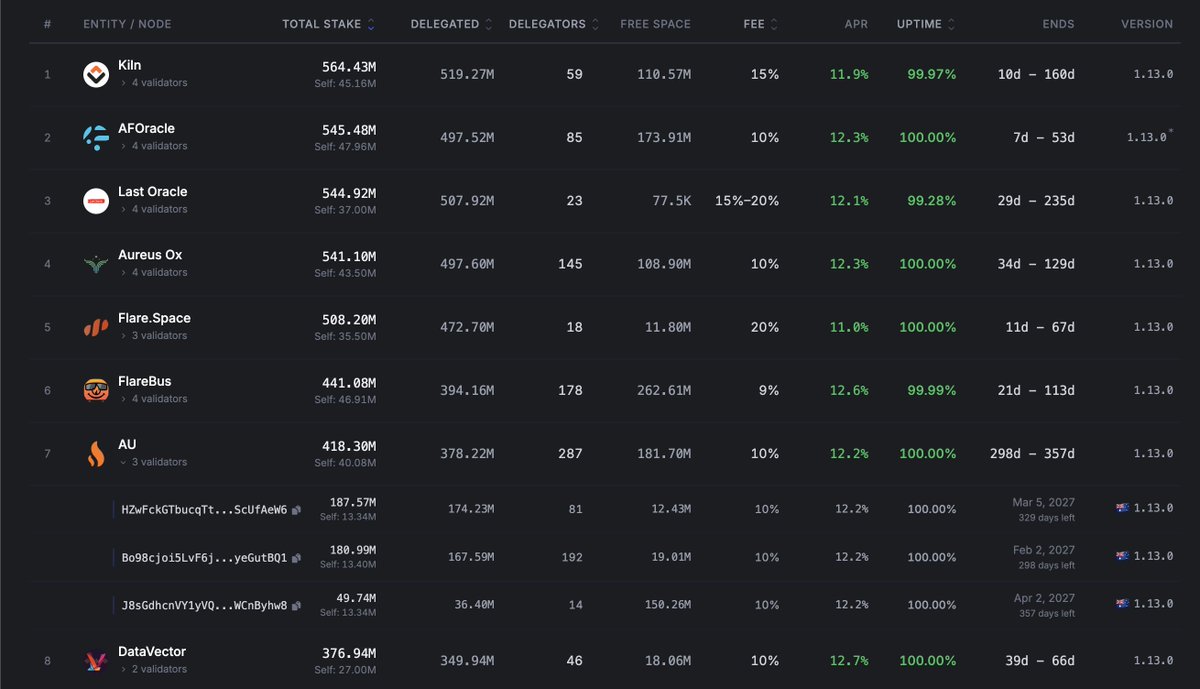
The Flare validators list now aggregates nodes under each entity to better demonstrate an entities wider participation. You can click on a row to expand it and see each validators node ID and individual data.
You can also see the traditional list by clicking the toggle switch at top right of the list.
Flare validator staking & FTSO delegation rewards can be auto-claimed! You don’t need to check in twice a week and claim, you can have an executor claim them on your behalf.
This functionality is built into the Flare reward contracts and explicitly allows ONLY claiming rewards on behalf of an address, that means no other transaction can be done. The rewards cannot be redirected by the executor, they simply go into your own wallet.
There are two types of executors, registered and non-registered. Registered executors pay a fee to the rewarding contracts on Flare (and/or Songbird) to register which allows them to be discovered (since they are listed as an executor in the contract).
Additionally it permits them to charge a fixed fee for each claim they make on behalf of an address. This fee is taken out of the claimed rewards.
Executors do not need to be registered. So long as an delegator/staker signs a transaction assigning an executor to claim their rewards, the claiming process can be completed - but this happens without a fee.
So this is either a free service the executor provides or a fee is paid elsewhere.
Executors are off-chain bots that will make the on-chain transaction that claims your FTSO or validator rewards for you.
So if you want your FTSO rewards to compound every reward epoch automatically or simply are tired of making the twice weekly transaction - you should consider using an auto claim service.
Just recently @aucc_official has established an auto claim service - and provides it with no fee if you are an existing delegator or staker to their FTSO/Validators (with some minimum stake/delegation requirement).
The AU app has been refreshed - we have reintroduced validator staking, added ability to mint/redeem FXRP & reward auto-claiming (no fee for our delegators & stakers*)!
We're offering zero fee auto-claim for our delegators & stakers who delegate 250,000 FLR or more, or stake 100,000 FLR or more to AU validators.
Enjoy!
🚨 Ensure your Infrastructures are Active within the Community!
Both @_DigitalDynamix Validators upgraded to V1.14.0 in preparation for July 14th!
👉 https://t.co/z39dYjAHsv
Flare validators must upgrade to version 1.14.0 by July 14. Currently 67% of stake has upgraded leaving 4.92B of staked funds still on the previous validator versions.
https://t.co/2ttKRrx1al
Important read if you delegate/stake on Flare and don't know what "minimum conditions" are. Visit Flare Metrics to see entities passes and min. condition history.
This is the MOST OVERLOOKED metric costing Flare stakers & delegators rewards right now.
Anyone staking to Flare validators or delegating to providers must be aware of the “minimum conditions” introduced in the last major FTSO update. Although this system has been in place for some time.
If you're delegating FLR, understanding these conditions and their impact on your rewards is crucial.
Every reward epoch, each entity (data providers/validators), is graded on their performance and either earn or lose "passes".
This is a system that decides if the entity (and their delegators) will keep their rewards.
They are judged on four protocols (conditions):
1⃣ FTSO (anchor feeds): Submit prices close the consensus median within a 0.5% band in at least 80% of rounds.
2⃣ FTSO (block-latency feeds): Submit at least 80% of expected updates (based on entities weight, entities with <0.2% of total wait are exempt).
3⃣ FDC (data connector): Participate successfully in 60% of rewarded rounds.
4⃣ Validators (staking): Validator must maintain 80% uptime and maintain at least 1m FLR self-bond.
Passes are like "get out of jail free" cards, and each entity can have at 3 passes at most.
When an entity fails to meet any one of the previously mentioned conditions, they lose a pass. Rewards are not at risk so long as the entity finishes a reward epoch with at least 0 or more passes.
In other words, an entity may fail at most 3 of the conditions and still be eligible for rewards. But if they fail all 4 conditions or have no passes AND fail a condition, their rewards are burned for that reward epoch (again, including their delegators).
All entities start with 0 passes and can earn passes (up to 3) by meeting all conditions for a given reward epoch.
There is a small caveat for entities to earn additional passes which is that they must have 3M FLR self-bond AND 15M FLR total active stake. This applies only for earning passes and does not lose strikes (as noted, only 1M FLR self-bond is required to meet the minimal staking condition.
For clarity, a provider who doesn't meet minimal conditions and has no passes will have all their reward burned, not just for individual protocols they fail, but for ALL. This includes "delegation" to data provider AND validator delegations.
It is typically okay for a provider form time to time to lose a pass, so it is more important to view the providers HISTORY of minimum conditions.
How quickly did they regain passes? Do they often lose passes?
Where can you see this? Flare Metrics.
🚨 CRYPTO: FLARE PROPOSES PROTOCOL-LEVEL MEV CAPTURE AND 40% INFLATION CUT IN FLR TOKENOMICS OVERHAUL
@FlareNetworks published a governance proposal to capture maximal extractable value at the protocol level and redirect it from external searchers and builders to the network itself. The plan would make Flare one of the first Layer 1 blockchains to capture MEV natively rather than letting it flow to specialized third-party actors.
Annual $FLR inflation would drop from 5% to 3% and the hard cap would fall from 5 billion to 3 billion tokens per year. The base gas fee would increase 20-fold from 60 gwei to 1,200 gwei, raising estimated annual burn from 7.5 million FLR to 300 million, while standard transactions would still cost a fraction of a cent.
The proposal creates the Flare Income Reinvestment Entity to collect protocol revenue from attestation fees, FAsset and Smart Account fees, confidential compute fees and captured MEV. FIRE's mandate is reducing FLR supply through open-market buybacks and burns.
The Flare validators list now aggregates nodes under each entity to better demonstrate an entities wider participation. You can click on a row to expand it and see each validators node ID and individual data.
You can also see the traditional list by clicking the toggle switch at top right of the list.
The Flare validators list now aggregates nodes under each entity to better demonstrate an entities wider participation. You can click on a row to expand it and see each validators node ID and individual data.
You can also see the traditional list by clicking the toggle switch at top right of the list.
@calminspace Done. You can now sort validators by APR. Any other suggestions? 😎
(side note, we exclude profiles with no profile from the APY sorting as a precaution, but those same nodes can still be found in the list in other sorting modes).
FIP 16 fundamentally changes the economics of Flare in a massive way. Some of these changes might seem small but together they matter.
Inflation reduced from 5% to 3% takes away free meal tickets from Flare’s native protocols and highlights that they are a product that earns on merit, not inflation.
The new “FIRE entity” earns fees that previously exclusively were directed to infrastructure providers. This includes fees from FDC requests, FAssets, Flare Smart accounts and Flare Confidential Compute.
Infrastructure providers (and their delegators) will now earn 10% of fees from the Flare Data Connector (FDC) while FIRE will earn 90%. While there is a decrease in percentage distribution, FDC fees will also be increased (infra providers and their delegators will also see an increase of earned fees).
Network transaction fees (gas) will increase by 20x from 25 to 500 gwei. All gas fees are burned. Typical transfer transaction cost will increase from $0.000004 to $0.00008 (still incredibly small compared to other blockchain networks).
Transaction fee increase is conservatively estimated to increased to 300m FLR being burned per year from ~15m (*based on 7.5m burned in last 6 months).
Flare’s EVM blocks will be built differently to counter the potential of validators harvesting MEV (rearranging transaction inside blocks to profit themselves).
Blocks will be built by a single “builder” that prioritizes transactions within blocks in a fair, transparent way that also focuses on taking advantage of MEV opportunities which benefits the network. Earnings from the MEV opportunities are sent to FIRE.
FIRE is an entity that earns from network protocol fees and captured MEV and uses those funds to benefit the network; such as buying and burning FLR tokens, replace inflation rewards and fund Flare Foundation activities (ie. grants, etc).
Validator operators will have a minimum fee of 20% (currently they range from 2-20%). This will help prevent a race to the bottom which can negatively impact the network.
Validator staking rewards on the P-chain get 5x higher reward weight than C-chain delegation and max validator node size increases from 200M to 300M FLR. This is a big incentive for real long-term staking and should mean higher rewards for delegators who stake with validators on the P-chain.
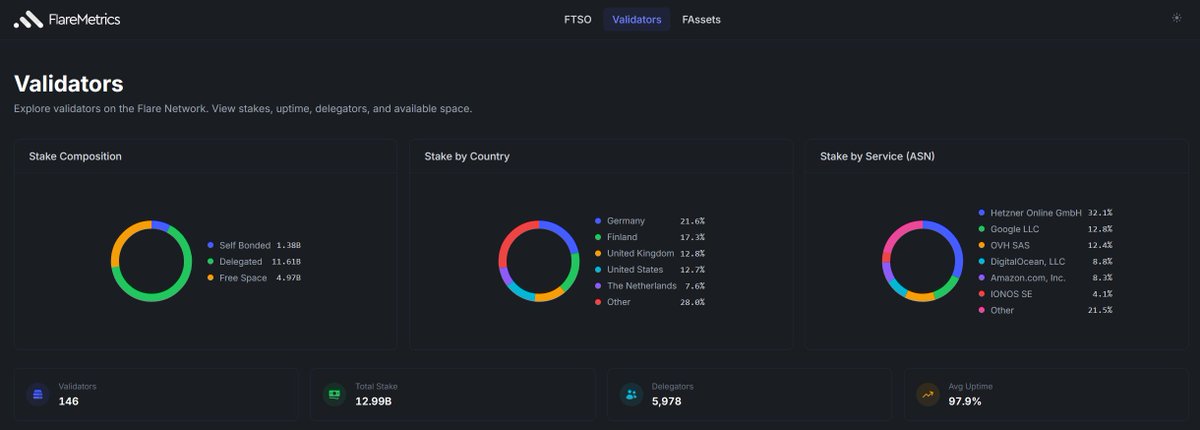
Flare Metrics now provides more insights to help you make a choice that is not only good for you, but also for the entire network.
You can view these stats live on Flare Metrics validator page (desktop only currently): https://t.co/8taSiT1mpQ
Europe leads with 58%+ of total validator stake and 31.5% of validators use Hetzner cloud hosting for their infrastructure on Flare.
Currently these numbers look healthy with the exception of Hetzner being slightly over utilized.