The mission ended Friday night, April 10, at 8:07 p.m. EDT, off the coast of San Diego. The Orion capsule hissed into the ocean, gently settling down atop the waves at just 17 miles per hour, under the control of three 116-ft. diameter parachutes. https://t.co/uJjxlGSEh2
The far side of the moon isn’t just the “dark side," it’s older, rougher, and full of clues about how the solar system formed. Here’s why scientists are so interested in it and why missions like Artemis II are heading there. Read about this week’s Artemis II launch here: https://t.co/eN0sN5M161
From @TheAthletic: Ilia Malinin has already helped deliver a gold medal for Team USA. Here's how to watch the “Quad God” in his remaining individual performances that begin on Tuesday afternoon. https://t.co/TQumMKCcqI
"Mainstream neuroscientists agree on one thing: brain waves matter deeply. They synchronize distant parts of the brain, allowing thoughts to feel unified instead of scattered."
@elonmusk#neucognition#Science
🧠 What If You’re Not a Brain… But a Wave?
What if you aren’t just neurons firing inside a skull? What if your consciousness is something far stranger — a living wave of energy, shimmering through your brain like music through air?
Some scientists are now exploring a bold idea: that awareness may not come only from brain cells, but from powerful wave patterns they create together. Instead of thinking of the brain as a machine made of wires and switches, imagine it as an orchestra. Neurons are the instruments — but consciousness is the harmony that rises when they play in perfect sync.
These waves, called brain oscillations, move across different brain regions, binding thoughts, memories, and emotions into one continuous sense of “you.” When the waves fall into stable, resonant patterns, consciousness may emerge — not as a thing, but as an ongoing pattern. Physicist Michael Pravica even suggests humans could be understood as quantum holograms — energy patterns shaped by waves that may not be limited by space… or even time.
Independent researchers have simulated brains as wave systems and found something unsettling: stable wave patterns appear when systems reach high levels of organization — a possible signature of conscious states. Mainstream neuroscientists agree on one thing: brain waves matter deeply. They synchronize distant parts of the brain, allowing thoughts to feel unified instead of scattered.
So maybe the truth lies between neurons and waves. Neurons carry the signals — but waves weave them into experience. And if consciousness is truly a pattern, not a place… it raises a haunting question: when the brain stops, does the pattern really disappear — or does it simply change form?
#ArtnetNews: The most anticipated museum openings in 2026. From the Guggenheim Abu Dhabi to the Lucas Museum of Narrative Art in L.A.—the museum landscape is set to swell in 2026. Read more: https://t.co/7B8Dcqkhsf
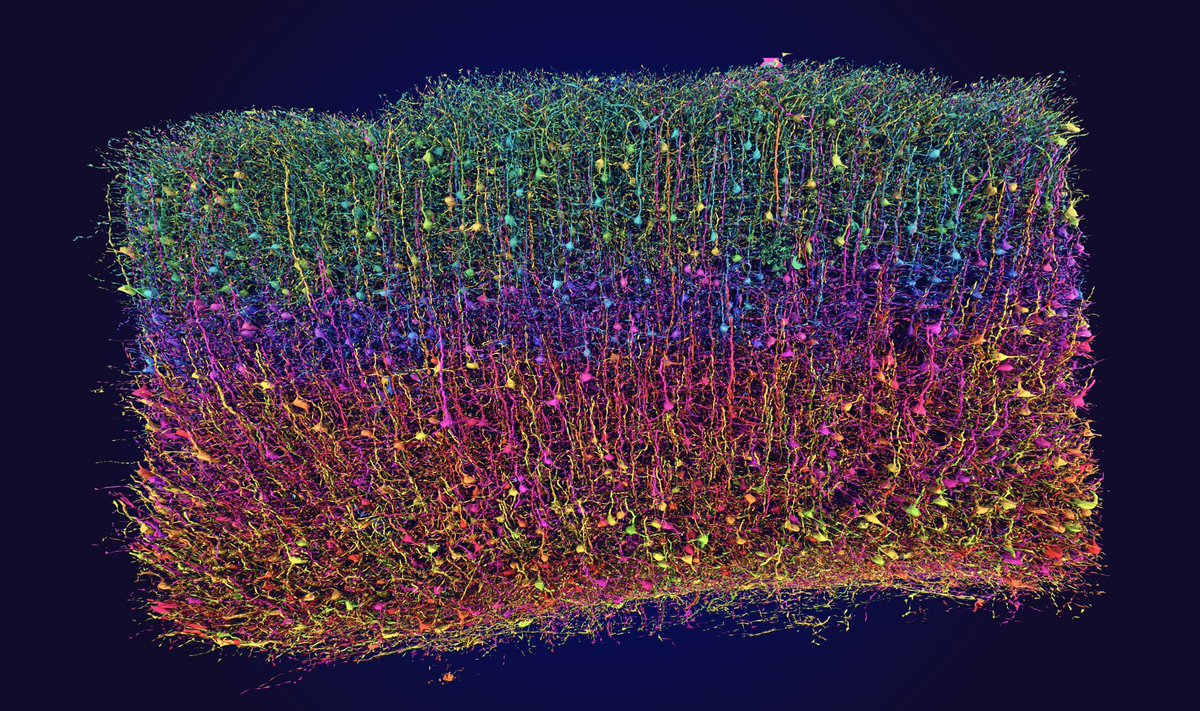
In this piece of brain tissue the size of sand grain are 200,000 neurons and nearly 2.5 miles of axons.
While it may seem small in size, it was previously thought impossible to map. The road to this beautiful image is both a scientific and human triumph: https://t.co/RtWiMgq75y
Excited to announce a new show from my friends over at @GoalhangerHQ called @RestIsScience - with @FryRsquared & @tweetsauce - exploring the ideas that shape our world: https://t.co/KWSVYNGxqf
Go check it out right now!