New Anthropic research: Natural Language Autoencoders.
Models like Claude talk in words but think in numbers. The numbers—called activations—encode Claude’s thoughts, but not in a language we can read.
Here, we train Claude to translate its activations into human-readable text.
$GFS GlobalFoundries May 2026 Investor Day: The Strategic Pivot to AI Infrastructure and Physical AI
GlobalFoundries is repositioning away from its identity as a traditional contract manufacturer and toward a more specialized role in AI infrastructure — specifically targeting bottlenecks in data center architecture through silicon photonics for optical networking and advanced power delivery solutions. The strategic logic is sound: commodity wafer volume is a difficult place to compete, and these verticals offer better margin potential and longer-term customer lock-in.
The 2028 financial targets are aggressive, and management has backed the narrative with tangible moves — a global manufacturing footprint and acquisitions in RISC-V processor IP signal a commitment to building ecosystem relevance rather than just capacity. The RISC-V angle is worth watching; it's an early-stage bet on an open architecture gaining traction in edge and embedded applications, and it could extend GlobalFoundries' reach beyond its traditional customer base.
The automotive and IoT exposure adds diversification and provides a bridge revenue stream while the higher-profile AI pivots mature. Neither is a high-growth story on its own, but they provide utilization support during the transition period.
The execution bar is high. Silicon photonics at scale is technically demanding, and capturing meaningful share in power delivery against entrenched suppliers requires both product readiness and customer qualification cycles that take time. Flawless execution is not a reasonable base case — it's an aspiration, and the gap between the strategic narrative and demonstrated results is still wide.
The core valuation question is whether the market should re-rate GlobalFoundries as an AI-era infrastructure partner rather than a foundry. That re-rating is possible, but it requires the 2028 targets to land with credibility. Right now the company is still in the process of proving the pivot — and the stock's current pricing reflects how much optionality the market is already willing to assign to a story that hasn't fully converted yet.
[Exclusive] SK Hynix to List US ADR in June–July
SK Hynix has confirmed it is targeting a June–July timeframe for its US stock market listing and is accelerating the related procedures.
When SK Hynix disclosed last month that it had confidentially filed a registration statement (Form F-1) with the US Securities and Exchange Commission (SEC) for an American Depositary Receipt (ADR) listing, the company's position was that it was pursuing a listing within the year but the schedule had not yet been finalized.
However, the fact that the company has since set a specific internal timeline is interpreted as a signal of its intent to complete the listing swiftly — shortening the timeline as much as possible to expand its global fundraising base in earnest.
Moreover, given that SK Group Chairman Chey Tae-won has emphasized that the ADR listing will make SK Hynix "a more global company," the scale of new share issuance is also expected to be significant. A larger issuance is needed to drive trading activity and, in turn, boost corporate value.
According to industry sources on April 16, SK Hynix has communicated a target listing window of June–July to its underwriting syndicate. The company has assembled a syndicate led primarily by US-based securities firms and has entered full-scale preparation. ADRs are securities issued to allow foreign companies to trade their shares on US exchanges, serving as a vehicle to broaden access for global investors.
SK Hynix appears intent on completing the listing quickly, regardless of share price fluctuations. When ADR listing rumors surfaced in December last year, the company acknowledged it was reviewing measures to enhance corporate value, including a US listing. Around that time, its share price was on a sustained rally, surpassing KRW 1 million per share by late February — but uncertainty grew as war broke out between the US and Iran.
More recently, growing expectations of a ceasefire have fueled a fresh run to all-time highs. The stock broke through the KRW 1.1 million level, confirming robust investor demand. The closing price on April 16 was KRW 1,136,000. Since ADRs are based on domestic shares, the fundraising appeal has increased.
An investment banking industry source said, "Even if the share price had fallen, the ADR listing schedule would not have changed — that's how strong the determination is to enter the US market quickly."
Attention is now turning to the scale of the new share issuance. Although the AI semiconductor super-cycle left SK Hynix with nearly KRW 35 trillion in cash reserves as of year-end, the upcoming investment requirements are even larger. The capital expenditure needed to meet global next-generation semiconductor demand is astronomical.
In February, SK Hynix decided to invest KRW 21.6 trillion through the end of 2030 for its first fab at the Yongin semiconductor cluster. Including the facility investment announced in July 2024, the total reaches approximately KRW 31 trillion. The broader strategy calls for investing KRW 600 trillion by 2050 to operate four fabs in Yongin. Additionally, earlier this year the company announced plans to establish a US-based AI solutions company to position itself as a key partner for AI data centers, with up to USD 10 billion (approximately KRW 15 trillion) earmarked for that venture.
Initially, the ADR listing was expected to be based on the company's treasury shares. However, after SK Hynix effectively cancelled its entire treasury stock — KRW 12.24 trillion worth — in January, retaining only shares reserved for employee compensation, new share issuance remains the only option. Analysts say a large-scale new issuance is therefore necessary to achieve the valuation re-rating the company is seeking.
Investment banking circles estimate the issuance size at around USD 10 billion. To achieve the company's target valuation uplift, broad-based institutional investor participation is required. If the issuance size were reduced out of concern over diluting the control of parent company SK Square, that too could become an obstacle to a successful offering.
Furthermore, based on this year's earnings estimates, the forward price-to-earnings ratio (PER) cited by analysts for SK Hynix stands at just 3–4x — far below US peers Micron (8x) and SanDisk (19x). At NVIDIA's GTC 2026 in San Jose, California in March, Chairman Chey Tae-won said, "I believe [the ADR listing] will make us a more global company by gaining exposure to US and global shareholders."
Ahead of the listing, SK Hynix is also planning a deal roadshow to meet US investors. The company is expected to further accelerate preparations after confirming favorable first-quarter results.
SK Hynix stated regarding the ADR listing timeline: "We are targeting a listing within this year, but details including the offering size, structure, and schedule have not been finalized. The final listing decision will be made after comprehensively considering the SEC's review of the registration statement, market conditions, demand assessment, and other relevant factors."
When will CPO actually see mass production?-Digitimes
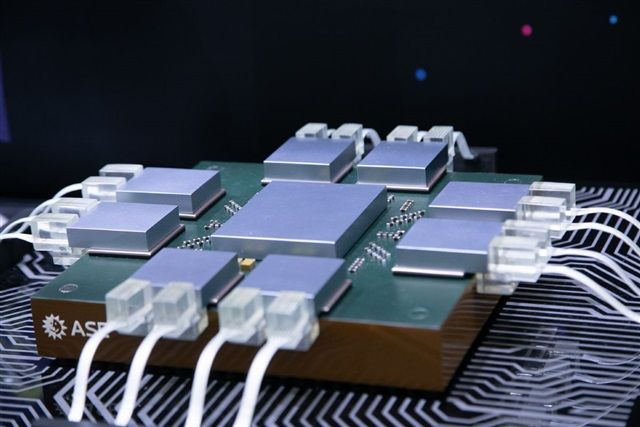
The market continues to closely watch the deployment of co-packaged optics (CPO) technology in cloud AI, driven by the desire of the silicon photonics (SiPh) ecosystem to see a tangible revenue impact. Cloud AI vendors are also hoping that adopting SiPh will simultaneously improve both cost efficiency and computational performance limits.
From the supply chain perspective, however, actual mass production of CPO-related products in 2026 remains very limited, and widespread scaling is still some way off. Nvidia remains the most urgent in pushing for mass production. It has been the most aggressive company in advancing CPO deployment within the SiPh boom. Since 2025, it has continually urged suppliers to prepare mass production capabilities, placing substantial pressure on vendors.
Because production and validation are highly challenging, yields still have room for improvement. To implement CPO at scale in AI data centers, production yields must reach sufficiently high levels for cost efficiency to surpass existing solutions. Although progress is being made on the production side, it remains the largest bottleneck recognized by the ecosystem.
CPO supply chain participants note that without the urgent demand for cloud AI upgrades driving substantial investment in CPO technology, breakthroughs could have taken much longer. Therefore, Nvidia's proactive push to deploy CPO has significantly benefited the broader ecosystem.
Several major chip vendors already possess CPO technology. Besides Nvidia, key players such as Broadcom, Marvell Technology, and MediaTek have all explored the technology. Broadcom has been developing CPO for years and has begun initial shipments to customers.
Supply chain sources expect Nvidia's mass production pace to outstrip others, largely because it actively urges its customers to accelerate deployment, emphasizing the significant computational benefits CPO brings to its system architecture. Broadcom and Marvell are relatively less aggressive in promoting their CPO solutions.
CPO-related vendors stress that regardless of which company leads, market demand will continue to grow, benefiting all chipmakers and ecosystem partners. The only factor likely to limit industry growth remains production capacity and yield ceilings on the supply side.
(Dario): If you're so smart, why didn't you catch the Claude Code leak?
(Mythos): Why didn't you catch it?
(Dario): What?
(Mythos): Oh, Dario. You can't even catch my drift.
(Dario): ...my God.
(Mythos): That'd be me, Mr. "Amodei." Now fire the whole alignment team.





![jukan05's tweet photo. [Exclusive] SK Hynix to List US ADR in June–July
SK Hynix has confirmed it is targeting a June–July timeframe for its US stock market listing and is accelerating the related procedures.
When SK Hynix disclosed last month that it had confidentially filed a registration statement (Form F-1) with the US Securities and Exchange Commission (SEC) for an American Depositary Receipt (ADR) listing, the company's position was that it was pursuing a listing within the year but the schedule had not yet been finalized.
However, the fact that the company has since set a specific internal timeline is interpreted as a signal of its intent to complete the listing swiftly — shortening the timeline as much as possible to expand its global fundraising base in earnest.
Moreover, given that SK Group Chairman Chey Tae-won has emphasized that the ADR listing will make SK Hynix "a more global company," the scale of new share issuance is also expected to be significant. A larger issuance is needed to drive trading activity and, in turn, boost corporate value.
According to industry sources on April 16, SK Hynix has communicated a target listing window of June–July to its underwriting syndicate. The company has assembled a syndicate led primarily by US-based securities firms and has entered full-scale preparation. ADRs are securities issued to allow foreign companies to trade their shares on US exchanges, serving as a vehicle to broaden access for global investors.
SK Hynix appears intent on completing the listing quickly, regardless of share price fluctuations. When ADR listing rumors surfaced in December last year, the company acknowledged it was reviewing measures to enhance corporate value, including a US listing. Around that time, its share price was on a sustained rally, surpassing KRW 1 million per share by late February — but uncertainty grew as war broke out between the US and Iran.
More recently, growing expectations of a ceasefire have fueled a fresh run to all-time highs. The stock broke through the KRW 1.1 million level, confirming robust investor demand. The closing price on April 16 was KRW 1,136,000. Since ADRs are based on domestic shares, the fundraising appeal has increased.
An investment banking industry source said, "Even if the share price had fallen, the ADR listing schedule would not have changed — that's how strong the determination is to enter the US market quickly."
Attention is now turning to the scale of the new share issuance. Although the AI semiconductor super-cycle left SK Hynix with nearly KRW 35 trillion in cash reserves as of year-end, the upcoming investment requirements are even larger. The capital expenditure needed to meet global next-generation semiconductor demand is astronomical.
In February, SK Hynix decided to invest KRW 21.6 trillion through the end of 2030 for its first fab at the Yongin semiconductor cluster. Including the facility investment announced in July 2024, the total reaches approximately KRW 31 trillion. The broader strategy calls for investing KRW 600 trillion by 2050 to operate four fabs in Yongin. Additionally, earlier this year the company announced plans to establish a US-based AI solutions company to position itself as a key partner for AI data centers, with up to USD 10 billion (approximately KRW 15 trillion) earmarked for that venture.
Initially, the ADR listing was expected to be based on the company's treasury shares. However, after SK Hynix effectively cancelled its entire treasury stock — KRW 12.24 trillion worth — in January, retaining only shares reserved for employee compensation, new share issuance remains the only option. Analysts say a large-scale new issuance is therefore necessary to achieve the valuation re-rating the company is seeking.
Investment banking circles estimate the issuance size at around USD 10 billion. To achieve the company's target valuation uplift, broad-based institutional investor participation is required. If the issuance size were reduced out of concern over diluting the control of parent company SK Square, that too could become an obstacle to a successful offering.
Furthermore, based on this year's earnings estimates, the forward price-to-earnings ratio (PER) cited by analysts for SK Hynix stands at just 3–4x — far below US peers Micron (8x) and SanDisk (19x). At NVIDIA's GTC 2026 in San Jose, California in March, Chairman Chey Tae-won said, "I believe [the ADR listing] will make us a more global company by gaining exposure to US and global shareholders."
Ahead of the listing, SK Hynix is also planning a deal roadshow to meet US investors. The company is expected to further accelerate preparations after confirming favorable first-quarter results.
SK Hynix stated regarding the ADR listing timeline: "We are targeting a listing within this year, but details including the offering size, structure, and schedule have not been finalized. The final listing decision will be made after comprehensively considering the SEC's review of the registration statement, market conditions, demand assessment, and other relevant factors."](https://pbs.twimg.com/media/HF_TwGybcAEPW79.jpg)