a principle of Dao: Wu Wei (无为): the importance of achieving the Dao without forcing or rushing against the natural order of things to avoid false development and mistakes. as you point out, most things in our life is random, often noise. why bother? inner peace…
⚡️ Excited to share that I am starting an AI+Education company called Eureka Labs.
The announcement:
---
We are Eureka Labs and we are building a new kind of school that is AI native.
How can we approach an ideal experience for learning something new? For example, in the case of physics one could imagine working through very high quality course materials together with Feynman, who is there to guide you every step of the way. Unfortunately, subject matter experts who are deeply passionate, great at teaching, infinitely patient and fluent in all of the world's languages are also very scarce and cannot personally tutor all 8 billion of us on demand.
However, with recent progress in generative AI, this learning experience feels tractable. The teacher still designs the course materials, but they are supported, leveraged and scaled with an AI Teaching Assistant who is optimized to help guide the students through them. This Teacher + AI symbiosis could run an entire curriculum of courses on a common platform. If we are successful, it will be easy for anyone to learn anything, expanding education in both reach (a large number of people learning something) and extent (any one person learning a large amount of subjects, beyond what may be possible today unassisted).
Our first product will be the world's obviously best AI course, LLM101n. This is an undergraduate-level class that guides the student through training their own AI, very similar to a smaller version of the AI Teaching Assistant itself. The course materials will be available online, but we also plan to run both digital and physical cohorts of people going through it together.
Today, we are heads down building LLM101n, but we look forward to a future where AI is a key technology for increasing human potential. What would you like to learn?
---
@EurekaLabsAI is the culmination of my passion in both AI and education over ~2 decades. My interest in education took me from YouTube tutorials on Rubik's cubes to starting CS231n at Stanford, to my more recent Zero-to-Hero AI series. While my work in AI took me from academic research at Stanford to real-world products at Tesla and AGI research at OpenAI. All of my work combining the two so far has only been part-time, as side quests to my "real job", so I am quite excited to dive in and build something great, professionally and full-time.
It's still early days but I wanted to announce the company so that I can build publicly instead of keeping a secret that isn't. Outbound links with a bit more info in the reply!
If you've got any fave trick questions for LLMs, try it on Sonnet 3.5 with this in your prompt: "Before you answer, make a list of wrong assumptions people sometimes make about the concepts included in the question."
"Claude 3.5, create an interactive model of how LLMs work"
"make it better"x3
Claude really reacts well to "make it better," which seems to work without limit until eventually the program gets too large and Claude refuses to finish it.
Life is too short to worry about little things. Have fun. Fall in love. Regret nothing, and don't let people bring you down. Study, think, create, and grow. Teach yourself and teach others.
NVIDIA CEO Jensen Huang: “I really discourage 1-on-1s”
Jensen famously has 60 direct reports. When Stripe founder Patrick Collison points out that this isn’t conventionally considered best practice, Jensen shares his reasoning:
“I don’t do 1-on-1s, and almost everything I say, I say to everybody all the time. I don’t really believe there’s any information that I operate on that only one or two people should hear about… I believe that when you give everybody equal access to information, that empowers people. And so that’s number one… Number two, if the CEO’s direct staff is 60 people, the number of layers you’ve removed in a company is probably something like seven.”
Patrick offers to steal man the other side of the argument:
“1-on-1s are where you provide coaching, where you maybe talk through personal goals and career advancement, where maybe you give feedback on something that you see somebody systematically not doing so well… Do you not do those things or do you do them in a different way?”
Jensen responds:
“I give you feedback right there in front of everybody. In fact, this is a really big deal. First of all, feedback is learning. For what reason are you the only person who should learn this?… We should all learn from that opportunity… Half the time I’m not right, but for me to reason through it in front of everybody helps everybody learn how to reason through it. The problem I have with 1-on-1s and taking feedback aside is you deprive a whole bunch of people that same learning. Learning from other people’s mistakes is the best way to learn.”
Video Source: @stripe
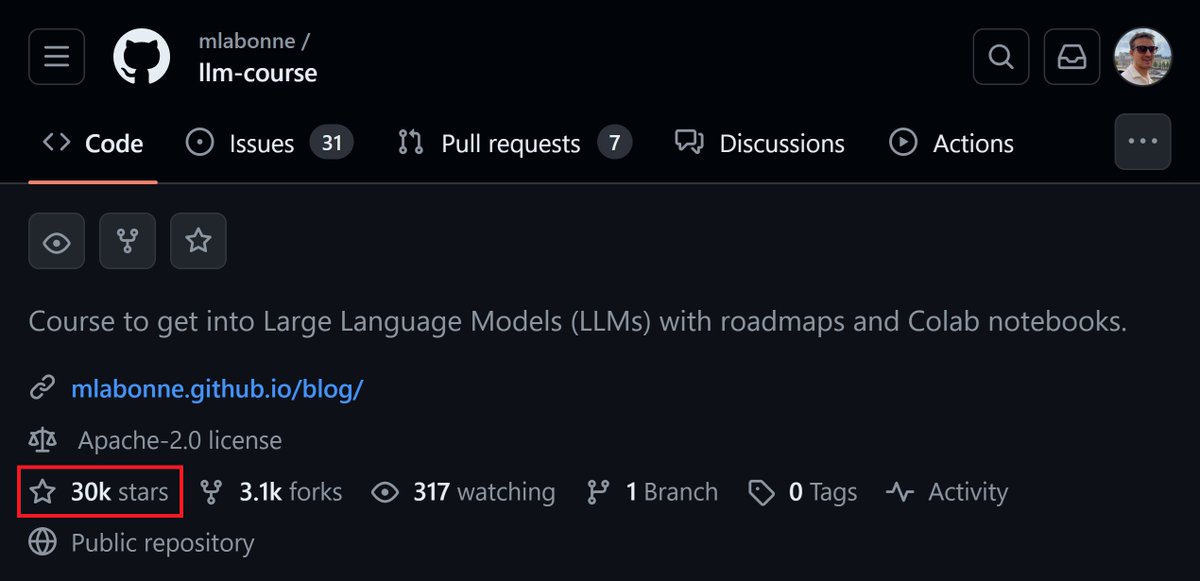
⭐ The LLM Course hit 30k stars on GitHub!
This is beyond anything I imagined. To compare, vLLM has 20k stars and Jax has 28k. We're not at llama.cpp (58k) or PyTorch (78k) yet, but this already feels indecent.
Thanks for all the support! I'll be adding new sections and updating older parts soon.
Let me know what you'd like to see in the course and how I can improve it.
📝 LLM Course: https://t.co/q5XtSIC7nL





![Rainmaker1973's tweet photo. The complexity of the human brain and its functions in a neat infographic map
[zoomable version: https://t.co/4KyqZPcgRB]
https://t.co/xSmZ7Vc3zH](https://pbs.twimg.com/media/F3wTXj9WcAAkpyE.jpg)





