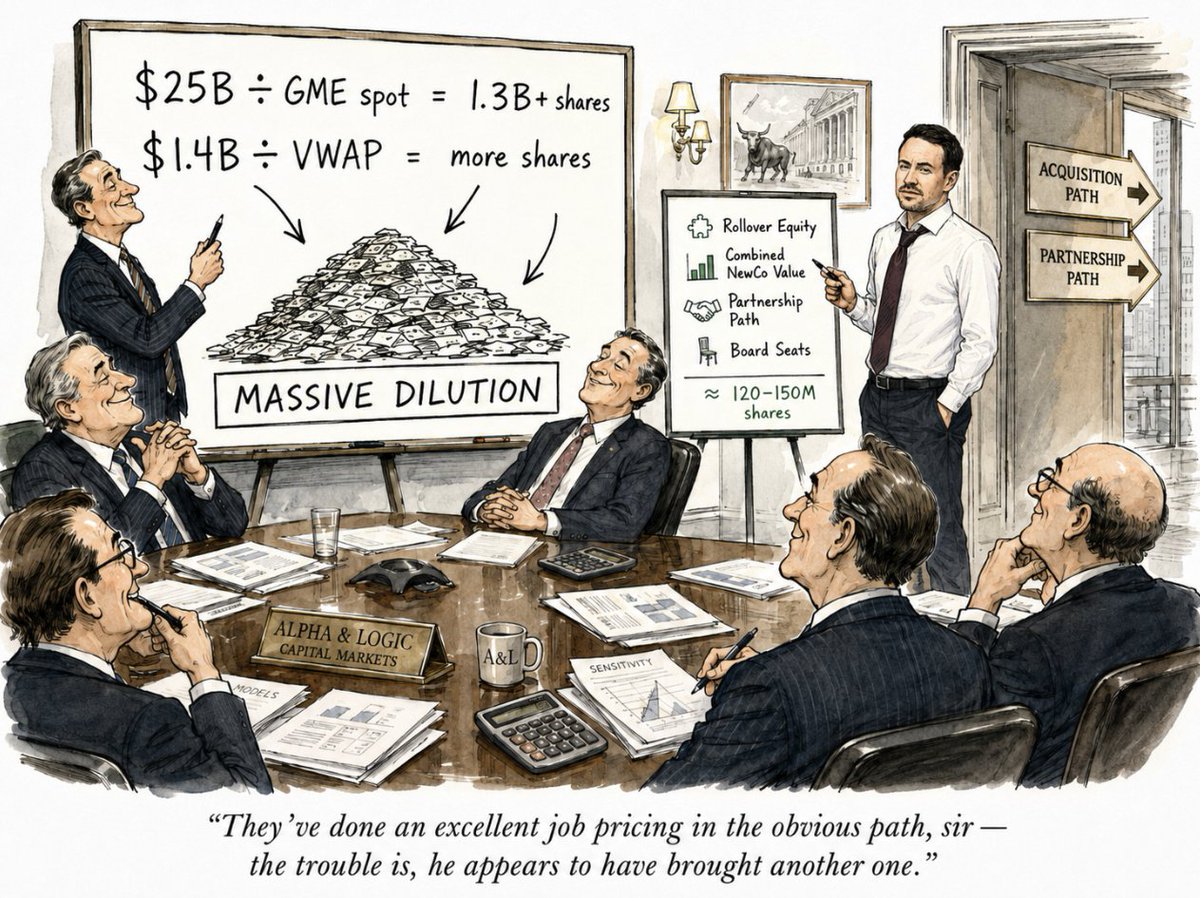
Again, again & again. The market assumes MASSIVE dilution for $GME to acquire $EBAY.
At $21/share, dividing the ~$25B stock portion of the offer by GME spot implies ~1.19B new shares. At $18.60, ~1.35B.
Then there’s the $1.4B convertible note exchange that assumes $1.4B ÷ ~$19 VWAP = ~73.7M additional shares.
Add both assumptions and the market can arrive at roughly ~1.42 BILLION new shares.
-HOWEVER-
What if BOTH assumptions are wrong? Why not calculate what Cohen has repeatedly described. That eBay shareholders would be “rolling” their equity into the combined company?
If the stock consideration is based on the economics of $GME + as a combined NewCo (not today’s depressed GME share price) the rollover equity model produces roughly ~648M acquisition shares.
That’s based on the value allocated between the two shareholder groups. Not $25B ÷ GME spot.
And GameStop didn’t say the $1.4B debt exchange is simply principal ÷ VWAP either. It said the final share count is “based in part” on the 35-day VWAP & is subject to an undisclosed per-share floor.
Meaning we still don’t know the full formula & we don't know the floor. Could there be a premium or another adjustment? @ChaddSchroy found premium language in the filings for these notes.
For example, a 37.5% premium would turn:
$19 VWAP → ~53.6M shares
$25 VWAP → ~40.7M shares
Compared against $19 VWAP w/o premium for ~73.7M shares.
So compare the two frameworks:
- Simple spot/VWAP assumptions: ~1.42B new shares
- Rollover equity + hypothetical premium example ~700M new shares
That’s a difference of roughly 700M shares. About 56% more than GME’s entire current share count.
And what if the $125 acquisition offer is also leverage for a much cheaper path to control? What if that's what the partnership rumor implies?
GME already owns ~9.8% of eBay. Could Cohen use the credible acquisition threat to win a partnership + board seats, gain increasing influence over eBay for billions less & gradually follow the same playbook he used at GameStop? @foxenflask saw that option months ago.
I wonder how many large funds have already modeled all of this & aren't following the media led narrative? When will we get clarity?
It’s forthcoming. And if this is the right read..
Suck my balls, Street 😎
You used to sell stuff on eBay.
Maybe an old camera. Maybe Beanie Babies. Maybe a coat that didn't fit.
You paid a small fee. The buyer got the thing. Everyone went home.
That eBay is gone.
The website looks the same. The logo is the same. The 135 million buyers are still there.
But the company isn't really a marketplace anymore.
It is an advertising business with a marketplace attached for distribution.
Last year, sellers paid eBay $2 billion just to make sure their own listings showed up.
Read that again.
The board calls this growth.
A Canadian who runs a video game store called it something else.
Here is what actually happened.
In 2020 the board hired a new CEO. His name is Jamie Iannone. He arrived with a strategy called focused categories.
In plain English, that means leaning into the stuff people pay extra for. Sneakers. Watches. Trading cards. Auto parts.
The everyday seller, the person with the camera and the coat, was no longer the customer.
The customer was now the seller who would pay to be seen.
In 2025 eBay did $80 billion in transactions. They kept $11 billion of that as revenue. Of that $11 billion, $2 billion came from advertising.
Sellers paid them $2 billion to promote listings on a website those sellers already pay fees to use.
That is the growth story.
In the same year, the number of enthusiast buyers, eBay's own term for their best customers, was 16 million.
It was also 16 million the year before.
And the year before that.
And the year before that.
Four years. Zero growth. They mention this on every earnings call without mentioning it.
So what does a company do when growth stops?
It buys back its own stock.
In 2025, eBay returned over $3 billion to shareholders. Most of that was buybacks. In February the board authorized another $2 billion on top.
Buybacks shrink the share count. Earnings per share goes up even when earnings stay flat. The stock price follows.
The stock was $68 a year ago. It is $108 today.
The company did not improve. The denominator got smaller.
Then a man from Canada noticed.
His name is Ryan Cohen. He runs GameStop. He started his career selling pet food online and sold it to PetSmart for $3.35 billion.
He looked at eBay. 135 million buyers. $80 billion in transactions. Real margins. Real cash flow. A board harvesting the business instead of running it.
He bought 5% of the company through derivatives and stock.
Then on May 4, he offered to buy the rest. $125 per share. $56 billion total.
On May 12, the eBay board rejected the bid. They called it not credible.
The math is credible.
What the board means by not credible is we would have to explain why we sold.
Then Cohen went on Piers Morgan.
He said eBay is run by a bunch of losers with perverse financial incentives.
He pointed out that eBay's CEO has been paid $144 million over six years.
He pointed out that he personally takes no salary and has put $128 million of his own money into the company he runs.
You do not have to like Ryan Cohen to notice he is making a point that is hard to argue with.
eBay used to be a place where regular people sold things to other regular people.
Now it is a $48 billion company whose largest growth driver is charging its own sellers to advertise to a buyer base that stopped growing four years ago, while spending billions a year buying its own stock to make the chart go up.
The board calls this strategy.
A video game CEO from Canada called it what it is.
The market is now waiting to see who else agrees.
Plz fix. Thx.
Sent from my iPhone
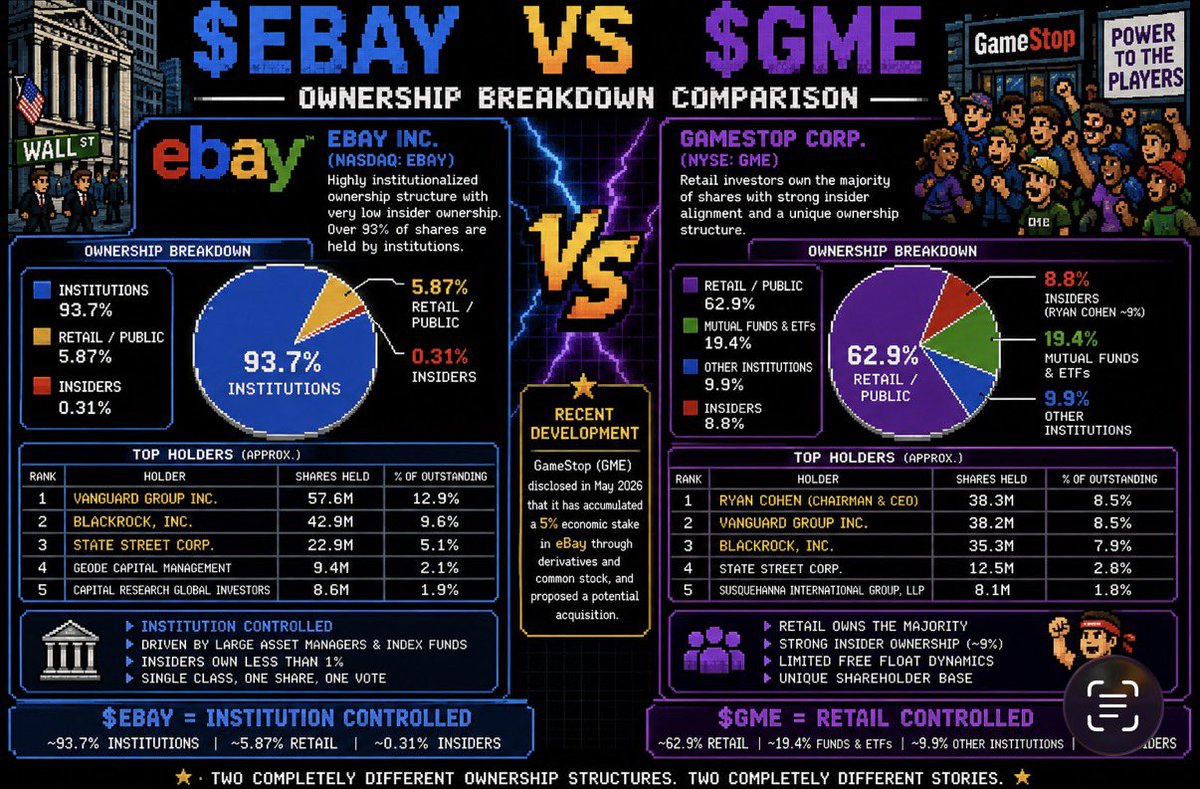
If you’re wondering where all the $EBAY investors are on X… there really aren’t many.
Over 93% of $EBAY is owned by institutions like Vanguard, BlackRock, and State Street. Retail ownership is tiny. Insider ownership is even smaller.
Meanwhile, $GME has one of the largest retail shareholder bases in the market, alongside significant insider ownership led by Ryan Cohen.
Two completely different ownership structures. Two completely different shareholder cultures.
The first half of 2021, I made some noise and news on a number of bearish callls - TSLA, GME, Bitcoin, Robinhood, the Nasdaq 100.
MANY, including journalists like Jonathan Levin and Shuli Ren @Bloomberg cite these specific examples of how wrong I have been again and again to invalidate what I am saying today, but history proves differently.
This is roughly what they did from that early 2021 time to early 2023, when in the middle of the banking crisis I said I was not seeing true danger and it could resolve quickly.
To look back at those calls 5, 10, years later - any short call - is ridiculous. You really think any short seller holds those positions for 5, 10 years?