@HyperliquidX's IOC speed-bump mechanism has a flaw. Normally designed to protect makers in the interests of a more liquid market, it breaks down in periods of high activity. When blocks become full, pending modifies and cancels queue up for later blocks, so their latency increases. However, IOCs behave as though they have a separate blockspace dedicated for them, and their latency barely budges. You can see this in the lower left chart, showing latency of different order types during 19 activity bursts.
The result is that under relatively modest load (25-30k tps), IOC + 8 bps (priority fee) orders can pick off resting liquidity before it has a chance to get out the way. Meanwhile, under higher load (35-40k tps), even IOCs without any priority fee can pick off resting liquidity.
This, in my opinion, is antithetical to the ethos and design of the ALO and cancel prioritization mechanism and needs investigation by the team. It exists to reduce toxicity from HFT takers, and is breaking down precisely when most needed.
It may also be exploitable. If IOCs really are insulated from the congestion affecting cancels and modifies, a malicious user could spam orders, delaying makers’ cancels while their own IOCs go through, and taking the liquidity left stale.
One single example that occurred on AVAX today caused 1.3M$ of volume to be adversely selected for a total loss of ~13k$ over the subsequent 10 seconds. This affected us materially. Faced with such episodes of adverse selection, spreads and liquidity are undoubtedly worse than they could be otherwise.
Would appreciate if anyone with a contact at HL could share this with the team.
Let's address a lot of the concerns over the recent SFDP changes.
First, what were the changes?
- 12-month time within SFDP
- Auto-graduation at 300k SOL
- 100 Validator max
- Run your own validator
These changes, as expected, were controversial. There are a lot of assumptions on where this stake will be going after the changes are in place.
The job of SFDP has been three-fold:
1. Help bootstrap net new validators
2. Provide a healthy testnet
3. Get some validators testing changes early
SFDP has done its job. Testnet exists, validators often find issues early, and a large amount of validators have started from SFDP.
Solana is much larger now than when SFDP started. Solana's validator set has matured significantly, has an amazing community, and encounters new challenges that were never conceived of in the beginning.
We've had a lot of feedback that SFDP is no longer reactive enough nor provides enough criteria given the ever-changing landscape of Solana. This feedback is heard and leads us to the next stage of delegation with a focus on continuing to improve network health and rewarding ecosystem contributors.
SFDP will continue to exist for the newer validators and validators that contribute greatly to network health should also be rewarded. We have historically helped fund huge ecosystem contributors such as Blueshift through delegation outside of SFDP. We delegated to a number of validators that tried Frankendancer first. These among many other delegations are success stories that have both pushed Solana to new heights as well as helped improve network health.
We're making a bet that we can be more proactive to future network health concerns, be more reactive to new issues, and help push Solana into this next stage with these changes.
If you have feedback on these changes, please let me know. SFDP helped us get to where we are today. These changes are about getting to what comes next.
in the next few days you will hear about the next big novelty project launching on slowlana
it will have a bunch of hype behind
it will go as good as the last very hyped slowlana project
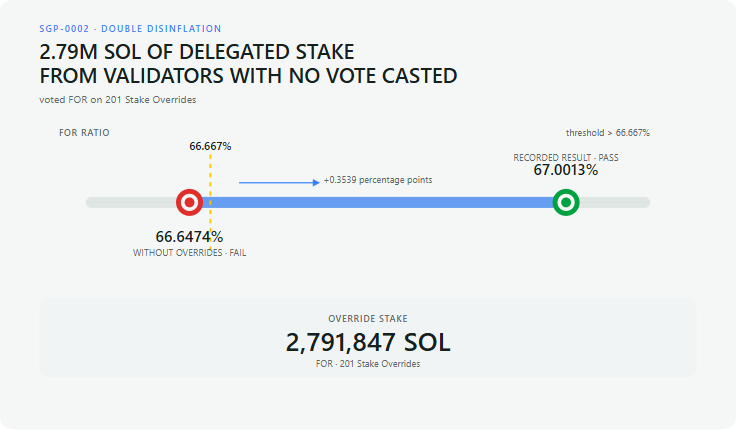
That feature played a crucial role in the outcome.
Delegators representing 2.79M SOL cast FOR votes via vote overrides, giving an option to stake that otherwise would have sat idle in the SGP-0002 vote.
Very cool seeing this come to fruition. When Solana governance v0 was in the works there was no plan to allow stakers to vote.
After working on TipRouter and chatting with @brian_smith_0 we came up with the idea to use a NCN to power voting and give stakers a voice.