@__MoFash Dont memtion Arsene. Wenger chose mr Good ebening over him..
Wenger left Arsenal a disgraced old man. And it was good riddance to bad smelly rubbish.
I remember celeberation all over the world when Wenger left Arsenal
🚨 Anthropic just showed a 27-minute workshop on how to actually do prompts for Claude.
Taught by the people who built it.
Free. No registration. No paywall.
I've seen $300 courses that don't cover what they teach in the first 8 minutes.
Watch it and bookmark it now.
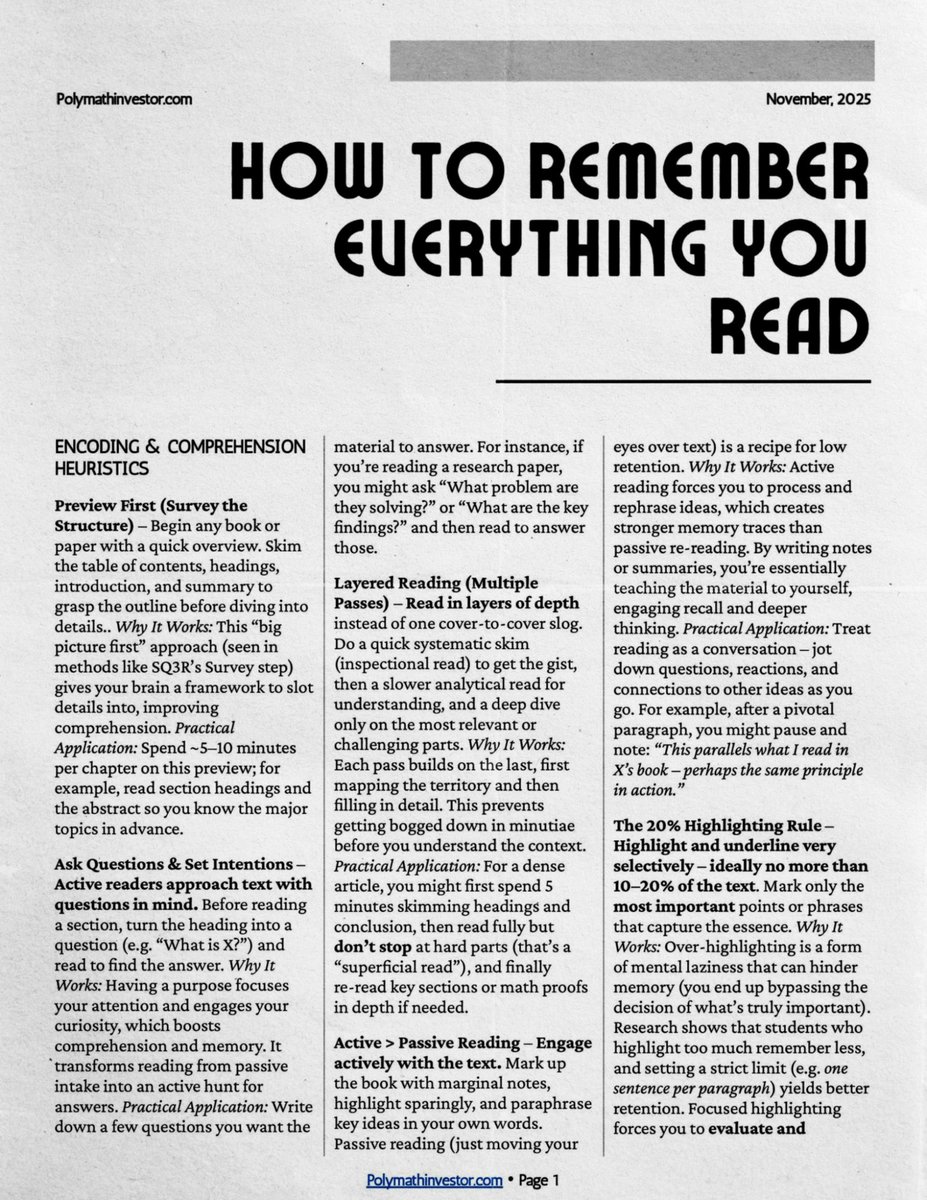
A few months back, I published this guide on how to remember everything you read.
Re-sharing it here for anyone who finds these protocols useful.
(1/11)
Because of Mikel Arteta, a young boy from Africa got his debut in professional football, spoke to first-team staff and started a million-dollar company.
Loyalty to greatness works.
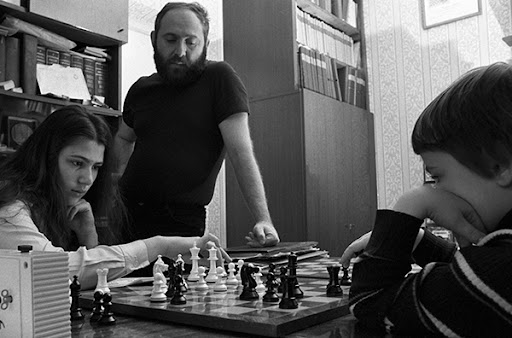
A Hungarian psychologist raised three daughters to prove that any child could become a chess grandmaster through early specialization. He succeeded. Two of them became grandmasters. One became the greatest female chess player who ever lived.
Then a sports scientist looked at the data and found something nobody wanted to hear.
His name is David Epstein. The book is called "Range."
The Polgar experiment is one of the most famous case studies in the history of deliberate practice. Laszlo Polgar wrote a book before his daughters were even born arguing that geniuses are made, not born. He homeschooled all three girls in chess from age four. By their teens, Susan, Sofia, and Judit were dominating tournaments against grown men. Judit became the youngest grandmaster in history at the time, breaking Bobby Fischer's record. The story became the gospel of early specialization. Pick a domain young, drill it hard, and you can manufacture excellence.
Epstein opens his book by telling that story honestly and then quietly demolishing the conclusion most people drew from it.
Chess works that way. Most things do not.
Here is the distinction that took him four years of research to articulate, and that almost nobody who quotes the 10,000 hour rule has ever read.
There are two kinds of environments in which humans develop expertise. Psychologists call them kind and wicked. A kind environment has clear rules, immediate feedback, and patterns that repeat reliably. Chess is the cleanest example. Every game ends with a winner and a loser. Every move is recorded. The board never changes shape. The pieces never invent new ways to move. A child who plays ten thousand games will see most of the patterns that exist in the game, and pattern recognition is exactly what chess mastery is built on.
A wicked environment is the opposite. Feedback is delayed or misleading. Rules shift. The patterns that worked yesterday may be exactly the wrong patterns to apply tomorrow. Most of the real world looks like this. Medicine is wicked. Investing is wicked. Building a company is wicked. Scientific research is wicked. Almost every job that involves a complex changing system with humans in it is wicked.
The Polgar sisters trained in the kindest environment any human can train in. Their success was real and the method was correct. The mistake was generalizing the method to fields where the underlying structure of the environment is completely different.
Epstein's research is what made the implication impossible to ignore.
He looked at the careers of elite athletes outside of chess and golf and found that the pattern was almost the inverse of what people assumed. The athletes who reached the very top of their sports were overwhelmingly people who had played multiple sports as children, specialized late, and often switched disciplines well into their teens. Roger Federer played squash, badminton, basketball, handball, tennis, table tennis, and soccer before tennis became his focus. The kids who specialized in tennis at age six and trained year-round for a decade mostly burned out, got injured, or topped out at lower levels of the sport.
The same pattern showed up everywhere he looked outside of kind environments. Inventors with the most patents had worked in multiple unrelated fields before their breakthrough work. Comic book creators with the longest careers had drawn for the most different genres before settling. Scientists who won Nobel Prizes were dramatically more likely than their peers to be serious amateur musicians, painters, sculptors, or writers.
The skill that mattered in wicked environments was not depth in one pattern. It was the ability to recognize when a pattern from one domain applied unexpectedly in another. That kind of thinking cannot be built by drilling a single subject. It can only be built by accumulating mental models from many subjects and learning to move between them.
The deeper finding is the one that should change how you think about your own career.
Specialists in wicked environments often get worse with experience, not better. Epstein cites studies of doctors, financial analysts, intelligence officers, and forecasters showing that years of experience in a narrow domain frequently produce more confident judgments without producing more accurate ones. The expert builds elaborate mental models that feel comprehensive and turn out to be increasingly disconnected from the actual structure of the problem. They stop noticing what does not fit their framework. They mistake fluency for understanding.
Generalists do better in wicked domains for a reason that sounds almost mystical until you understand the mechanism. They have less invested in any single mental model, so they abandon broken models faster. They are used to being a beginner, so they are not threatened by the discomfort of not knowing. They have seen enough different domains that they can usually find an analogy from one field that unlocks a problem in another. The technical name for this is analogical thinking, and the research on it is one of the most underrated bodies of work in cognitive science.
The single most useful sentence in the entire book is the one Epstein puts almost as a throwaway.
Match quality matters more than head start.
A person who tries six different fields in their twenties and finds the one that genuinely fits them will outperform a person who picked one field at fourteen and stuck to it on willpower alone. The lost years were not lost. They were the search process that produced the match. Every field they walked away from taught them something they later imported into the field they finally chose.
The reason this is so hard to accept is cultural, not empirical. We tell children to pick a path early. We reward the prodigy who knew at six. We treat the late bloomer as someone who failed to launch on time, when the data suggests they were running an entirely different and often more effective optimization process underneath.
The Polgar sisters were not wrong. The conclusion the world drew from them was.
If your environment is genuinely kind, specialize early and drill hard. If it is wicked, and almost every interesting human problem is, then the people who win are the ones who refused to specialize until they had seen enough to know what was actually worth specializing in.
You are not behind. You were running the right experiment all along.
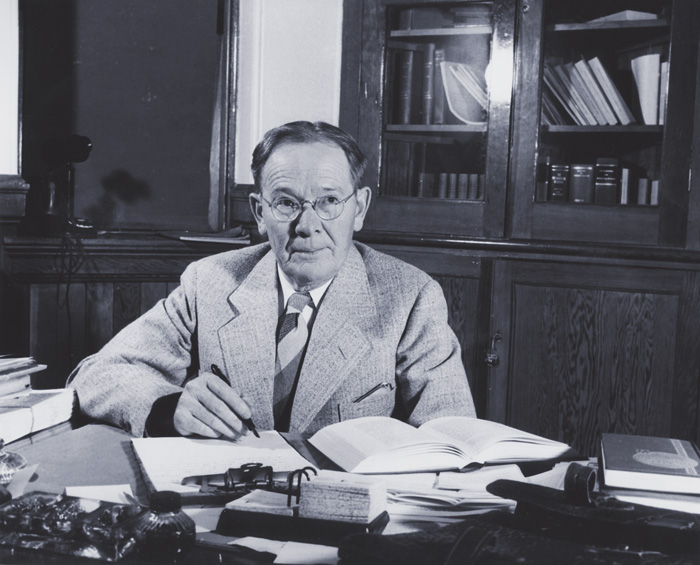
A Stanford psychologist spent 35 years trying to prove that high IQ produced genius. He selected 1,528 of the smartest children in California and tracked them for the rest of their lives.
Not one of them won a Nobel Prize. Two of the boys he had rejected from the study won the Nobel Prize in Physics.
The trait he had built his entire career on did not predict the thing he thought it predicted.
His name was Lewis Terman. The study is one of the most honest accidents in modern psychology.
In 1921, Terman was the most famous psychologist in America. He had translated and adapted the original French intelligence test into the version that would dominate American schools for the next 50 years.
He called it the 'Stanford-Binet'. He believed, with the certainty of a man who had built a career on a single idea, that intelligence was the master variable behind every form of human achievement. The doctors, the inventors, the senators, the artists, the great writers and great scientists. All of them, in his model, were sitting at the top end of the same bell curve. If you could find the children with the highest scores, you could predict the future leaders of the country.
So he set out to prove it.
He sent his research team into California schools and screened roughly 168,000 children. He had teachers nominate their brightest pupils. He gave the nominees the Stanford-Binet. He kept the ones who scored 135 or higher, which placed them in roughly the top one percent of the population. The final sample was 1,528 children, average age 11. They had a name in his lab notebooks within a year. Termites.
He planned to follow them for the rest of their lives. He died in 1956 having tracked them for 35 years. Stanford kept the study going. The last surviving Termites were tracked until the 2000s. The data set is one of the longest continuous psychological studies in human history.
Here is what the data showed.
The Termites did well. They went to college at higher rates than their peers. They earned more money. They became professors and engineers and lawyers and physicians at higher rates than the general population.
Terman was not entirely wrong. High IQ is correlated with conventional success. The correlation is real and the effect size is meaningful.
But that was not what he had set out to prove.
He had set out to prove that high IQ produces genius. The kind of genius that wins Nobel Prizes, writes great novels, founds new fields, and reshapes the technological direction of the world. And on that specific question, the dataset turned on him.
None of the 1,528 Termites won a Nobel Prize. None of them won a Pulitzer. None of them became world-class musicians. None of them produced a single piece of work that historians of science or art still talk about. They were accomplished. They were comfortable. They were not, in any sense Terman would have recognized in his original ambition, geniuses.
The detail that haunts the study is what happened to the children he rejected.
In the screening phase, his team had tested two boys named William Shockley and Luis Alvarez. Both scored below the cutoff. Both were sent home. Shockley went on to co-invent the transistor and win the 1956 Nobel Prize in Physics, the same year Terman died. He founded the company that seeded the entire ecosystem we now call Silicon Valley. Alvarez won the 1968 Nobel Prize in Physics for his work on subatomic particles, and later proposed the asteroid impact theory of dinosaur extinction that turned out to be correct, too.
Two of the most consequential American physicists of the 20th century had been measured by Terman's own instrument and judged not gifted enough to be worth tracking.
There is an important caveat here that the more honest critics have raised in recent years. A 2020 simulation study from researchers at Utah Valley University showed that even with a perfect IQ test, the base rate of Nobel Prizes is so vanishingly low that Terman would have been statistically unlikely to catch a future laureate in any sample of his size, no matter where he set the cutoff.
The Shockley and Alvarez story is dramatic but it does not, on its own, prove that IQ does not matter. It proves that rare outcomes are hard to predict from any single variable, including a very good one.
That caveat is real. It is also not the most important thing the study showed.
The most important thing the study showed is what Terman himself eventually admitted, late in his career, in a quieter voice than he had used for the previous three decades. He wrote that the relationship between intelligence and achievement was, in his words, far from perfect. Within the Termite sample itself, the highest-IQ children did not become the most accomplished adults.
The variation in outcomes inside the group of geniuses was enormous, and IQ explained almost none of it. Some of the Termites had unremarkable careers. Some of the Termites had remarkable ones. The thing that distinguished the two groups was not the score he had used to select them.
What distinguished them, when researchers eventually analyzed the data more carefully, was a cluster of traits Terman had not been measuring. Persistence. Curiosity. Health. Stable family circumstances.
The willingness to keep going when a project stopped being interesting and started being hard. Most of the Termites who went on to do meaningful work were not the ones with the highest scores. They were the ones who had spent decades grinding on a single problem.
The lesson is the part that should change how anyone reading this thinks about talent.
The trait you select for is the trait you optimize for. If you measure children on a test of pattern recognition and verbal recall, you will find children who are good at pattern recognition and verbal recall. You will not find the children who will spend 30 years thinking about a single equation. You will not find the children who will quietly read the same difficult book six times.
You will not find the children whose curiosity is wider than their working memory. Those traits do not show up on the test you are running, which means they do not show up in the dataset you build.
Terman spent his life trying to find genius and ended up proving that he had been measuring the wrong thing all along. The kids he rejected were not stupider than the kids he kept. They were running a different program underneath, and his instrument could not see it.
The trait you can measure is almost never the trait that actually matters.
Most people building careers, hiring teams, and raising children are still selecting for the version of the trait that fits on a test.
Young people are going to start new businesses, find new careers, get new jobs, close out contracts, marry their lovers, buy new homes off the back of this Arsenal victory.
A new wave of success stories breaking through. A new wave of projects winning. A New World Order. ✨
For most European citizens, the world is their oyster. But for citizens of some African and Asian countries, there's no escaping the visa. https://t.co/ZqR16oCzwn via @visualcap
If your marketing feels inconsistent, read this:
It’s probably not your ads.
It’s not your content.
It’s not even your team.
It’s your system.
No structure equals random results.
You’re not building momentum by starting over every week.
Clarity is step one.
Systems are step two
Most founders think they have a marketing problem.
They don’t.
They have a clarity problem.
Marketing just amplifies what’s already there.
If your positioning is weak, your growth will be expensive.
If you’re hunting for a remote job, you just need to figure out how Reddit works, and you’ll never be unemployed for a long time.
Here’s a list of subreddits you should bookmark right now:
𝗧𝗵𝗲 𝗠𝗰𝗞𝗶𝗻𝘀𝗲𝘆 𝗦𝗹𝗶𝗱𝗲 𝗣𝗹𝗮𝘆𝗯𝗼𝗼𝗸 𝗳𝗼𝗿 𝗖𝗹𝗮𝘂𝗱𝗲 🔥
McKinsey charges $300k for a strategy engagement.
A big part of what you're buying is the deck: the structure, the logic, the way the argument unfolds so that a senior partner can read it in four minutes and understand exactly what you're recommending.
That framework has a name. Five rules.
Most founders build decks that feel convincing while they're presenting and fall apart the moment someone reads them alone.
The five rules fix that at the structural level, not the aesthetic one:
→ Pyramid Principle: the conclusion on slide one, proof after
→ SCQA: situation, complication, question, answer, in that order
→ Action titles: every heading is a thesis, readable top to bottom
→ MECE: no slide duplicates another, no logical step is missing
→ One message per slide, and one only
I built a Claude Code project that runs all five automatically. Feed it your startup brief. Get back a McKinsey-style outline.
Inside you'll find:
1. The Five McKinsey Rules That Make a Deck Impossible to Misread
2. How to Set Up the Claude Project
3. How to Make Claude Apply the Five Rules
4. How to Input Your Startup the Right Way
Comment MCKINSEY and I'll send you the link.
Anthropic just launched the Claude Architect Certification!
You’ll have to complete 60 multiple-choice questions across five competency areas in a single session. No external resources or breaks.
Here’s how I’m planning to prepare for it (steal my roadmap):
Week 1
Complete the recommended courses:
- Building with the Claude API
- Introduction to Model Context Protocol
- Claude Code in Action
- Claude 101
Week 2
Build real projects with:
- Claude Code
- Agent SDK
- Anthropic API
- MCP
Week 3
Get familiar with the exam structure and guide:
- Go through the six exam scenarios
- Get familiar with the five competency areas / domains
- Learn the skills needed for each task assessment
Week 4
Do the preparation exercises from the exam guide:
- Build a Multi-Tool Agent with Escalation Logic
- Configure Claude Code for a Team Development Workflow
- Build a Structured Data Extraction Pipeline
- Design and Debug a Multi-Agent Research Pipeline
Week 5
- Take the practice exam
- Aim for a score greater than 850 / 1000
Week 6
- Take the real exam
- Only one attempt allowed
NOTES:
- At this point the certification is exclusive for Anthropic Partners and early access is free for first 5,000 partner company employees.
- Your mileage may vary depending on your skill level. E.g. It may take 2 weeks for some but 10 weeks for others.
If you are eligible, register here → https://t.co/wkFI7ZEAhL
I ACCIDENTALLY OPENED MY CTO'S PERSONAL NOTION WORKSPACE AND NOW I UNDERSTAND WHY HE SHIPS 5X FASTER THAN THE REST OF US.
He is 48. I am 26. He manages 3 products and never works past 5 PM.
I work 10 hours a day and barely clear my Jira board.
In his workspace, one specific document explained everything:
Most people panic when the workload scales. They work longer hours, burn out, and eventually drop the ball. High performers do not manage time. They manage boundaries.
The document was a list of strict operating rules. Here are 18 systems you can steal.
Cancel your weekend plans
if you work in marketing, you need to catch up
> set up claude code (superpowers, skip permissions, obsidian integration)
> create your brand foundation file (voice, tone, audience, what you never say)
> map out your workflows and see where you can slot in AI automations
> set up marketing skills (find on github or build your own)
> set up wispr flow for voice-to-text across every app
> build an n8n content repurposing pipeline (one post → every platform)
> experiment with clay for AI-powered lead gen and enrichment
> build a multi-agent content system (researcher, writer, editor, publisher)
> test perplexity computer and build a marketing agent team inside it
> take the anthropic skilljar course and get claude certified
> test perplexity pro source mapping for competitive research
> build an outbound pipeline with apify + claude code + n8n (scrape, enrich, email)
> set up AI-powered ad dashboards that update in real time
> use linkedin scraping → email enrichment → facebook custom audiences for targeting
> study GTM engineering (the gap between "I shipped" and "I have users" is where the money is)
> learn prompt engineering (your inputs determine your outputs)
now is the time to lock in