Six of the biggest regrets athletes have later in life:
1. Not giving their best effort.
2. Not taking enough risks.
3. Not putting their team first.
4. Not enjoying the moment.
5. Not prioritizing their physical and mental health.
6. Not spending enough time with family.
John Wooden said, "A player who makes a team great is more valuable than a great player. Losing yourself in the group, for the good of the group, that’s teamwork."
Great teams come together.
They don't let dysfunction take over...
The Five Dysfunctions of a Team according to Patrick Lencioni
1. Absence of Trust - Trust is the foundation of any team. When team members are reluctant to be open up and communicate, it blocks trust and performance. Overcoming this requires openness and the willingness to share weaknesses and fears without fear of reprisal.
2. Fear of Conflict - Healthy conflict is essential for growth. Teams that avoid conflict out of fear of discord end up with unresolved issues and tension. Encouraging open and constructive conflict leads to better decision-making and problem-solving.
3. Lack of Commitment - Without commitment, teams cannot achieve their goals. This dysfunction arises from ambiguity in direction and priorities. Setting clear goals and creating active buy-in from team members are crucial for commitment.
4. Avoidance of Accountability - When team members are not held accountable, standards start to slip. A culture where people are regularly held responsible for their performance creates a sense of collective responsibility and excellence.
5. Inattention to Results - The ultimate goal of any team should be collective results. When individual goals overshadow team goals, it leads to stagnant progress. Emphasizing shared success is essential for driving team performance.
"Teamwork is not a virtue, but rather a choice. It's a strategic decision and an intentional one." - Patrick Lencioni
Clark Lea shares what the real cost of success is.
"We all as humans want the results now."
"Most people - their tolerance level for suffering, sacrifice, struggle - only goes so far as they're rewarded for it."
"It's challenging when you know you're putting effort in but not seeing the results."
Success requires hard work, patience, and consistency. It means having faith in the process and delayed gratification.
"We've asked for a high level of suffering, sacrifice, and struggle from our players and staff."
"The beauty of it is - we haven't deviated from that ask. That's what we call our team into every day."
The results will come. But only if you stay in it long enough.
Success requires sacrifice and struggle because you can't get where you want without breaking past your current limits.
(🎥 D1 Training)
Clark Lea shares what the real cost of success is.
"We all as humans want the results now."
"Most people - their tolerance level for suffering, sacrifice, struggle - only goes so far as they're rewarded for it."
"It's challenging when you know you're putting effort in but not seeing the results."
Success requires hard work, patience, and consistency. It means having faith in the process and delayed gratification.
"We've asked for a high level of suffering, sacrifice, and struggle from our players and staff."
"The beauty of it is - we haven't deviated from that ask. That's what we call our team into every day."
The results will come. But only if you stay in it long enough.
Success requires sacrifice and struggle because you can't get where you want without breaking past your current limits.
(🎥 D1 Training)
Nick Sirianni shares the philosophy that drives all great teams.
"Can you do it by yourself? You can't do it in this sport by yourself. It takes everybody."
"I can't be great without the greatness of others. Period."
No one wins alone.
Greatness requires a team and great teammates.
You need everyone to buy in. Then he gave them the mantra:
"Sometimes you. Sometimes me. Always us."
"Sometimes you. Sometimes me. Always us. Together. Team."
Great teams are connected. They know how to come together.
It requires selflessness, humility, and hard work.
Sometimes you. Sometimes me. Always us.
(🎥 Philadelphia Eagles)
Nick Sirianni shares the philosophy that drives all great teams.
"Can you do it by yourself? You can't do it in this sport by yourself. It takes everybody."
"I can't be great without the greatness of others. Period."
No one wins alone.
Greatness requires a team and great teammates.
You need everyone to buy in. Then he gave them the mantra:
"Sometimes you. Sometimes me. Always us."
"Sometimes you. Sometimes me. Always us. Together. Team."
Great teams are connected. They know how to come together.
It requires selflessness, humility, and hard work.
Sometimes you. Sometimes me. Always us.
(🎥 Philadelphia Eagles)
Dusty May shares how he built a culture of never being afraid to fail at Michigan.
"In our program we're very intentional to never be afraid of failure. Literally ever."
"If I ever feel like our guys have any self-doubt or any fear - we bring it to the surface."
"The media's gonna criticize us. It'll be over in 24 hours. All that stuff is vapor. What people are gonna say about us on Twitter is vapor."
Focus on the work, not the criticism or the praise. It's vapor.
"We're more concerned with just doing our best."
"That's not gonna affect our behaviors. We're gonna go out and be unafraid. We're gonna be aggressive. We're gonna let it rip - and trust that the results are gonna be there."
Focus on doing the work and giving your best.
Trust the process and let it rip.
The real enemy of your performance is being too afraid to fail.
(🎥 Way of Champions)
Pat Summitt shares the philosophy that guided 38 years and 8 national championships.
"You win in life with people."
"It's not about me. I've never scored a basket for the University of Tennessee...It's all about the people you surround yourself with - and what they bring to the court, to the game."
You can't win without having a team there to help. It starts with the people and the team.
"It is a team concept. And they have to do it together."
It was never about her - it was always about them.
Surround yourself with great people.
Great teams know how to trust and come together for a goal bigger than themselves.
(🎥Lifeissport )
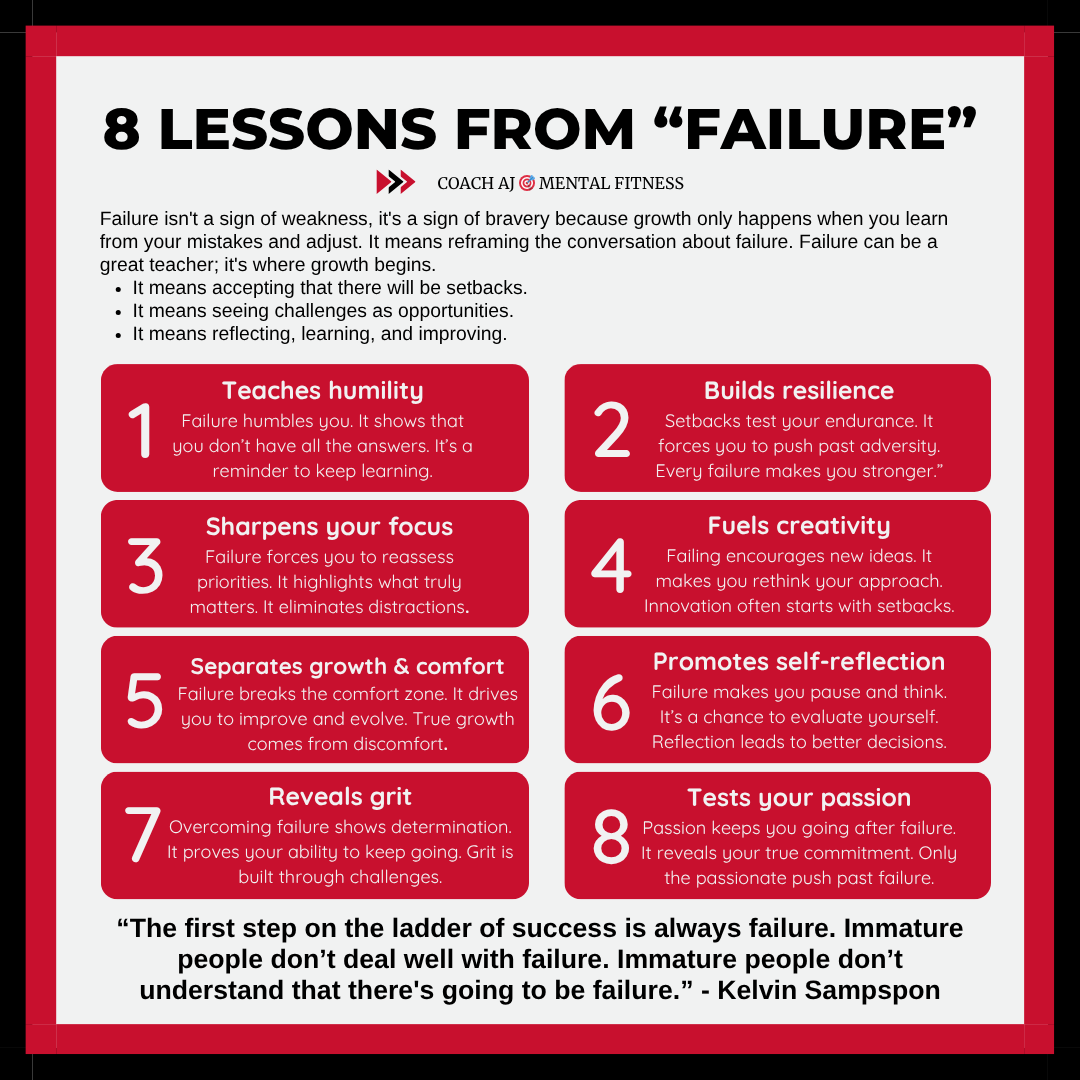
Kelvin Sampson said, "The first step on the ladder of success is always failure."
"Immature people don’t deal well with failure.”
Failure can be a great teacher; it's where growth begins.
Here are 8 lessons we can all learn from failure👇
Jalen Brunson shares the mindset his parents instilled in him and why he's never afraid of the big moment.
"I've always been taught by my parents to never be afraid to fail."
"You put yourself in those positions in the summertime - when you're envisioning what's going on on the court, when you're by yourself - putting yourself in those positions to get better."
"When those opportunities come about - you're not afraid of the moment. Because you worked hard enough to where if you do fail, you're gonna learn anyway."
Preparation kills fear. You can't be scared of a moment you've already lived a thousand times.
"You put the confidence you have in everything you do when the lights are on - because of everything you've done when no one's watching."
"That's the mindset my parents instilled in me. Every coach I've had has helped make it better."
Confidence comes from doing the work.
Do the work in private and give yourself proof of what you're capable of doing.
Focus on preparation not failure.
That's the mindset.
(🎥NBA)
Jalen Brunson shares the mindset his parents instilled in him and why he's never afraid of the big moment.
"I've always been taught by my parents to never be afraid to fail."
"You put yourself in those positions in the summertime - when you're envisioning what's going on on the court, when you're by yourself - putting yourself in those positions to get better."
"When those opportunities come about - you're not afraid of the moment. Because you worked hard enough to where if you do fail, you're gonna learn anyway."
Preparation kills fear. You can't be scared of a moment you've already lived a thousand times.
"You put the confidence you have in everything you do when the lights are on - because of everything you've done when no one's watching."
"That's the mindset my parents instilled in me. Every coach I've had has helped make it better."
Confidence comes from doing the work.
Do the work in private and give yourself proof of what you're capable of doing.
Focus on preparation not failure.
That's the mindset.
(🎥NBA)
Shane Steichen shares the goal-setting principle everyone needs to hear.
"You gotta set clear, specific goals. Number one."
"Vague goals equal vague results."
Then he broke it down what that actually looks like:
"If you're a wideout and you're like, 'Man, I wanna have no drops' - that's a good goal."
"But it should be - 'I'm gonna do the jugs machine 4 days a week, catch 100 balls a day, 400 balls a week - to have no drops.' That's a clear, specific goal."
Focus on the process and the habits.
The goal isn't the destination.
The goal is the daily process that gets you there.
Vague goals create vague results.
Specific goals require specific action.
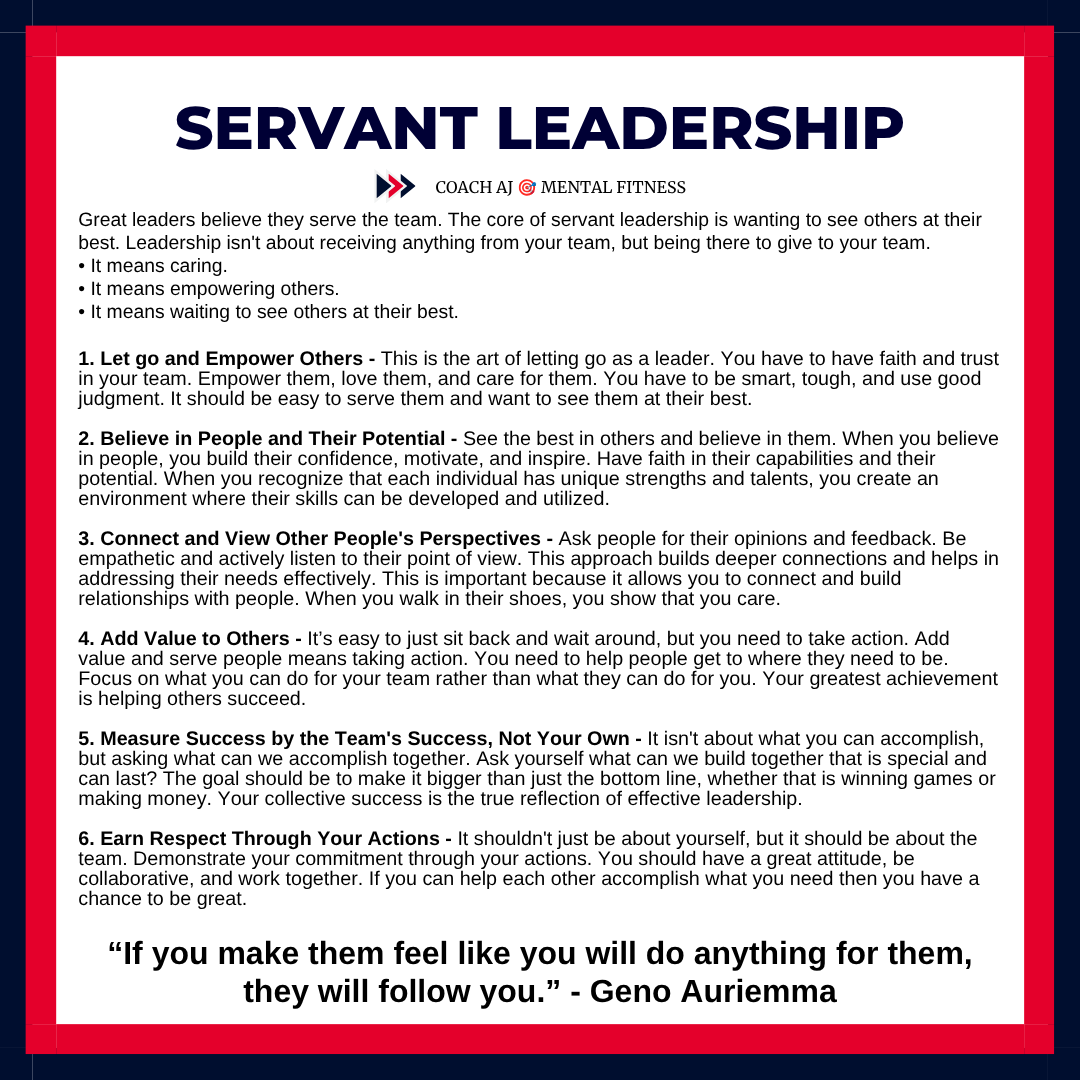
Great leaders believe they serve the team.
• They know that it means caring.
• They know that it means empowering others
• They know that it means wanting to see others at their best.
Here are 6 habits to be a better servant leader:
“Every one of those kids are giving you everything they got, they play with passion…and if we win or lose this whole thing, it doesn’t matter to me man, as long as they continue to do what they do the rest of their lives."