A Stanford psychologist spent 4 years proving that the simple act of walking generates 60% more creative ideas than sitting, and the experiment she designed to kill every alternative explanation is one of the most decisive findings in modern psychology.
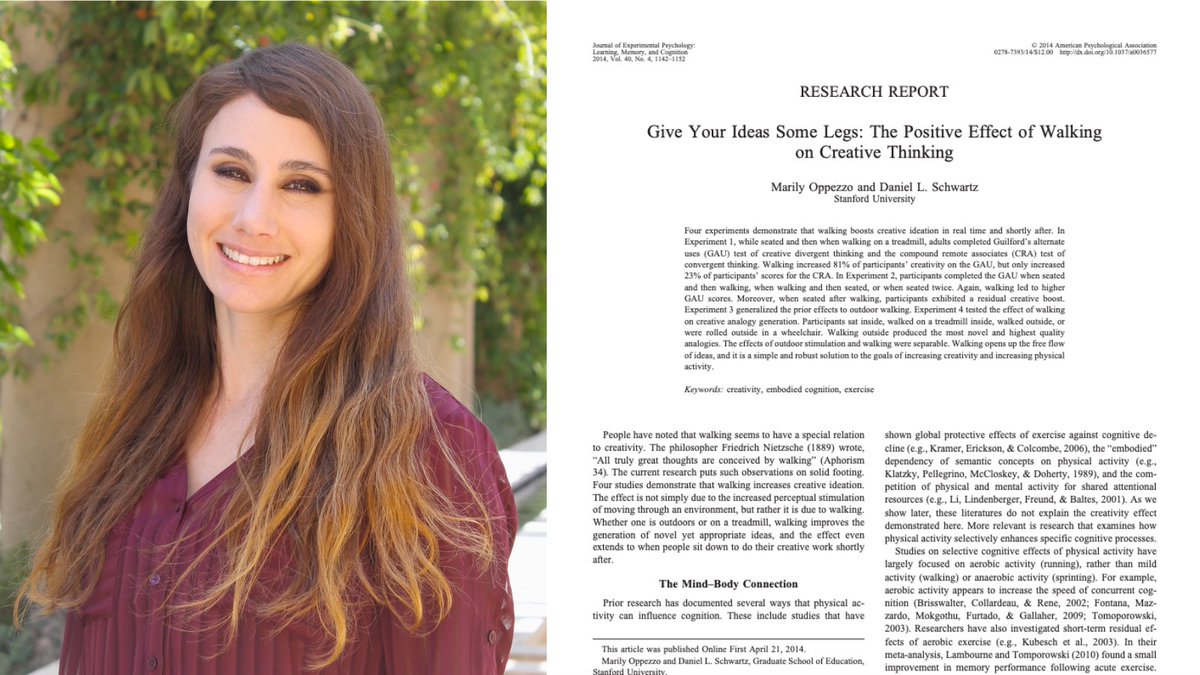
Her name is Marily Oppezzo.
She got the idea for the study while walking with her advisor at Stanford to discuss her thesis topic, and the paper she eventually published in the Journal of Experimental Psychology in 2014 is sharp enough that it should have ended the seated meeting on the day it came out.
She ran 4 experiments on 176 people. Same person tested twice. Once sitting, once walking. The creativity tasks were the standard ones psychologists have used for decades to measure how good a brain is at generating novel useful ideas.
The result was almost too clean to publish.
81% of participants in the first experiment produced more creative ideas while walking than while sitting. In the second experiment, 88%. In the third, 100%. Every single person walked into a more creative version of themselves.
On average, people generated 60% more novel useful ideas the moment their legs started moving.
The skeptical question is the obvious one. Maybe it was the fresh air. Maybe it was the scenery passing by. Maybe it was the change of environment doing the work, not the walking itself.
Oppezzo killed every one of those explanations with one experimental decision.
She put people on a treadmill facing a blank wall. No scenery. No fresh air. No environmental change. Just legs moving in place while staring at white drywall. The 60% boost held.
Then she ran the experiment that closed the case completely. She took participants outside in two conditions. Half of them walked through a Stanford courtyard. The other half were pushed through the exact same courtyard in a wheelchair. Same outdoor stimulation. Same scenery passing at the same speed. The only difference was whether the legs were moving.
The walkers produced dramatically more novel high-quality ideas than the wheelchair group. The outdoors did almost nothing on its own. The walking did everything.
This is the part of the study that hit hardest when I read it the first time.
She also tested the opposite kind of thinking. Convergent thinking. The kind where there is one right answer and you have to narrow down to it.
Word puzzles where 3 words share a hidden fourth word that connects them. The seated participants did slightly better on these. Walkers got slightly worse.
Walking is not a general intelligence enhancer. It does one specific thing. It opens up the divergent search inside your brain. The part that generates options. The part that produces unexpected connections. The part that takes a problem and finds five ways into it instead of one.
When you need to converge on the single right answer, sit down. When you need to find the answer in the first place, get up.
The mechanism is now well understood. Walking selectively activates what neuroscientists call the default mode network, the system inside your brain that runs when you are not consciously focused on anything. The DMN is where mind-wandering happens. Where memories cross-reference each other. Where ideas that have been sitting in separate folders inside your head finally bump into each other.
When you sit at a desk and force yourself to concentrate, you suppress the DMN. When you walk at a natural pace, the executive part of your brain gets just busy enough handling the walking that the DMN comes online and starts doing the work that focus was blocking.
The most useful finding in the entire paper is the one almost nobody quotes.
The boost did not turn off the moment people stopped walking. Participants who walked first and then sat back down stayed elevated. Their next round of seated creativity work was still significantly better than people who had been sitting the whole time. The rest lingered for at least several minutes after the legs stopped moving.
You do not need to do creative work while walking. You need to walk before the creative work. The brain holds the state.
The history of this is the part that should haunt anyone who still does meetings in chairs.
Charles Darwin built a gravel loop behind his house in Kent called the Sandwalk and walked it 3 times a day for the rest of his life. The theory of evolution was developed one lap at a time on that path.
Nietzsche walked up to 10 hours a day during the years he wrote his most important books and openly said the work was conceived on his feet.
Beethoven composed for the morning and walked for 5 hours every afternoon with a pencil in his pocket for when something landed.
Kahneman said the best thinking of his Nobel Prize-winning career happened on leisurely walks with Amos Tversky. Steve Jobs refused to take important conversations sitting down. He held them on foot.
Every one of them was using the system Oppezzo would not measure until 2014. They just did not know what to call it.
The question worth sitting with is the one almost nobody asks.
Every meeting you have ever attended sitting around a table was a meeting held at a fraction of the brain power that was actually available to the people in the room. Every brainstorm that got stuck inside a conference room. Every problem you tried to solve at a desk and gave up on. Every idea you could not quite get to.
The intervention is the easiest one in modern science. No supplement. No app. No subscription. No training program. Just a pair of legs and 15 minutes.
The Stanford lab proved it. The philosophers knew it. The neuroscience explains it.
And almost everyone reading this is still trying to think their way out of problems sitting completely still.
UPDATE: AI coding budgets are burning FASTER than anyone expected
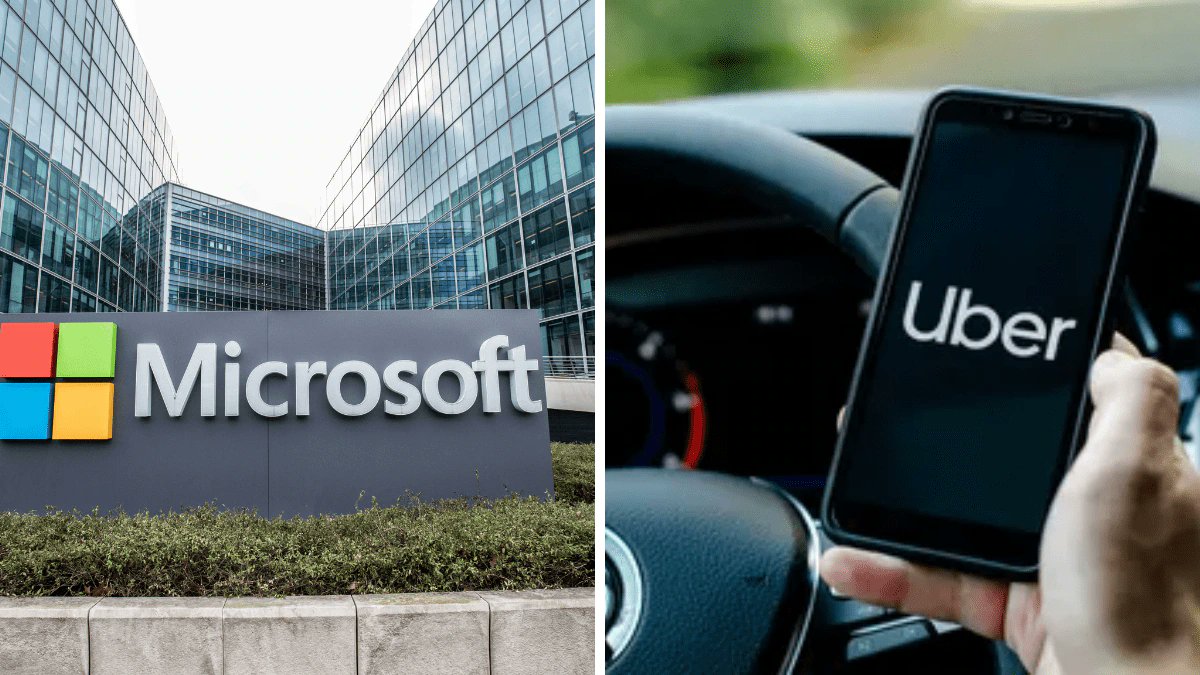
@Microsoft scaling back @claudeai Code access + Uber torched their entire 2026 AI budget in just 4 months
The AI revolution might be hitting some serious economic reality checks
JUST IN: BlackRock CEO Larry Fink admits he once called Bitcoin the domain for money launderers and thieves. Says the market taught him to rethink assumptions. Now sees a role for crypto similar to gold
𝗦𝗼𝗺𝗲 𝗽𝗲𝗼𝗽𝗹𝗲 𝗱𝗼𝗻’𝘁 𝗷𝘂𝘀𝘁 𝘄𝗮𝘁𝗰𝗵 𝗪𝗲𝗯𝟯 𝗴𝗿𝗼𝘄.
They spend years working closely with founders, ideas, and projects and know which ones truly have the potential to last.
🎤 That’s why we’re excited to welcome @mary_pedler , Founder of @INPUT_global as a Jury Member for the 🏆𝗖𝗼𝗶𝗻𝗚𝗮𝗽𝗲 𝗪𝗲𝗯𝟯 𝗜𝗻𝗻𝗼𝘃𝗮𝘁𝗶𝗼𝗻 𝗔𝘄𝗮𝗿𝗱𝘀 𝟮𝟬𝟮𝟲
With deep experience across communications, ecosystem growth, strategic partnerships, and #Web3 adoption, Mary brings a perspective shaped by working alongside some of the industry’s most ambitious builders and emerging projects.
Because the next generation of winning Web3 projects won’t just be technically strong.
They’ll know how to:
• Build global communities
• Drive real adoption
• Create sustainable ecosystems
• Connect technology with people 🌐
That’s exactly the lens Mary brings to this year’s jury panel 🚀
📍 𝗩𝗼𝘁𝗶𝗻𝗴 𝗶𝘀 𝗻𝗼𝘄 𝗟𝗜𝗩𝗘
Support the innovators shaping the future of Web3 👇
https://t.co/NXRjpoxgyC
SpaceX IPO is getting close.
Expected:
• $75B raise
• $1.75T valuation
• Goldman Sachs leading
This could become one of the biggest IPOs in history.
Wall Street’s biggest names are lining up.
Read more at our @CPOfficialtx Newsletter.
Subscribe to our free daily newsletter - alpha delivered straight to your inbox.
👉 https://t.co/mJ6CN5HwkM
Bitcoin price prediction is bearish, according to CryptoQuant's head of research, as the current condition mirrors that of March 2022.
https://t.co/ngfcfAAAyj
📬 Mid-Week News Roundup
• BTC hovered near $77.3K
• ETH traded around $2.11K
• XRP demand rose on yield + RWA momentum
• Anthropic strengthened its AI lead with a key hire
• Kevin Warsh sold $100M in stocks ahead of Fed role
• Tether filed South Korea trademarks
• Elizabeth Warren launched a fresh OCC crypto probe
• U.S. tightened crypto sanctions as Japan advanced digital infra
• Estonia suspended Zondacrypto’s license
• Fed said 1 in 4 U.S. workers used AI
• Pump fun moved to tap USDC liquidity
• HYPE surged above $48 on SpaceX pre-IPO buzz
• SEC prepared a tokenized stock exemption
• Kevin Warsh readied for White House swearing-in
NEW: @ProjectEleven partners with @Ripple to advance post-quantum security on the XRP Ledger, conducting a full audit of XRPL's validator, custody and wallet layers for quantum vulnerabilities.
#Binance Dominates Market Flows
➡️ binancecoin:native captured 78% of monthly exchange inflows, showing strong trader activity and market dominance.
➡️ At the same time, #stablecoin liquidity jumped by $3.6 billion in just 7 days.
#CoinPedia#CryptoNews#Blockchain #CryptoMarket
Crypto markets remained steady before the Trump-Xi summit in Beijing, with Bitcoin holding above $80,000, while LiquidChain’s presale moved past $750,000.
https://t.co/AqxdVNXgYE
Key events to watch this week:
May 12 — U.S. CPI for April due at 7:30am ET. Est. 3.3% YoY vs prior 3.3%.
May 13 — U.S. PPI for April due. Core PPI est. vs prior 3.8% YoY.
May 14 — Senate Banking Committee markup of the CLARITY Act scheduled.
May 15 — Jerome Powell's term as Fed Chair officially ends.
Top 7 Token Unlocks This Week
➡️ Seven major #crypto projects are set to release millions of locked tokens between May 11-17.
➡️ Major unlocks include:
$TON - $86.77M
$PIEVERSE - $31.59M
$PUMP - $21.04M
$STBL - $16.67M
$ARB - $13.12M
$APT - $11.20M
$PENGU - $7.26M
#CoinPedia #CryptoNews #Blockchain #CryptoMarket