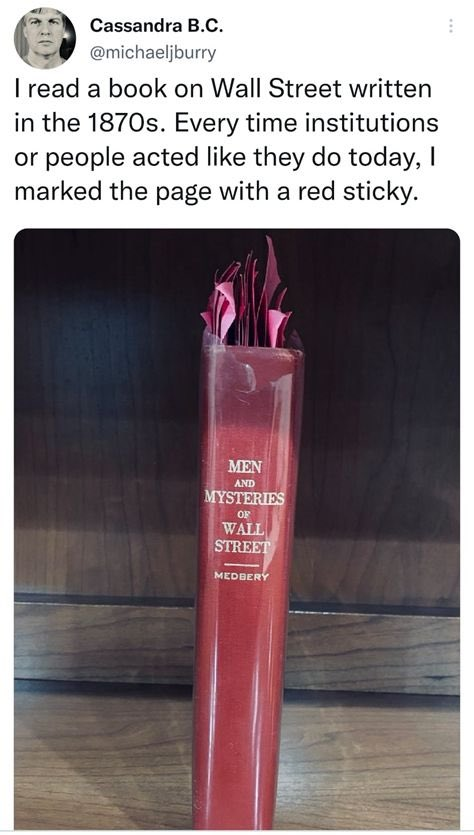
Michael Burry @michaeljburry read a Wall Street book from the 1870s.
Every time institutions or people acted like they do today, he marked the page with a red sticky.
The book is basically a porcupine.
Human nature doesn't change.
Greed doesn't change.
Fear doesn't change.
Leverage doesn't change.
The crash always comes.
Only the asset class has a different name.
Railroads in 1870.
Stocks in 1929.
Dot-coms in 2000.
Mortgages in 2008.
What's the red sticky for today?
$SOXX
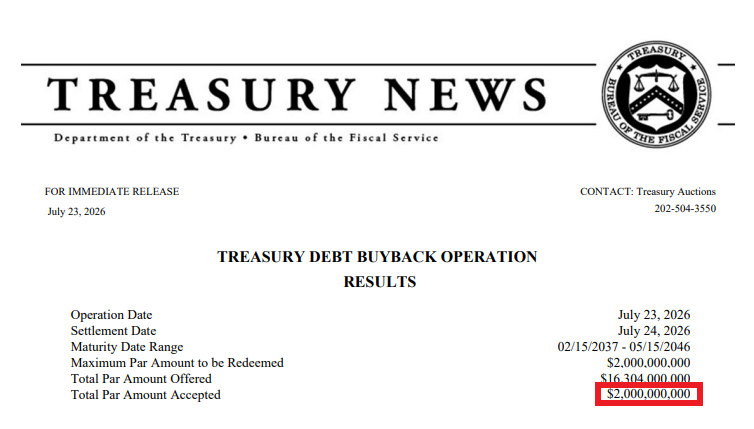
🚨 The U.S. Treasury just repurchased $2 billion of its own debt.
99% of investors have no idea what this means or why they did this.
Here’s what that actually means, and why it matters: 🧵
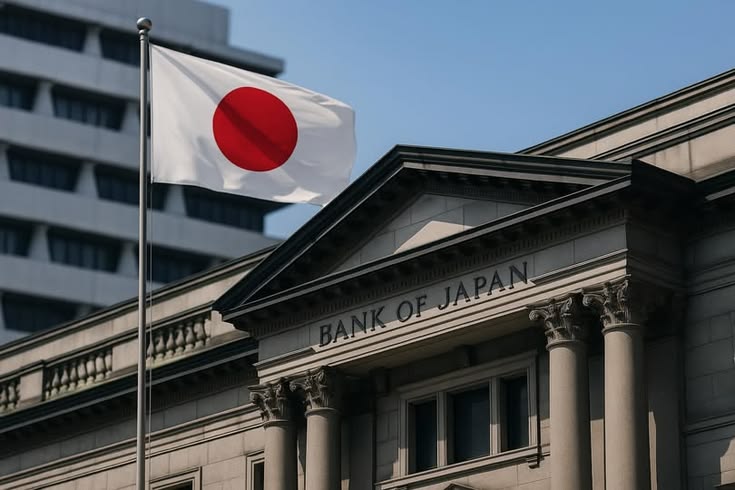
🚨 JAPANESE GOVERNMENT AND BOJ ARE NOW WORKING AGAINST EACH OTHER.
Today Katayama said Japan wants GPIF, its $1.5 trillion public pension fund and the largest in the world, along with other public funds, to increase investment in domestic Japanese assets.
GPIF currently holds close to 50% of its portfolio in foreign stocks and bonds. Even a small shift back toward Japan pulls real money out of US treasuries and US equities and redirects it home.
A fund that size moving even a few percentage points can move global bond markets on its own.
Japan's PPI just came in at 7.1% year over year, above the 6.8% forecast and up from 6.3% the month before. This data just came in today. Inflation accelerating and a major pension fund preparing to buy more domestic bonds should both push Japanese yields higher.
Instead, the 10-year JGB fell 10 basis points to 2.775%, and the 20-year fell 10 basis points to 3.765%.
This comes only months after Japan's actual bond crisis in January 2026, when the 40-year JGB yield broke above 4% for the first time, driven by fiscal expansion promises from the government during an election cycle.
That crash is the reason yields are still this sensitive to every new signal out of Tokyo.
Underneath all of it, the BOJ has been shrinking its own balance sheet, down roughly $502 billion from its 2024 peak, now near $4.33 trillion, as it pulls back from the bond buying that kept yields artificially low for over a decade.
Less BOJ buying means the market has to absorb more JGB supply on its own, right as the government plans to issue more debt.
That is where the new tax plan fits in.
Japan is planning to cut its food consumption tax from 8% to 1% starting April 2027. The remaining 1%, close to ¥600 billion a year, gets redistributed as direct cash payments to lower income households.
A bigger tax credit system is scheduled for 2029, with parts possibly moving up to autumn 2027. Every one of those steps means more government spending funded by more bond issuance, landing at the exact moment the BOJ is stepping back from being the buyer of last resort.
Rate hikes are supposed to slow the economy and support the yen. Tax cuts and cash handouts speed it back up.
The BOJ has rates projected near 1.5% by 2027, the highest in decades, while the government spends more, at the same time the central bank is buying fewer bonds than it has in years.
The yen carry trade, where global funds borrow cheap yen to buy higher yielding assets abroad, is still estimated at $4 to $8 trillion.
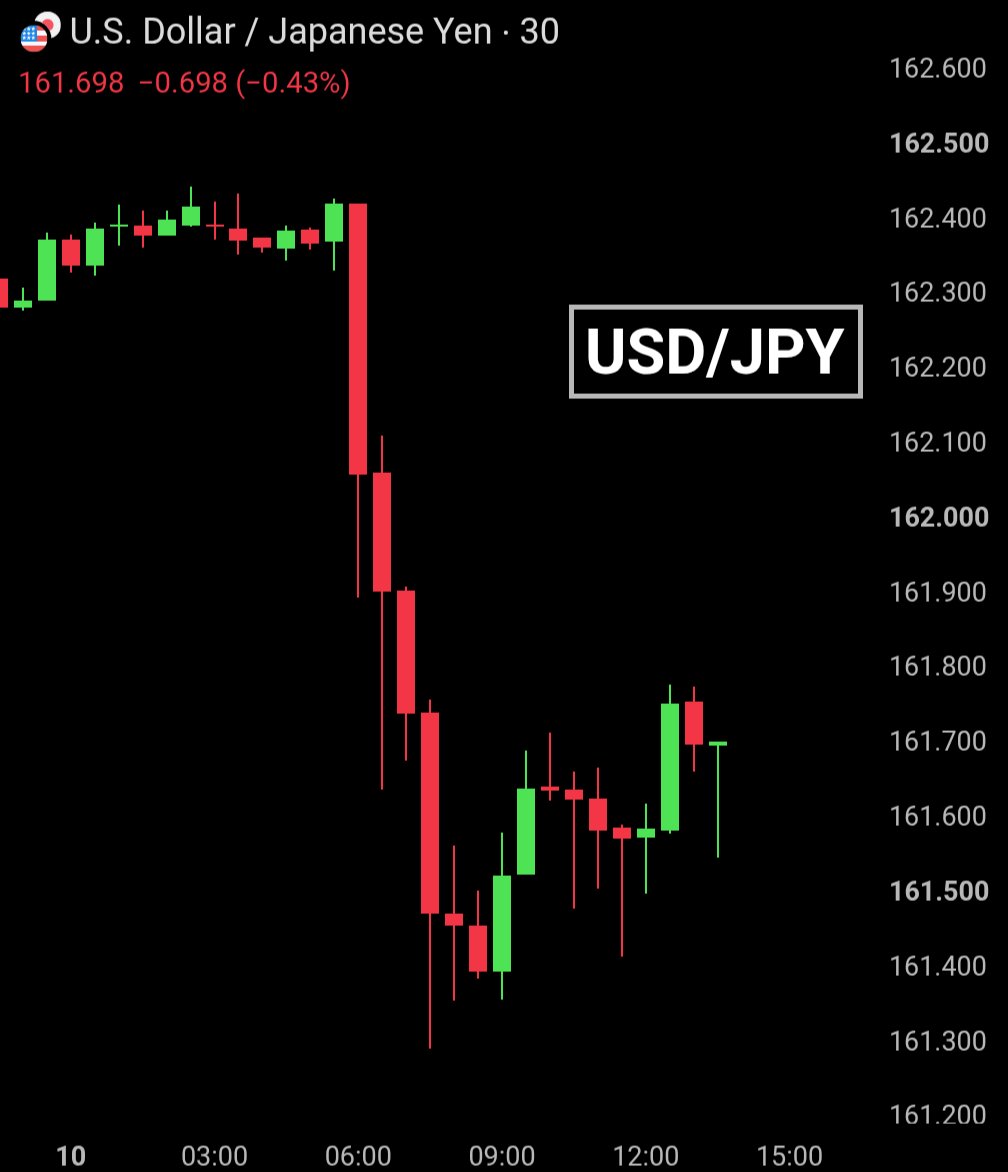
Japan spent $72 to $73 billion defending the yen earlier this year, and USD/JPY still hit 162, a 40-year high.
In August 2024, a BOJ hike of just 0.15% triggered a rapid carry unwind.
The Nikkei fell over 12% in a single session, and Bitcoin dropped from around $65,000 to under $50,000 in less than a week, purely from leveraged yen positions getting margin called at once.
Japan is now tightening policy, shrinking its balance sheet, and expanding fiscal spending, all at the same time, this has never happened before.
I think about this every single day.
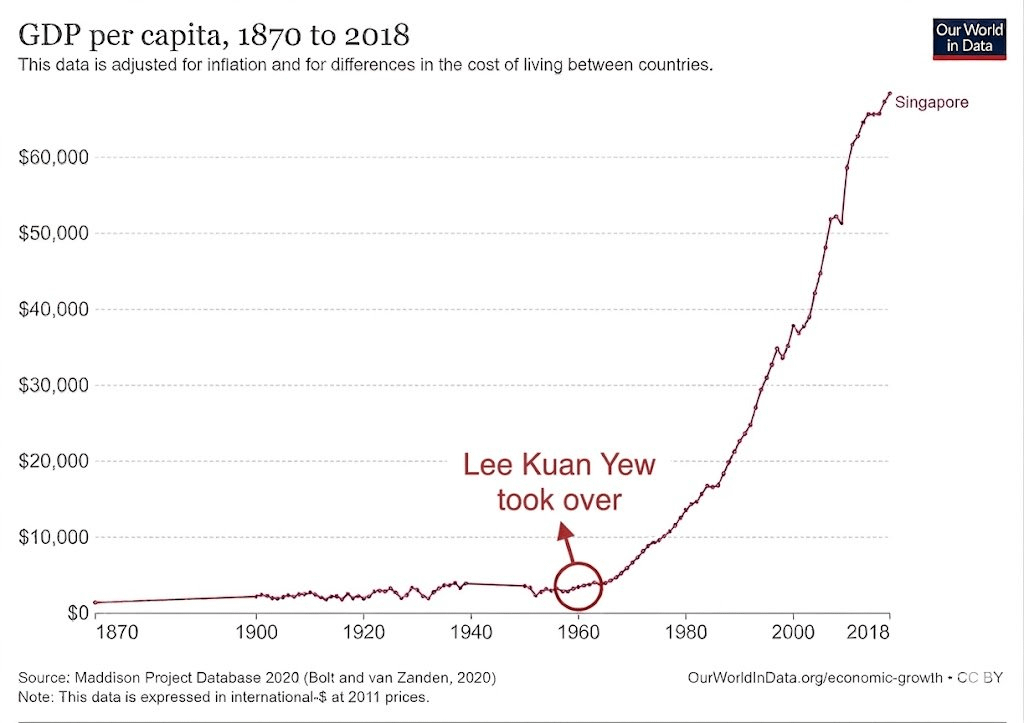
What happened in Singapore should be mandatory study in schools.
It's the single greatest wealth creation in the history of capitalism.
Why Lee Kuan Yew was an absolute genius🧵
I recently spent a month in Asia, including 10 days in China, where I met with senior policy makers in several countries, and I found that over the past few months, there has been a big shift in the world order. I share my perspective in my latest article.
As always, I welcome your questions and thoughts.
10 books recommended by Naval Ravikant:
1) The Lessons of History by Will & Ariel Durant
"Concise and well written, summarizes the long arc of history with poetic insights."
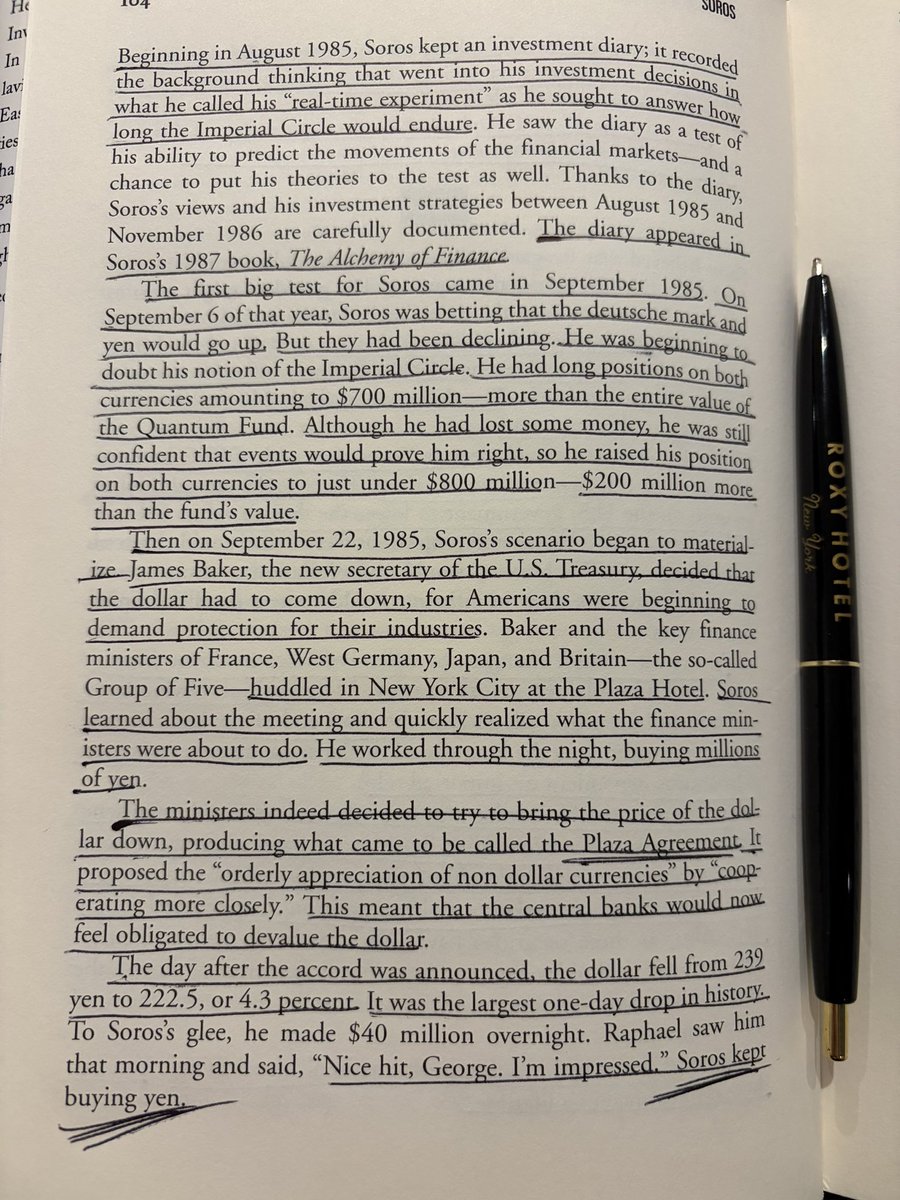
Then on September 22, 1985, Soros's scenario began to materialize. James Baker, the new secretary of the US Treasury, decided that
the dollar had to come down, for Americans were beginning to demand protection for their industries. Baker and the key finance ministers of France, West Germany, Japan, and Britain—the so-called Group of Five—huddled in New York City at the Plaza Hotel. Soros Learned about the meeting and quickly realized what the finance ministers were about to do. He worked through the night, buying millions of yen.
The ministers indeed decided to try to bring the price of the dollar down, producing what came to be called the Plaza Agreement. It proposed the "orderly appreciation of non dollar currencies" by "cooperating more closely." This meant that the central banks would now feel obligated to devalue the dollar.
The day after the accord was announced, the dollar fell from 239 yen to 222.5, or 4.3 percent. It was the largest one-day drop in history. To Soros's glee, he made $40 million overnight. Raphael saw him that morning and said, "Nice hit, George. I'm impressed." Soros kept buying yen.
Soros: The World's Most Influential Investor - Robert Slater
Then there was the vaunted Soros self-confidence.
When Soros believed he was right about an investment, nothing could stop him. No investment position was too large. Holding back was for wimps. The worst error in Soros's book was not being too bold, but too conservative. "Why so little?" was one of his favorite questions.
Soros: The World's Most Influential Investor - Robert Slater
A British biologist looked at 200,000 years of human history and found that the entire reason humans broke out of poverty was not intelligence, not language, not even agriculture, but one mechanism so simple a 6-year-old could explain it.
His name is Matt Ridley.
He is a zoologist by training, an evolutionary biologist by career, and in 2010 he wrote a book called The Rational Optimist that quietly argued the most important fact about human progress had been hiding in plain sight for the entire history of economics.
Naval Ravikant has been telling people to read everything Ridley has ever written for the last 15 years. The reason is the argument inside this one book.
For 200,000 years, anatomically modern humans walked around with the same brain you have right now. Same skull size. Same neural architecture. Same raw capacity for language, planning, and abstract thought.
For roughly 190,000 of those years, almost nothing happened. Generation after generation lived and died inside the same Stone Age toolkit their great-great-grandparents had used. Then somewhere around 50,000 years ago, the line on the chart of human progress started to tick upward. Then it bent. Then it exploded.
The question Ridley spent years on was the only question that mattered. What changed.
It was not the brain. The brain had been the same for 190,000 years. It was not language, which had existed long before the takeoff. It was not even agriculture, which arrived only 10,000 years ago and was actually preceded by the upward bend, not the cause of it.
What changed was that humans started trading with strangers.
This sounds too small to be the answer. Ridley argues that it is the answer to almost everything. The moment one human exchanged a useful object with another human from a different group, something happened that no other species on earth had ever done.
Two ideas that had developed in isolation came into contact. The flint knapper learned what the spear maker had figured out. The fisherman from the coast learned what the hunter from the forest had figured out. The two pieces of knowledge fused into something neither side could have produced alone.
Ridley calls this ideas having sex. The phrase sounds frivolous and it is meant to. The point is that ideas, like genes, get better when they combine with other ideas from different lineages.
An idea sitting inside one head, no matter how brilliant the head, eventually hits a ceiling. The same idea exposed to ten thousand other ideas does something genes do under sexual reproduction. It mixes. It recombines. It produces offspring nobody planned.
The cleanest proof of this argument is the most uncomfortable case study in the book. Tasmania.
Around 10,000 years ago, rising sea levels cut Tasmania off from mainland Australia. A population of roughly 4,000 humans was now isolated on an island, with no possibility of contact with the rest of humanity. They had the same brains. The same language. The same starting toolkit as their cousins 150 kilometers north. The natural experiment was now running.
What happened next is something no economist or geneticist had ever predicted.
The mainland Australians kept inventing. Boomerangs. Spear-throwers. Fishing nets. Bone needles for sewing fitted clothes. Watercraft with paddles. Their technology compounded slowly across the centuries.
The Tasmanians went the other way. They did not just fail to invent the new tools their cousins were developing. They started losing the tools they already had. Fishing was abandoned within a few thousand years. Bone tools disappeared. Fitted clothing disappeared. They forgot how to make fire from scratch and started carrying lit firebrands from camp to camp instead, relighting their fires from a neighbor's whenever their own went out.
By the time European explorers arrived in the 17th century, the Tasmanians had the simplest toolkit of any human society ever recorded. Their material culture had gone backward for 8,000 years.
The archaeologist Rhys Jones called it a slow strangulation of the mind.
Joseph Henrich at Harvard later proved with formal mathematical models that there was nothing wrong with Tasmanian brains. There was something wrong with their network. A toolkit requires a critical mass of people exchanging skills to maintain itself.
The act of teaching a skill is imperfect. Every generation loses a small percentage of what the last generation knew. If your population is large enough and trading widely enough, those losses get caught and corrected by someone else who still remembers.
If your population shrinks below a certain threshold and stops mixing with outsiders, the small losses compound until entire technologies disappear.
This is the part that should haunt anyone reading this in 2026.
Intelligence is not a property of the individual brain. Intelligence is a property of the network the brain is connected to. A genius in isolation will produce less than a mediocre thinker inside a dense exchange of other mediocre thinkers.
The thing your ancestors needed in order to break out of 190,000 years of stagnation was not better brains. It was better connections between brains they already had.
The implication for any individual is direct and uncomfortable. If you are smart and isolated, you will be outproduced by people half as smart who are connected.
The most successful people in any field are almost never the smartest people in it. They are the ones positioned at the intersection of the most idea flows. They are reading more authors than their competitors. They are talking to more people from more disciplines. They are in the rooms where ideas from different lineages bump into each other.
Ridley ends the book on the line that sounds optimistic but is actually a warning its this "The future will be invented by people who connect ideas, not by people who guard them."
10 books to understand how money works:
1) The Ascent of Money: A Financial History of the World
narrative of how money, credit, and finance shaped civilizations: from ancient bonds to modern bubbles.
Naval Ravikant never ran a hedge fund
He never managed billions
But Warren Buffett, Ray Dalio, and Sam Altman all read the same books he recommends
He reads 1 to 2 hours every day. He says that alone accounts for any material success he's had in his life
Here are his most recommended books 🧵