In this era of artificial intelligence, it is becoming urgent to distinguish human art from what machines produce. There is an ontological difference, even before an aesthetic one, between art and what a machine can generate through statistical calculation based on millions of images created by others. Algorithms lack the spark of humanity. For this reason, the Church wishes to renew an alliance with artists and cultural institutions to safeguard our humanity.
Third question on AI.
A question that also remains unasked is whether the AI boom can continue without leading to a massive increase in inequality.
A recent paper by Stijn Van Nieuwerburgh runs the numbers on how much revenue the AI industry needs to generate to recover its massive investment (summary and a link to the paper can be found here: https://t.co/QIGcoObcVc).
Van Nieuwerburgh’s arithmetic should make us more concerned. AI investments will average about 3.6% of GDP annually between 2025 and 2032. Van Nieuwerburgh calculates that, using a 10% rate of return, the industry would need to generate annual revenues of about $3.7 trillion by 2032 to recover these costs (growing from its current levels of about $200 billion or so). That is significantly more than 10% of current US national income, and will likely remain around 10% of national income by 2032, even if GDP growth rose from its current level.
A large fraction of this revenue will go to capital income. That means a massive increase in the share of capital in national income, which has already risen substantially over the last 25 years or so – now standing at an all-time high of about 47% (https://t.co/IuYldl173r).
Capital income is much more unequally distributed than labor income, so a massive increase in the capital share of national income will translate into a very sizable surge in inequality.
The rise in inequality may not stop with the capital share. My work with Pascual Restrepo documents that (automation-driven) increases in the capital share of national income are typically associated with rising labor income inequality as well (see, for example, https://t.co/2D9KUL3QfM). The same may happen in the next several years, boosting inequality further.
What is missing from our current debate is any discussion of a fundamental dilemma these numbers pose: can the AI boom avoid both an economically costly crash and a huge increase in inequality?
If the industry reaches these revenues, inequality surges. If the industry does not become profitable, a crash, with substantial costs in terms of lost output and jobs, becomes likely.
My assessment would be that the industry is unlikely to reach levels of revenue Van Nieuwerburgh calculates. First, diffusion has been and will likely continue to be slow. Second, competition from open-weight models, which are getting better, will limit how much proprietary models can charge. Third, despite important advances, I still believe that AI models will not be able to automate entire occupations anytime soon, thus limiting their value to businesses as cost-saving devices.
Whether this leads to a crash or not is more complicated and will depend on whether various AI companies are bailed out and what kind of support they receive.
Nevertheless, even if revenues fall short of these gargantuan amounts and we avoid a dramatic surge in inequality, I expect that the diffusion of AI will push up inequality between capital and labor and within labor.
If inequality does surge, a further question becomes central: can our democracy survive such astronomical levels of inequality?
My latest memo discusses recent attempts to rein in long-dated government bond yields and why the only sustainable solution is responding to the underlying factors pushing interest rates up, even if politically uncomfortable.
You can read it here: https://t.co/RakxMnFvOY
"Why do people play golf?" Sean Connery was once asked, and he gave a brilliant answer.
"If you play golf, you can’t think, honestly, or do anything else while you’re playing.
"I think it’s the most revealing game. I don’t know if it’s a game. It’s something other than a game. I couldn’t define it.
"But it’s obsessive and revealing and a very healthy balancing act, I think. It certainly is for me, and also it’s one of the few games in the world that’s really still got dignity as a game.
"It’s endless, and as Jack Nicklaus says, it’s an unfair game and you have to accept it. It’s like life in that way.
"It’s also a game that you can cheat it. It’s the easiest game in the world to cheat at. The only one that suffers is you, because you know. And you can’t unknow."
WORRYING TRENDS IN PISA SCORES
The latest PISA (Programme for International Student Assessment) results are out.
PISA is a landmark program and the most comprehensive assessment of students across the word and its results provide invaluable information about the trends and performance of national education systems.
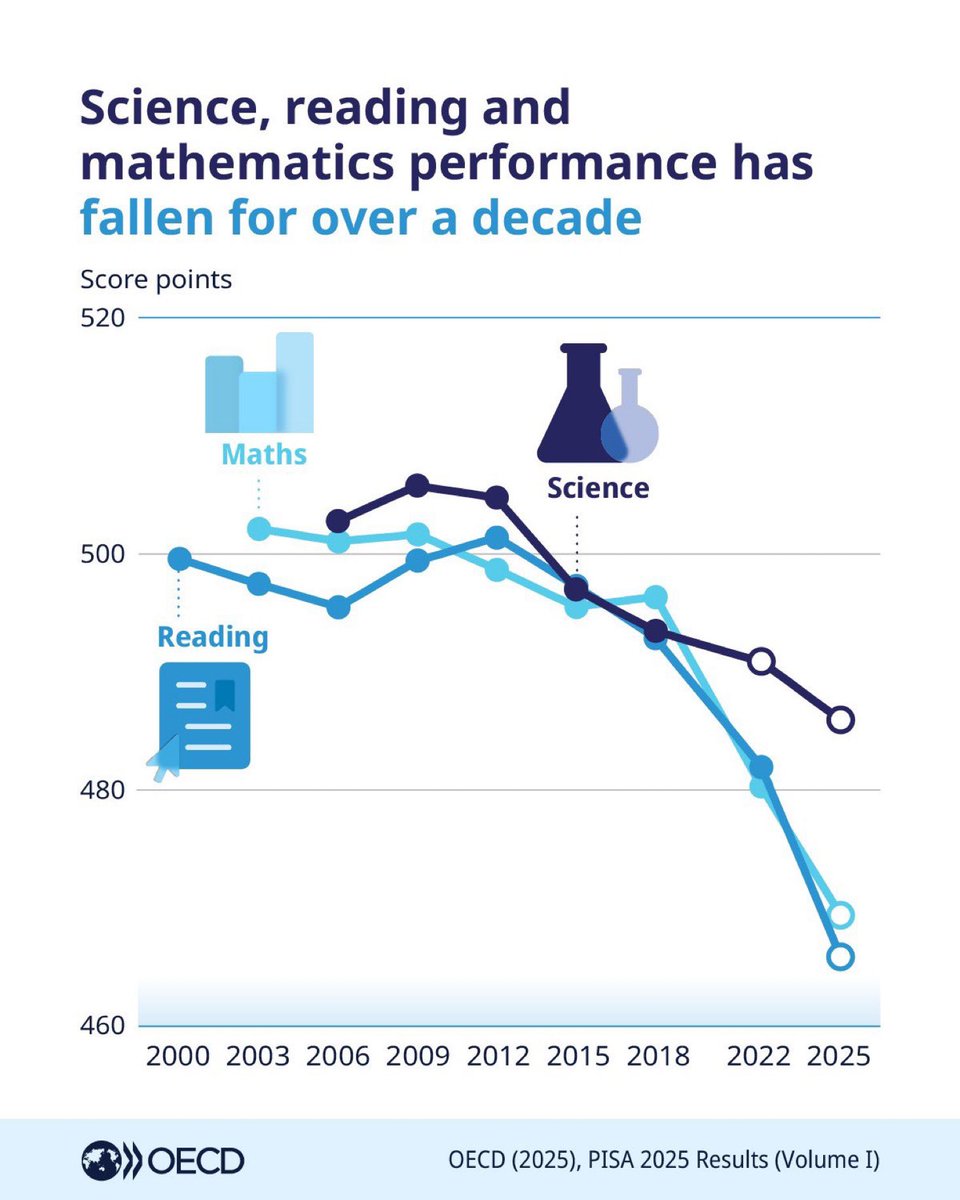
The latest global results are not very encouraging: after the steep decline in student performance in 2022, which took place during the pandemic, there is yet another large decline in scores in most countries (see the graphs below).
The largest decline in performance occurred in Reading. Perhaps not too surprising, given that “digital distractions” became all pervasive.
As Andreas Schleicher (director of the OECD Education directorate) mentions: “A large share of students struggled on reading tasks involving longer texts, requiring higher-order cognitive skills… At the same time, all students are more likely to “read in haste”, at least some of the time.”
Remember: these trends are happening for several years, preceded the pandemic, and, of course, the advent and diffusion of Artificial Intelligence.
If nothing is done, AI will likely reinforce these trends, even though students might obtain better results when they can use AI tools in their exams.
These are trends that should worry us all and are a call for action for policymakers. The next few years will be crucial to revert these worrying trends.
@OECD@OECDEduSkills@SchleicherOECD
The AI Singularity
The argument goes like this:
1. Humans build an AGI.
2. The AGI becomes good at AI research.
3. It designs a smarter AI.
4. That smarter AI designs an even smarter AI.
5. The cycle repeats faster and faster.
Looking at the results and capabilities from the various labs over the past few weeks I would say we are firmly in this loop now.
The next 18months will be wild.
Recursive self improvement will dramatically increase capability very quickly from here.
Marginal costs of all models will go to ~$0.
The 2026 World Humanoid Robot Games have begun. 666 teams from around the world are competing with more than 2,000 humanoid robots https://t.co/8GwBuNnNn1 https://t.co/KMF1kkBiI6
Let me walk you through the events of the war so far:
1. The United States and Israel tried regime change; it didn’t work. Or rather, they got regime change—Iran became an Islamic Revolutionary Guard Corps–led military dictatorship. That was not an improvement.
2. The U.S. won an overwhelming military victory with air and naval power and scarcely a boot on the ground. But it destroyed less of Iran’s missile- and drone-launching capabilities than at first appeared.
3. Then there was a hostage crisis. Iran took both the Gulfies and the Strait of Hormuz hostage. The result was a massive economic shock for the world that required a rapid resolution.
4. The choice was between 1) military escalation (boots on the ground or strikes on Iranian infrastructure), and 2) a diplomatic deal. Trump chose 2.
5. In Islamabad, the U.S proposed big economic concessions in return for some kind of change in the status of Iran’s enriched uranium stockpile, as well as the reopening of the strait. Contrary to the president’s social media feed, the Iranians did not accept.
6. In any case, the devil of any deal will be in the details, not the Truth headline. (When the small print finally comes out, every former Obama and Biden official will be ready to tell The New York Times that it’s worse than the 2015 Joint Comprehensive Plan of Action.)
7. Meanwhile, the Iranians have survived regime change and discovered that closing the strait is just as powerful a lever in economic warfare as they had always hoped. It’s not, despite the Russian quip, an “economic nuke,” because unlike a nuclear weapon you can use it.
8. Where we go from here is fairly predictable. I would be surprised if Trump now deploys ground forces. There will be more negotiation, so Islamabad, here we come. There may have to be more bombing, if the Iranians dust down the North Vietnamese playbook of stringing the U.S. negotiators along. And the final compromise will take longer to be agreed upon than Mr. Market currently believes. The consensus in prediction markets is this will be over by the end of May, but remember: It took Henry Kissinger more than four months to get the 1973–1974 oil embargo lifted.
"I can offer three possible explanations:
1. Mr. Market is seeing through all the noise and realizing that the war will be over by the end of May, and normal service will be restored.
2. Mr. Market loves AI more than he hates the closure of the Strait of Hormuz.
3. Mr. Market is as clueless as he was in July 1914, September 1929, December 1972, August 2000, October 2007, and February 2020—all months when stocks reached highs shortly before reality struck devastating blows."
MESSAGE
I wholeheartedly endorse the powerful appeal for peace made by the Holy Father, Pope Leo, during his Palm Sunday Mass. His call for the laying down of arms and the renunciation of violence resonated profoundly with me, as it speaks to the very essence of what all major religions teach.
Indeed, whether we look to Christianity, Buddhism, Islam, Hinduism, Judaism or any of the world's great spiritual traditions, the message is fundamentally the same: love, compassion, tolerance, and self-discipline. Violence finds no true home in any of these teachings. History has shown us time and again that violence only begets more violence and is never a lasting foundation for peace.
An enduring resolution to conflict, including the ones we see in the Middle East or between Russia and Ukraine, must be rooted in dialogue, diplomacy and mutual respect — approached with the understanding that, at the deepest level, we are all brothers and sisters.
I urge for and pray that the violence and conflicts may soon come to an end.
DALAI LAMA
31 March 2026
“Oh my god… I have no words.”
Listen to the emotional moment this year’s laureate Maria Corina Machado finds out she has been awarded the Nobel Peace Prize.
Kristian Berg Harpviken, Director of the Norwegian Nobel Institute, shared the news with her directly before it was announced to the world.
#NobelPrize #NobelPeacePrize
Este inmenso reconocimiento a la lucha de todos los venezolanos es un impulso para concluir nuestra tarea: conquistar la Libertad.
Estamos en el umbral de la victoria y hoy más que nunca contamos con el Presidente Trump, el pueblo de los Estados Unidos, los pueblos de América Latina y las naciones democráticas del mundo como nuestros principales aliados para lograr la Libertad y la democracia.
Venezuela será libre!
Dreams are made of occasions like this. Times when you stand shoulder to shoulder like a true team and win together.
@LukeDonald led like he did in Rome but with more armour, power, knowledge and experience. He deserves all the credit, we were just the pieces on a chess board.
It’s an honour to receive the Nicklaus/Jacklin award and bringing 4 points home to the team but to be honest I’d do anything for this group of incredibly special human beings!! Love this Team, and always will!!! My heart is 💙💙💙💙 @RyderCupEurope
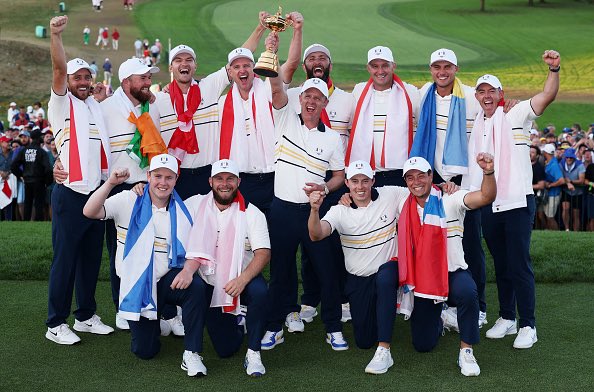
It has been an unbelievable privilege to Captain these 12 men again. We set out to create history in New York and to become only the fifth European team to win in America. We achieved that. Keegan and the US team deserve huge credit for how they played on Sunday. We knew they would be formidable opponents and they were. That’s what makes our achievement even more special. Incredibly proud to say 47 Europeans have now won the Ryder Cup in America. This is a victory for everyone involved in Team Europe. #OurTimeOurPlace
I’d like to congratulate @RyderCupEurope on their victory. Your team play the first few days was sensational.
More importantly, I’d like to apologize for the rude and mean-spirited behavior from our American crowd at Bethpage.
As a former player, Captain and as an American, I am ashamed of what happened. #RyderCup