Forterra CEO, Josh Araujo, joined Colin Demarest at the @axios Future of Defense Summit to discuss ground autonomy and the decisions that will determine how quickly it reaches the force.
In March 2025, Forterra was awarded the @USArmy's first-ever prime contract to deploy autonomous land systems to combat. Six months later, we delivered 105 vehicles to Ukraine to support resupply and casualty evacuation missions under fire.
Industry’s responsibility continues after delivery: sustaining those vehicles and maintaining the capacity to replace losses and meet growing demand. Government has to back proven technology with the multiyear purchasing certainty that traditional platforms receive. That commitment gives companies the confidence to expand production before a conflict forces the issue.
Production capacity takes time to build. Procurement that stops at experimentation cannot deliver at wartime scale.
Lancer continues to log miles and complete critical missions in Ukraine, showing why reliability matters as much as capability.
Tests and demonstrations show what a system can do. The harder question is whether it can keep delivering in harsh conditions, without support, and amid constantly changing variables.
That answer comes in the field, where reliability is earned through consistent performance—mile after mile, mission after mission.
It all comes back to providing soldiers with the reliable autonomous capabilities that matter most to their mission and the confidence that those capabilities will deliver.
This Veterans Day, we honor those who have served our country by supporting their well-being long after their service ends. Our work with Higher Ground and America’s Warrior Partnership puts that commitment into action.
@HigherGroundUSA helps veterans living with disabilities reclaim independence and confidence through therapeutic recreation. Shared outdoor experiences offer new challenges, lasting friendships, and a renewed sense of freedom.
@AWPartnership connects veterans and their families with resources for housing, employment, healthcare, and other needs. Its community-based approach helps people find support before challenges become a crisis.
Every veteran deserves lasting support, and Forterra is committed to strengthening the communities that provide it.
Forterra’s autonomy is already in production for the U.S. military.
Our AutoDrive system powers autonomous mobility on Oshkosh Defense's ROGUE-Fires, the unmanned carrier at the heart of NMESIS. The Marine Corps’ latest launcher production agreement and establishment of its first medium missile battalion mark the program’s continued growth.
Delivering autonomous mission systems requires close integration between autonomy and the vehicles that carry it, backed by the manufacturing expertise to support the force at scale. Our work with Oshkosh Defense and the broader NMESIS team puts that approach into practice.
https://t.co/VDFvCb0r1A
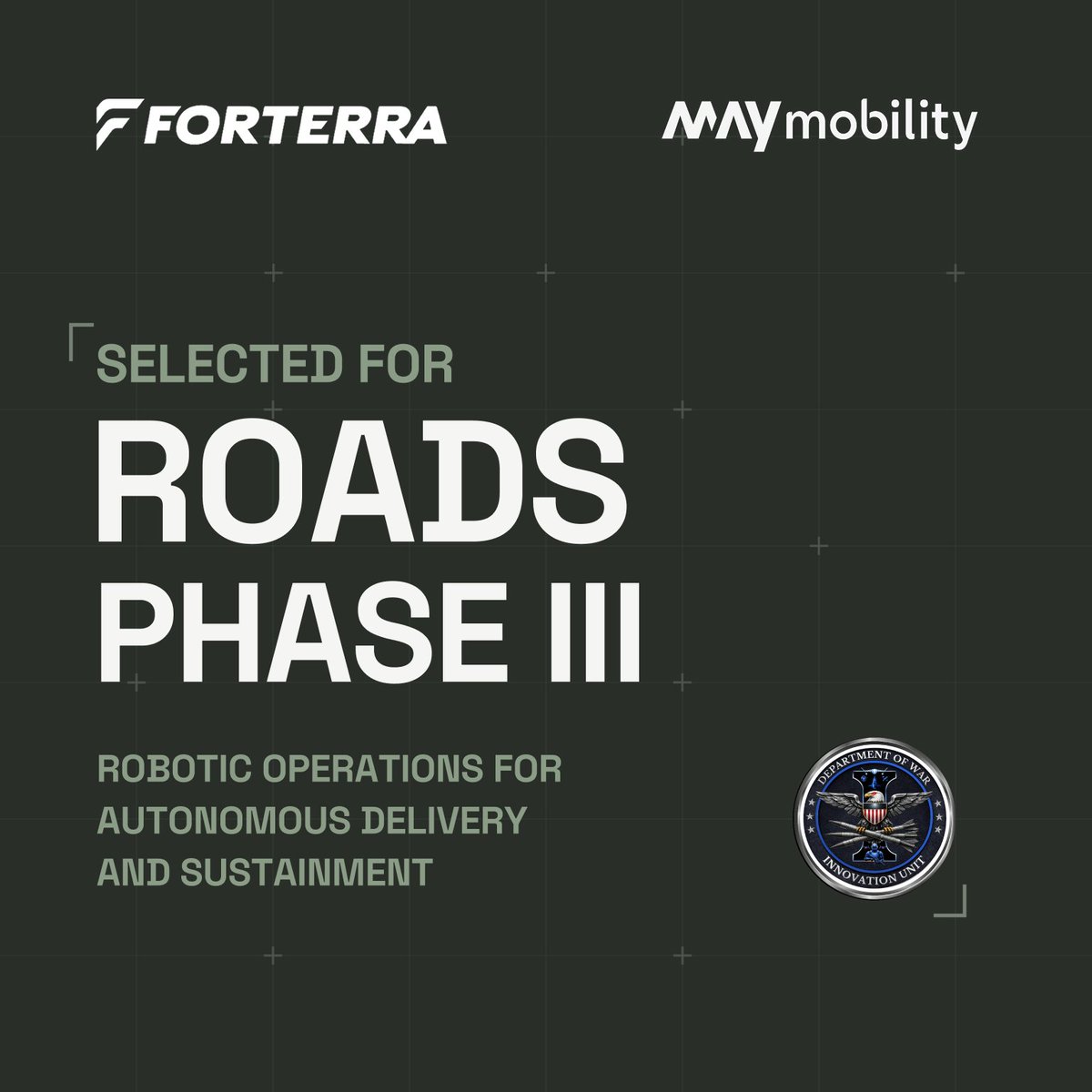
Forterra and @May_Mobility are advancing to Phase III of the @DIU_x's Robotic Operations for Autonomous Delivery and Sustainment (ROADS) challenge, working toward autonomous rides for soldiers at Army bases.
Forterra will operate and test an autonomous passenger service through OneLink, evaluating how autonomy can reduce the personnel and resources tied up in routine trips across post. May Mobility will provide the passenger vehicles, equipped with its autonomous driving system.
Read the full announcement: https://t.co/7MzmjhZCvU
Every new defense system promises an operational advantage, yet delivering it often depends on custom integrations that put vendors in control of how quickly the force can adopt, upgrade, and replace technology.
“MOSA compliant” doesn’t eliminate that dependency. The government can own its data and still rely on a vendor to access and use it.
Our latest blog makes the case for a Mission Data Commons: data that stays available, usable, and under the mission owner’s control as systems and vendors change. That control gives the force the freedom to modernize without starting over.
Read our perspective on MOSA 2.0: https://t.co/0J1Z0Wdbwv
There’s a lot of work behind every mile driven autonomously. For AutoDrive, that work starts with high-quality data that helps our systems interpret and navigate the environments where warfighters operate.
Our partners at @encord_team went behind the scenes with Forterra to explore the data and development work that goes into putting autonomy in the field.
Forterra has been named to @a16z's 2026 American Dynamism 50, recognizing companies strengthening America’s industrial base. This year’s theme, “Production is Deterrence,” speaks directly to our work: delivering autonomous mission systems at the speed and scale warfighters need.
As a16z highlights, we produced and delivered 105 Lancer vehicles to Ukraine in less than six months. Those vehicles are moving supplies and supporting casualty evacuations along dangerous routes, putting autonomy to work where reducing human exposure matters most.
Scaling that impact means connecting proven autonomy with the manufacturing capacity to get it into the field. That is how we help turn American industrial strength into operational advantage.
https://t.co/V48V9nam6Q
Forterra’s Lancer autonomous ground vehicles have completed 1,426 casualty evacuation and resupply missions in Ukraine, with Ouster Rev7 OS1 digital lidar at the core of their perception stack. Forterra built and delivered 105 Lancers in under six months.
Across more than 7,300 miles, each vehicle carries up to 750 kilograms of supplies through high-danger zones where persistent drone surveillance makes crewed vehicles targets. Each OS1 gives the vehicle 360-degree awareness that would otherwise take several narrow-field sensors, and its range holds in dust, rain, fog, and darkness. Forterra plans to bring Rev8 native color lidar to its next-generation AutoDrive vehicles.
“Forterra exists to take people out of harm’s way, and in Ukraine, Lancer is doing that every day under constant drone surveillance.” - Josh Araujo, CEO of @ForterraDefense
Read the full announcement: https://t.co/gUUirNmEBG
Ukrainian forces have carried out 1,500+ missions with Forterra's Lancer, moving ammunition and supplies to the front lines. The vehicles have also supported over 88 medical evacuations, helping reduce warfighter exposure on dangerous routes.
@DefenseDaily spoke with Forterra's VP of Defense, Patrick Acox, about the battlefield results driving demand for more Lancer UGVs. Read the full story: https://t.co/5cjuOioGom
Forterra’s OneLink brings autonomous systems and mission tools into a single operator workspace, working alongside the command and control tools already in use.
OneLink is part of OASIS, our family of products for integrating, operating, and validating mission systems and complex robotic swarms. Fabric establishes a persistent shared mission data environment even as networks degrade. OneLink puts that shared data to work for operators. VIE enables rapid testing and validation in a virtual “operational surrogate” before systems reach the field.
Together, they give warfighters the freedom to rapidly introduce, adapt, and employ new capabilities into the mission, without rebuilding integrations, adding license fees, or forcing vendor lock-in.
Forterra has been named AUSA’s 2026 Top National Partner feature award winner. It’s a meaningful close to a week of demonstrating fielded autonomy and showing how vehicles, mission systems, and partner technologies can work together to give warfighters more options.
We appreciate @AUSAorg for this recognition and for bringing the industry together around the operational challenges that matter. We stand alongside AUSA in support of the warfighter, and our focus remains on delivering autonomy that extends their reach, reduces exposure, and strengthens deterrence.
I'm proud to be partnering with @ForterraDefense!
Forterra builds autonomous ground systems. Its autonomous driving system, AutoDrive, now runs on data produced in @encord_team.
Excited to be working together 🤝
Forterra’s autonomous vehicles are supporting operations in Ukraine, and lessons from those deployments are shaping the technology coming to @USArmy training. @NewsNation's exclusive report examines that connection and what it means for the warfighter.
The measure of success is whether a warfighter under pressure can plan a mission with the tools in front of them, without waiting on higher headquarters. That is where the technology has to deliver: in the decisions made closest to the fight.
Read the full story: https://t.co/hxkEXVLt7f
Forterra debuts OASIS-OneLink at AUSA with an open approach to mission integration: connect capabilities across vendors, keep existing command tools, and bring autonomous systems into one operator workspace.
Built on OASIS-Fabric, OneLink lets operators add or swap capabilities without starting integration from scratch. With offline support, they also retain access to mission information even when networks are degraded or denied.
See OneLink at booth #461.
https://t.co/T9Xh6dqHCs
Stop by Booth #461 in Hall A at AUSA to see the Razorback platform up close.
AUSA October 12-14.
Hall A Inside
Forterra's Booth #461.
#ausa#UGV#DefenseTech#forterra#AUSA2026