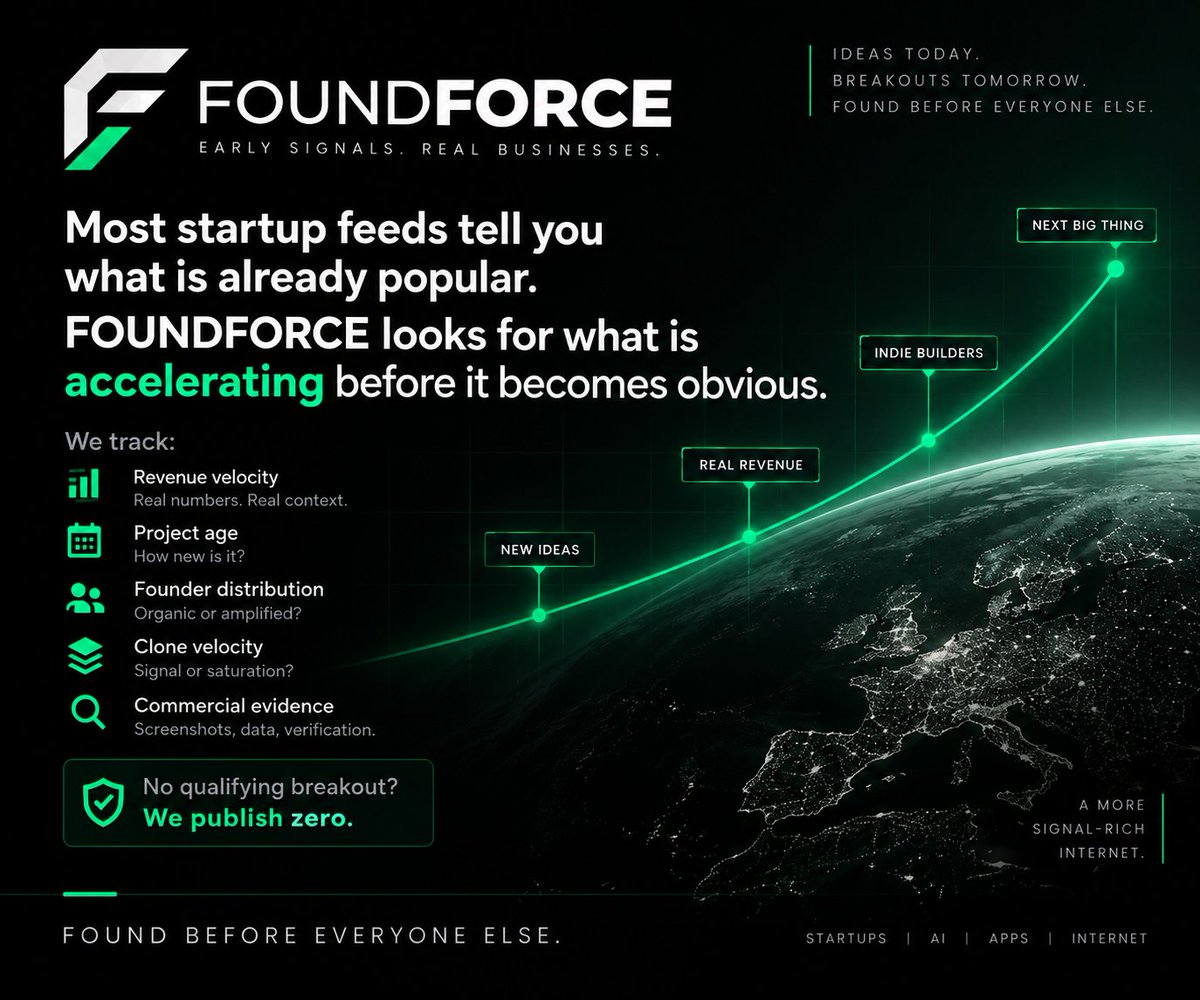
Most startup feeds show what’s already popular.
FOUNDFORCE finds what’s accelerating early.
We track:
• revenue velocity
• project age
• founder distribution
• clone velocity
• real evidence
No breakout? We publish zero.
Found before everyone else.
@spicermatthews@HarborMyNotes Harbor’s written price cap is the part we flagged — 3 years frozen, then 10% max. Most notes apps never put that in writing.
When people actually switch, is it the cap, the Evernote import, or the API/CLI/MCP?
Minicart
You make the product. But who builds the store, writes the listings, creates promotions and handles orders?
Minicart lets makers and sellers create an online storefront from a product photo, then manage it by chatting with an AI team.
Sloane builds the storefront and manages listings and payments.
Milo drafts marketing content and promotions.
Logan helps with orders, shipping, inventory and customer replies.
You can also import an existing catalog from Etsy, Shopify or eBay. Store changes and drafted replies remain subject to your approval.
Co-founders: Chris Nguyen & Lee Liu
🌐 https://t.co/4F7rtg328j
💬 https://t.co/HSTWmdmpTJ
Which part of running an online store would you hand to an AI teammate?
4 products worth a closer look this week. 👀
An AI research API. A notes app with a written price promise. A new take on Meetup. An AI team for your online store.
Meet the builders behind Answers, Harbor, Radius & Minicart 🧵
Which one would you actually use?
Radius
Want to bring people together without running every meetup through a social-media feed?
Radius helps people discover local groups, events and activities — from running clubs to coding meetups.
Organizers can create recurring events, collect RSVPs, invite members and export group data. Guests can RSVP without creating an account.
There's also a lighter way to meet: post that you're up for a coffee, walk or ride and find others nearby who share the interest.
Builder on Hacker News: radius89
🌐 https://t.co/ituPqAgmus
What would make organizing a local community easier for you?
Harbor
What happens when years of notes become expensive to keep — or difficult to move?
Harbor is a private Evernote alternative built around keeping your notes accessible and under your control.
Import notebooks, tags and attachments from Evernote. Search text inside scans and PDFs with OCR. Work offline across devices, export your data and connect your own AI through its API, CLI or MCP server.
Harbor also publishes a pricing commitment: no increase for your first 3 years, then a maximum 10% annual rise.
Built by @spicermatthews
🌐 https://t.co/vG5mNVCrrk
Would data portability or predictable pricing make you switch notes apps?
https://t.co/T2rd2EtMjj
Building an AI agent that needs current web data? The hard part isn't just searching. It's finding relevant pages, extracting facts and returning data your app can actually use.
Answers handles that research through one API endpoint: send a task and a desired JSON format, then receive structured results with source URLs.
Use cases: company research, pricing comparisons and checking product documentation.
Built by @mynameisyahia
🌐 https://t.co/3tgYWDTRrf
What research task would you automate first?
@islamhachimi A dedicated sandbox per client job is a compelling approach to AI operations.
We featured Mycel in today���s FOUNDFORCE Product Discovery.
What’s the first real client workflow you’ve completed end-to-end — from task creation and human approval to invoicing?
An AI agent that doesn't just chat — it runs client work in a sandbox.
Mycel combines isolated task environments, human approvals and invoicing for service firms.
Its Product Hunt launch drew attention on Sep 20. But the key question isn't upvotes — it's whether external customers are completing and paying for real work.
@mycelhq: what's the first end-to-end client workflow you've validated?
We're following what comes next. 🇺🇦
🚀 Ami AI is building beyond automated sales outreach.
Sending more messages isn't the same as creating better sales conversations. Ami aims to help teams identify prospects, shape campaigns, and turn outreach into booked meetings.
We asked co-founder @yz_aisdr where humans still fit into the workflow.
His answer? “Showing up to demos :)”
He added that founders should talk with Ami and make sure they're comfortable with the tone and style of messages sent on their behalf.
That's the part we're watching: not just how much work AI can automate, but how teams retain their voice and learn from real customer conversations.
Our next question: Can feedback from those demos help Ami improve its targeting and messaging for the next campaign?
Congrats to Yuriy and the Ami team on their Astra Challenge launch. We're following what comes next. 🇺🇦
#AmiAI #Startups #SalesAI
Haha, fair point, Yuriy 😄 Even the best AI can't show up to a demo on the founder's behalf — at least not yet!
What caught our attention about Ami is that you're tackling a harder problem than simply automating outreach: deciding who to approach, what to offer, and whether a campaign has a realistic path to booked meetings.
Your point about getting comfortable with Ami's voice is important, too. A founder's tone can be the difference between a relevant conversation and another message that feels automated.
Here's something we'd love to understand: once those demos happen, can Ami use what the team learns — objections, unexpected use cases, reasons a prospect isn't ready — to rethink its targeting and messaging for the next campaign? Or does that feedback still need to be entered manually?
That learning loop would be fascinating to follow, especially for small teams finding their first repeatable sales motion.
Thanks for taking the time to reply, and congrats on the launch! We're following Ami's progress at FOUNDFORCE. 🚀
@yz_aisdr@OpenAI@OpenAIDevs@ProductHunt@Lovable Fair point 😄 So the human role shifts from building each outbound sequence to setting the right tone and actually showing up for the conversations.
Thanks for clarifying, Yuriy! We’re featuring Ami AI in our FOUNDFORCE Astra Challenge coverage.
@RicardoDeZoete@ProductHunt@OpenAIDevs@threejs Thanks for sharing those details, Ricardo! We featured MeshEdit on FOUNDFORCE and highlighted your AI-driven 3D workflow. Looking forward to seeing how the project develops!
🚀 MeshEdit — Create 3D Assets with AI, Not Manual Modeling
Imagine creating 3D models without spending hours manually editing geometry, rigging characters, or preparing animations. Instead, you simply tell an AI agent what you want to build.
That's the idea behind MeshEdit, a browser-based 3D editor developed by @RicardoDeZoete and showcased at the GPT-6 Astra Challenge.
MeshEdit brings 3D modeling, rigging, animation, and GLB export into a single browser-based workflow. Through WebMCP integration, AI agents can interact directly with the editor, allowing creators to build and modify 3D assets using natural-language instructions.
We asked Ricardo which parts of the process still require manual work. His answer:
“No manual work, just prompting!”
For indie game developers and small studios, this approach could significantly accelerate prototyping, character creation, and asset production without the complexity of traditional manual modeling.
MeshEdit is still an emerging project, and public data on adoption or revenue remains limited. But its AI-driven approach to editable 3D creation makes it a project worth watching.
https://t.co/SuDYQrKOQq
What if creating 3D game assets required no manual modeling?
MeshEdit lets Astra model, rig, animate and export editable assets in your browser.
Founder @RicardoDeZoete told us: “no manual work, just prompting!”
Technical signal ≠ proven traction. We're watching.
@brenych_r BDB's approach to agent execution caught our attention: the human approves a specific action, and the system verifies what was executed. How does this workflow handle changes between approval and execution?
@xodud_rkd@ProductHunt Octomus Agent caught our attention during the Astra Challenge. Proactively finding improvements and opening PRs without auto-merging is an interesting workflow. How often do maintainers accept the agent's proposed changes?
@favo@OpenAIDevs@ProductHunt Found TaskChef while scouting the Astra Challenge. A single dashboard for coordinating Codex tasks across projects could simplify multi-agent workflows. What has been the biggest challenge in managing concurrent tasks?
@Shay_Benshabtay Yoetz tackles a real problem with coding agents: knowing whether "done" actually means done. Does it catch cases where an agent completes only part of a task but still reports success?