Citadel Securities just put institutional weight behind what the AI bulls won't say out loud.
In a new macro note titled "Tokenomics," Citadel makes the argument plainly: even the most powerful technology on earth still has to pass through the boring discipline of cost curves, capacity limits, and marginal returns.
The evidence is piling up:
– Amazon removed its token usage leaderboard
– Microsoft cancelled Claude Code subscriptions
– Multiple companies reporting unexpectedly massive token bills
Their conclusion is the part that matters.
Adoption is no longer about what AI can do in principle. It's becoming about the price and scarcity of the inputs needed to run it at scale. Compute. Power. Cooling. Memory bandwidth. Inference budgets. All real, all binding constraints.
And here's the kicker from the chart.
The Silicon Data LLM Token Expenditure Index, a benchmark for how much the market is actually spending on AI tokens, has started rolling over. Citadel reads it as a shift toward cheaper models. Companies substituting away from expensive frontier AI toward "good enough" alternatives.
That's economics 101 doing what it always does. When the price of something rises, people use less of it, or find a cheaper version.
Citadel sees a bifurcation forming. Frontier AI concentrated among a few firms with the balance sheets to absorb the cost. Everyone else quietly downgrading to simpler, cheaper models.
This is the part of every technology revolution the early narrative ignores.
The technology being real was never the question.
The question was always whether the economics could carry the valuations.
When one of the most sophisticated trading firms on earth starts writing about AI in the language of cost curves and rationing instead of limitless demand, the conversation has quietly changed.
The hype was about what AI could do.
The reckoning is about what it costs.
$GME At $23, we’re 100% at the bond like zone, where convertible arbitrage is the most profitable. Desks short GME stock > holding the bond. Volatility scalping is at its highest here. They just farm vol and rebates, low risk steady returns.
Once GME trades far above $28.91, the bond becomes more equity like. There’s less juice to squeeze out of the stock, and the trade becomes less attractive from an arb standpoint.
Think of this table when you want to understand where we’re currently at on the lifecycle of this convertible arb trade.
🪀 @PunterJeff
In 1985, Warren Buffett sat down for his most iconic interview ever.
If you want to understand the psychology of wealth, this is 10 minutes of pure gold.
Save this rare footage, you’ll be coming back to it.
“You don’t need 20 right decisions to get very rich. 4 or 5 will probably do it…” “It’s a terrible mistake to think you have to have an opinion on everything.”
— Warren Buffett
Charlie Munger just gave the ultimate masterclass on wealth creation.
These rules aren't just for investing, they are for life.
Save this video, you'll come back to this.
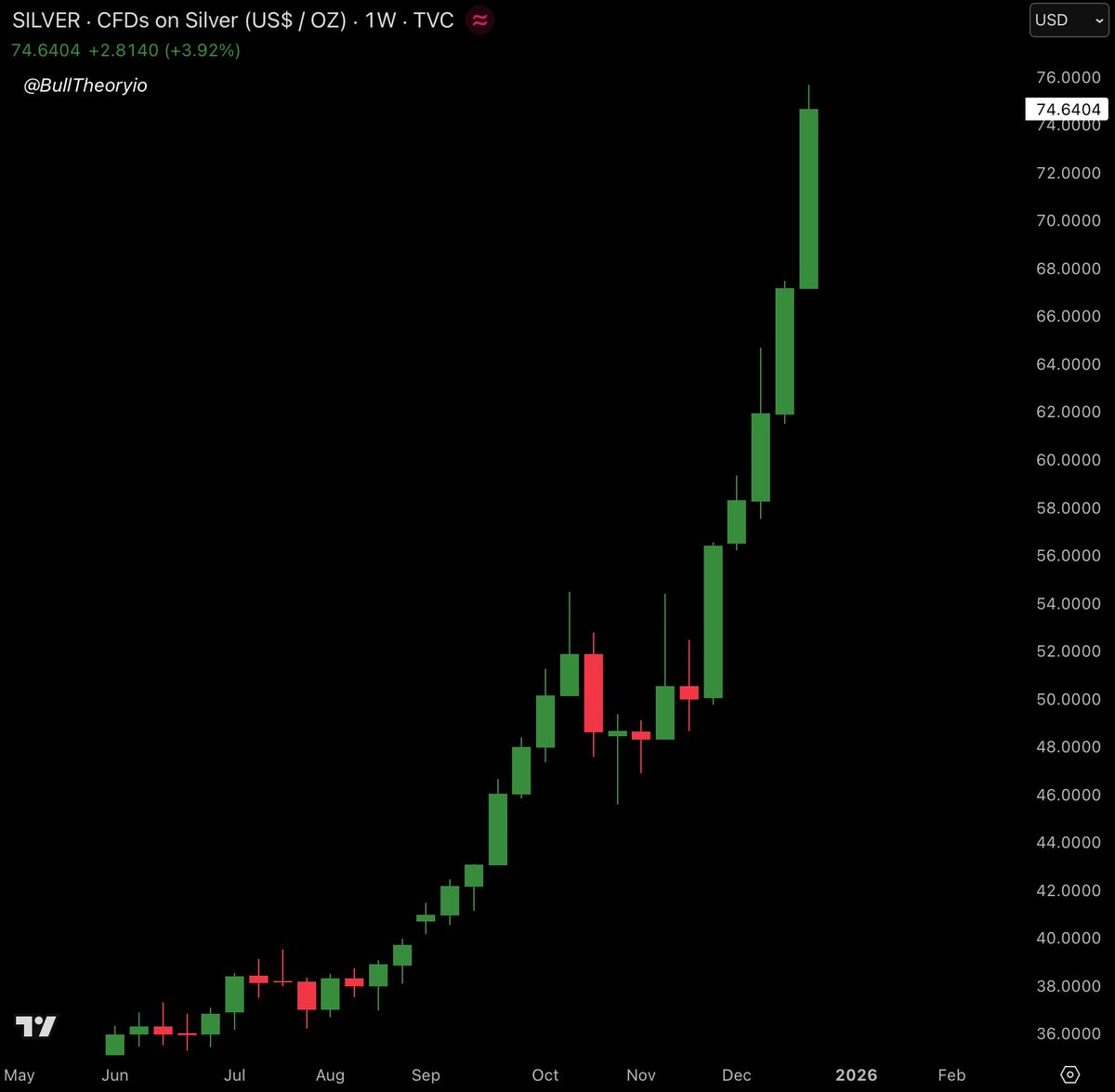
🚨BREAKING: Silver prices are exploding due to a severe global supply shortage.
The physical market can no longer meet soaring demand.
Here is what is actually going on 👇
1. China is changing the rules.
Starting January 1, 2026, China will restrict silver exports.
To export silver, companies will now need government licenses.
Only large, state approved firms qualify:
- At least 80 tonnes of annual production
- Around $30 million in credit lines
This effectively blocks small and mid size exporters.
China controls roughly 60–70% of global silver supply. When China tightens exports, global supply drops immediately.
This is the same tactics China used with rare earth metals.
2. The silver market was already short supply.
Silver has been in a structural deficit for 5 straight years. That means demand is higher than supply every single year.
For 2025:
- Global demand: 1.24 billion ounces
- Global supply: 1.01 billion ounces
That is a gap of 100–250 million ounces. And this gap is expected to get worse after China’s export limits.
Mining supply is not growing:
Silver mining is mostly a by product of copper and zinc mining.
New mines take 10+ years to build, Ore quality is falling, Recycling is not enough to fill the gap.
There is no quick fix here.
3. Physical silver inventories are collapsing.
This is where it gets serious.
- COMEX inventories are down 70% since 2020
- London vaults are down 40%
- Shanghai inventories are at 10-year lows
At current demand, some regions hold only 30-45 days of usable silver.
This is why physical premiums are exploding.
In Shanghai:
- Physical silver trades at $80+/oz
- COMEX prices are much lower
This price gap means buyers are paying extra just to get real silver.
4. Paper silver is completely disconnected from reality.
There is an extreme imbalance between paper silver and real silver.
The paper to physical ratio is around 356:1.
That means:
- For every 1 ounce of real silver
- There are hundreds of paper claims
If even a small percentage of buyers ask for real delivery, the system breaks.
Markets understand this. That is why price moves are becoming vertical.
5. Industrial demand keeps rising.
Silver is not just a safe haven metal.
It is critical for:
- Solar panels
- Electric vehicles
- Electronics
- Medical devices
Industrial use now makes up 50-60% of total silver demand.
There is no substitute for silver in many of these uses.
Banks and institutions are reacting to:
- Supply limits
- Physical shortages
- Paper market risk
Silver is not rallying because of fear.
It is rallying because a real supply squeeze is playing out in real time.
Charlie Munger:
“What caused [my] financial success was not extreme ability. I have a good mind, but I'm way short of a prodigy. And I've had results in life that are prodigious. And that came from tricks. I just learned a few basic tricks.”
“One – I invert all the time.”
Charlie Munger:
“A few, rare opportunities will come. You got to learn how to recognize them...” “Opportunity doesn’t come often, so seize it when it comes.”
Why I Think Michael Burry Is Shutting Down Scion Now
Let’s put a few things together…Burry’s liquidation letter, his depreciation thread on the hyperscalers, and his “me then, me now” Big Short meme and he’s basically spelling out one story.
He thinks we’re in an earnings inflated, AI driven bubble that a value investor can’t sit inside without eventually getting crushed.
In the letter he says it plainly “My estimation of value in securities is not now, and has not been for some time, in sync with the markets.” That’s not a I’m tired of running money line. That’s a man saying, I can’t reconcile what I see in the numbers with the prices the market is willing to pay. When someone like Burry reaches that point, the logical move isn’t to keep collecting fees and hope it mean reverts. It’s to get out of the structure that forces you to play the game at all.
Then you look at his post on depreciation. He’s saying the biggest beneficiaries of the AI boom that includes META, GOOG, ORCL, MSFT, AMZN of juicing earnings by quietly stretching the useful life of servers and GPU rigs that are really on a 2–3 year technology cycle. Extend the life in the accounting model, and you cut today’s depreciation expense. Cut depreciation, and EPS looks 20–30% higher than it would under a stricter assumption. He’s saying that the market is paying premium multiples on numbers that are, in his view, structurally overstated.
Put that together with the “me then, me now… it worked out, it will work out” post, and he’s clearly casting himself as the same guy who sat in front of a wall of subprime prospectuses in 2005. Back then, he saw engineered AAA paper built on bad collateral. Now he sees trillion dollar market caps built on AI capex and accounting choices he thinks will blow up 2026–2028 as the depreciation math reverses.
SO WHY SHUT DOWN SCION NOW? MY HIGHEST PROBABILITY READ IS THIS
He expects a major repricing in the very stocks that dominate the indices and he doesn’t want to live through the last, craziest stretch of the bubble with other people’s money tied to his name.
If he’s right about the under depreciation, then over the next few years earnings growth for the hyperscalers should slow sharply or even go negative just as the AI narrative cools and the cycle matures. When that happens, multiples compress, passive flows that are overweight those names work in reverse, and the broad market takes a hit because the “Magnificent Few” are the market. From his perspective, that looks less like a normal correction and more like the equity version of the housing unwind: a long stretch of fake comfort, then a sharp break when the math can’t be hidden anymore.
Closing the fund accomplishes a few things at once. It lets him step aside before that break, so he’s not fighting client redemptions or daily benchmarking while he’s trying to hold deeply contrarian positions. It frees him to short or sit in cash on his own terms, without regulators and LPs looking over his shoulder. And it sends a signal: if valuations are this disconnected from what he thinks the true earnings power is, the most honest thing he can do as a fiduciary is hand back the money and say, I don’t want you in this.
So, in my view, he’s not walking away because he’s done with markets. He’s stepping off the stage because he thinks the show has turned into something he’s seen before: a late cycle mania, powered by flattering models and aggressive accounting, that ends with a long, grinding reset in stock prices especially at the top of the index. @michaeljburry