Mysterious little red dots. Impossibly large black holes. Galaxies that shouldn’t exist. Since coming online in 2022, the James Webb Space Telescope has revealed a series of cosmic enigmas that challenge our very understanding of astrophysics. https://t.co/8bu0Wa35kn
@PeterMorganQF I agree that "explain classically" is way too broad in general. That's why I use a very specific set of Hamiltonian models, one of which can be viewed as classical, and talk about excluding it
Can you "test the quantization of gravity" with gravitational wave experiments?
Last week I was asked for an overview on this question. This was a nice chance to spell out some details I usually have to trim, so I'm sharing the slides:
https://t.co/EbPas6aCJk
@bcubeddd@NanoscaleViews I think doug is correctly interpreting the paper. They are using “ER=EPR” to literally mean that there is a physical spacetime wormhole connecting the proton and electron. Pretty different from the original meaning where the wormhole would be a dual description
Cute observation, which can be summarized in two lines:
1. Nonlinear QM models can solve NP problems in polynomial time (Abrams & Lloyd, 1998)
2. Taking G_mn = <T_mn> at face value, the result is a nonlinear QM model.
However, modern "classical" gravity models do not obey 2.
So... yet another reason to not use G_mn = <T_mn> as a defining equation of matter coupled to gravity. But there are plenty of other "semiclassical" gravity models that, presumably, do not give polynomial time solutions of NP problems. Still have to kill those with experiment :)
Gravity is unique among the known fundamental forces: There is currently no experimental result that requires a quantum theory of gravity. Markus Aspelmeyer and @four_form explore what’s needed to identify elusive signatures and finally connect gravity to quantum mechanics.
https://t.co/R1i6mAWybN
As an American who has been in this specific competition for my entire life, the main result has been that my work is better precisely because I had to compete against the rest of the world for my jobs
Artificially restricting open competition is un-American to the core
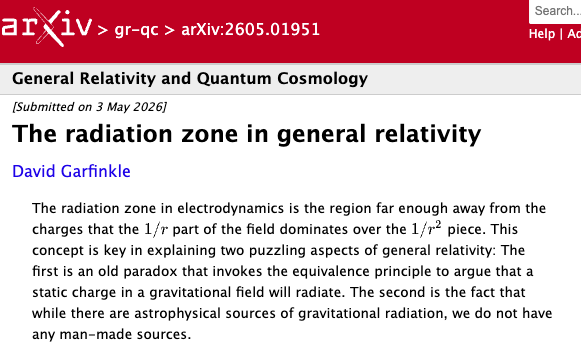
"Why doesn't a charge sitting still on the surface of Earth radiate" has many good answers but this paper is my new favorite.
If the earth was big enough that the radiation zone of the charge was within the "approximately flat" local region, the earth would be a black hole 😎
@martinmbauer All true, but many of those effects can also be explained by classical or semiclassical radiation. To really nail it down, add sub-Poisson photocounting, Bell violations with light, entanglement in light-matter experiments…