The data looks horrific when broken down.
British nationals: -137,000
EU+ nationals: -45,000
Non-EU+ nationals: +258,000
We're swapping British people who want to leave because our countries declining for 3rd world migrants who have no cultural, traditional or historical connection to us.
This is the brutal reality of VC-backed crypto.
Early insiders and institutions get in at fractions of a cent, wait for retail liquidity, and spend years unloading token unlocks onto buyers at the top.
This is the exact reason Kaspa ($KAS) is the way forward:
100% fair launch
Zero pre-mine, zero ICO
Zero VC funds waiting to dump on you
When there are no insider allocations, nobody gets a free head start. Pure Proof-of-Work on equal terms.
Study Kaspa.
Hi everyone, today marks NIO's 12th anniversary. We also held NIO IN 2026, our innovation and technology event. In my opening remarks, I shared NIO's thinking and practice in building an AI-native organization, and unveiled our six-layer architecture for this transformation.
Smart EVs are the most valuable form of physical AI on a per-unit basis, delivering the greatest value to users, operating at the largest industrial scale, and having the most significant societal impact. From components and vehicles to sales, services, energy, and financial services, the global automotive industry represents a market of approximately USD 7 trillion to 9 trillion. If AI could unlock just 15% more value across this industry, that would represent more than USD 1.2 trillion in additional value.
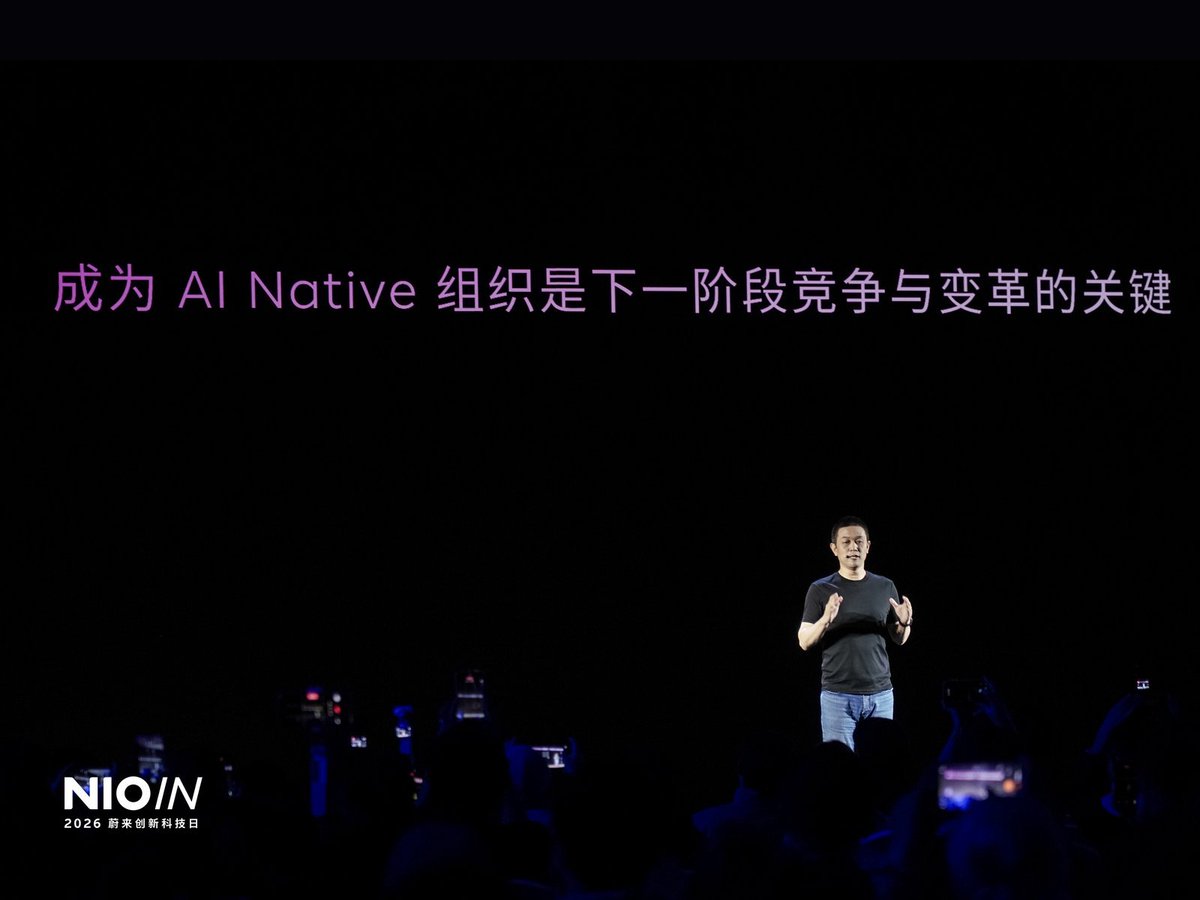
Realizing these efficiency gains and unlocking this enormous value requires far more than simply using AI as a tool. What matters most is reshaping our organizational structure, business processes, and decision-making mechanisms around AI. Only then can the efficiency gains brought by AI be translated into tangible business results. We believe that building an AI-native organization will be central to the next phase of industry competition and transformation.
Here is the full text of my opening remarks.
For more than a decade, smart electric vehicles (EVs) have been at the forefront of technological innovation. Now, as we enter the AI era, smart EVs are poised for a new wave of technological breakthroughs. Every smart EV is inherently a physical AI system, with a complete closed loop of perception, decision-making, and execution. Smart EVs are the most valuable form of physical AI on a per-unit basis, delivering the greatest value to users, operating at the largest industrial scale, and having the most significant societal impact.
The transformative power of AI in the automotive industry goes far beyond product innovation. It also holds enormous potential in operational efficiency enhancement across the industry. We believe the automotive industry will become the largest sector for AI applications. From components and vehicles to sales, services, energy, and financial services, the global automotive industry represents a market of approximately USD 7 trillion to 9 trillion.
Across such an expansive and complex value chain, the opportunities for AI applications are immense. If AI could unlock just 15% more value across this industry, that would represent more than USD 1.2 trillion in additional value.
Realizing these efficiency gains and unlocking this enormous value requires far more than simply using AI as a tool. What matters most is reshaping our organizational structure, business processes, and decision-making mechanisms around AI. Only then can the efficiency gains brought by AI be translated into tangible business results. We believe that building an AI-native organization will be central to the next phase of industry competition and transformation.
Building an AI-native organization starts with defining how value is created and establishing an operating model that supports agile decision-making and clear accountability. In recent years, NIO has strengthened its system capabilities and business ownership across the organization. This means ensuring that every Business Unit (BU) knows which Cell Business Units (CBUs) it oversees and which system capabilities to leverage to create lasting value.
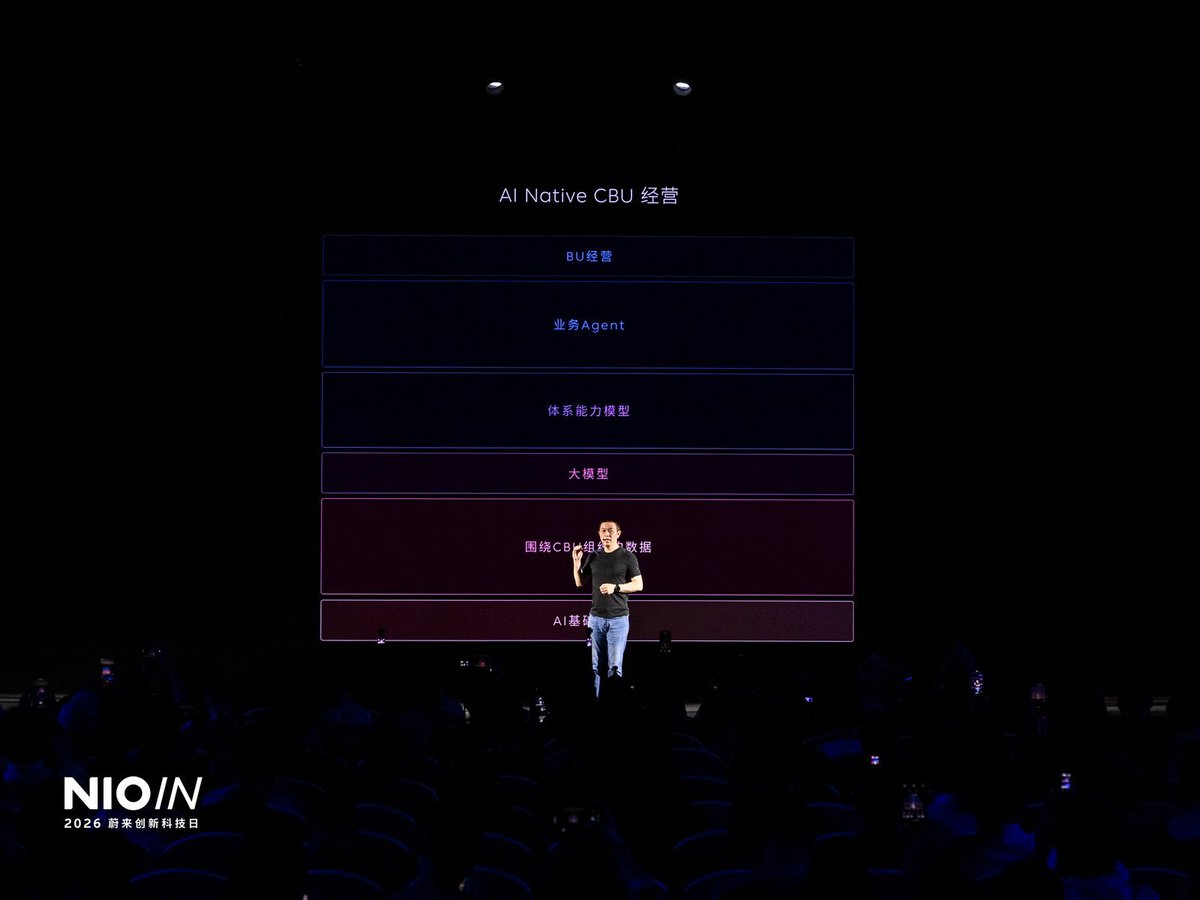
Embedding AI throughout this operating model is how NIO is building an AI-native organization. Known as "AI-native CBU operations," this approach is built on six layers:
▪At the foundation is advanced AI infrastructure, connecting every user, vehicle, Power Swap Station, store, employee, and server securely and reliably.
▪Next comes the CBU data layer, also known as the enterprise semantic layer. It brings together and governs data assets from across business systems and databases, organizing them into more than a dozen categories and tens of millions of CBUs. This enables AI models to access and use the data efficiently. CBU serves as both a core unit of business operations and the ontology underpinning NIO's enterprise AI.
▪Above that is the foundation model layer, where we can leverage cutting-edge general-purpose models while developing proprietary enterprise models tailored to NIO's business needs. This allows us to combine broad AI capabilities with industry-specific expertise.
▪Building on the CBU mechanism and powered by foundation models, we continue to turn proven system capabilities into reusable, model-based components that higher-level AI agents can access and deploy as needed.
▪Next comes the business agent layer. We are systematically developing and deploying specialized agents across BUs to serve as intelligent assistants. Built on a unified company-wide AI platform, these agents can work seamlessly across departments and business functions.
▪At the top is the BU operations layer. Our ultimate goal is for everyone, every department, and every cross-functional team to leverage AI agents to achieve business goals with greater efficiency and effectiveness.
This is how NIO puts AI-native CBU operations into practice.
Building an AI-native organization, however, is far more challenging than simply introducing and using AI tools. It requires us to continuously challenge established ways of working and overcome organizational inertia. We began exploring this transformation in 2023, and even today, we are still at an early stage of realizing its full potential.
To date, we have deployed more than 7,500 agents across business operations, with over 2.9 million executions.
▪In R&D, more than 1,800 project CBUs are now under management. Since the transformation began, R&D productivity has improved by 13%, and overall R&D efficiency has increased by 35%.
▪In industrial operations and supply chain, more than 560 partner CBUs are under management, supporting over 3.6 million vehicle configurations. With AI deployed across the entire value chain, we have achieved a 99% on-time delivery (OTD) rate and improved inventory turnover by 23%.
▪In user services, more than 9,750 Fellows now have access to a range of agents through our AI-powered sales assistant. Their operational efficiency has improved by 44.5% year over year, and the value they create has increased by 8.1%.
Since the first half of last year, NIO has made significant progress in operational efficiency and overall business performance. This progress has been driven by both the continued trust users place in our products and services and the organizational transformation we are advancing through AI. As I mentioned earlier, building an AI-native organization will be critical to staying competitive in the next phase of industry transformation. We will continue to drive this transformation forward.
Let's Power Up! Let's Jiadian!
#NIO #NIOIN #BlueSkyComing #AINative #AI
🚨 Bitcoin is crashing, but this altcoin is quietly beating it: Kaspa has gained about 10% against BTC since early November
- One KAS was worth about 43 satoshis on November 21, up from around 39 earlier in the month
- That's a gain of roughly 10% against Bitcoin from the November low
- In dollar terms KAS is still down, trading at around $0.025
- It held up while Bitcoin fell below $60,000 and hit a two-year low
- Smaller coins usually fall harder than Bitcoin in a sell-off, which makes the move unusual
- Over the full month, though, KAS is still slightly down against BTC, from about 45 satoshis in late October