How are the restaurants at your place doing?
Some observations here in Berlin. I love my local Italian restaurants that serve simple, authentic dishes to the masses (cucina popolare). Pizza, Pasta, some daily menu. No cocktails, no wines a la carte.
Those places are empty as I haven’t seen them in years. Maybe 1/3 of occupancy rn, not just anecdotal - I go there couple days per week.
But then on my stroll back home I pass by a new sort of Italian restaurant which was packed tonight. This restaurant also serves steaks, fancy plates, cocktails, has real wine list.
I rarely go there, maybe just for some variety or when I crave a steak and don’t go for German & French cuisine that day, so I don’t have a full grasp on how well they are doing rn.
Yet, it seems that the broader population is currently not going out that often anymore, while the more affluent guys and fancy dinner peeps are still out and about. Or is it simply that my neighbourhood is changing that much towards gentrification? Certainly, the area has developed very well over the last 10 years but it is not exactly where snobs are moving, even today.
Curious to hear the consumption patterns you are observing at the place you live …
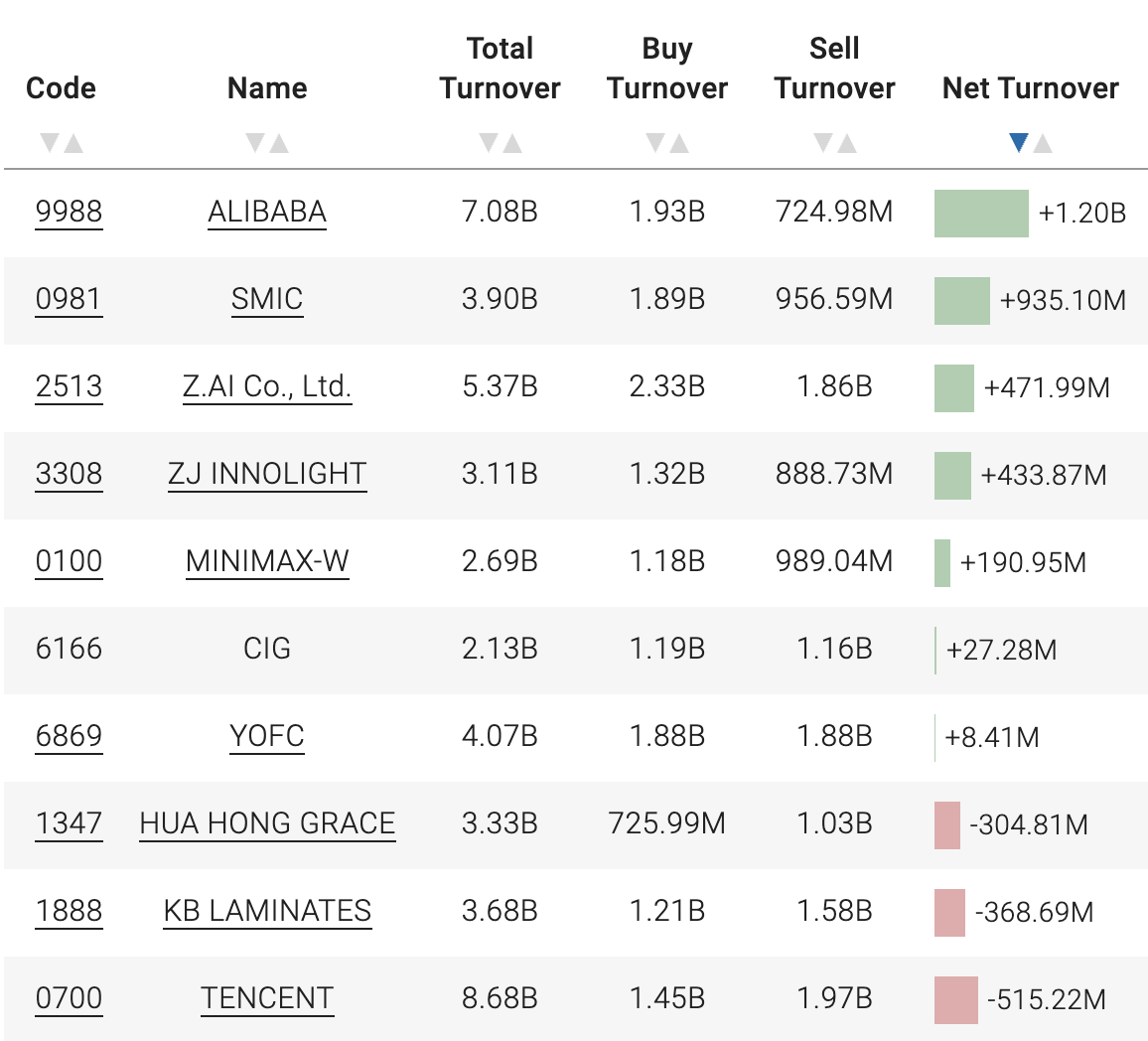
Alibaba $BABA https://t.co/bNsxlSaWZq finally breaks into the top of the #StockConnect with a net inflow of US$154 million today. That's the 4th straight day of net inflows, which accelerated today after news that the company will proceed with the spin-off of its T-Head chip arm, potentially unlocking value of one of the most important growth plays in China's booming AI sector. #StocksToWatch
Meanwhile DeepSeek founder Liang Wenfeng:
• “AI is large enough that it might eventually account for 10% of human GDP. You cannot monopolize such a thing. You must share it with others, or you won’t survive. If we tried to monopolize the benefits, we would be discarded by history. This is an objective law, a historical perspective.”
• “Those who take more get beaten by those who take less. You don’t even need to actually be taking more. If your ambition is to take more, you will be beaten by someone whose ambition is to take less.”
• “If your vision is to take more, you’ve already lost; you may face even greater difficulties. That’s just the way the world is.”
• “We must not imagine that we can claim a certain percentage of the world’s GDP for ourselves — the more you cling to that idea, the less likely you are to succeed. … The more restrained you are, the more likely you are to achieve AGI.”
Interesting remarks Anthropic made in a meeting with the sell side:
- Anthropic has the stability and the better talent that open source lacks.
- The AI market is winner take all. As long as we execute properly, we will take all of it.
- The contract with SpaceX will not be extended beyond the middle of next year.
- Developing Opus 5.5 cost more than $10 billion.
NIO’s ES9 and ES8 continue to lead their respective segments.
The all-new ES8 topped both China’s large SUV and RMB 400K ($60K) segments from January to October 2026, with 119,167 units sold. Cumulative deliveries have now exceeded 160,000 since launch.
$NIO
Does Europe really need to build its own humanoid robots?
Two interesting days in Frankfurt at the VDMA's RoX × Robotics Institute Germany (RIG) event, bringing together German robotics research and industry.
Lots of impressive research, some genuinely interesting approaches to manipulation and embodied intelligence, and very open discussions about the gap between research and industrial deployment.
But one thing kept coming back to me: Why are we so focused on building everything ourselves?
Germany has world-class robotics research, industrial know-how, automation expertise, and an enormous base of potential customers.
China, meanwhile, is moving at remarkable speed in hardware development, manufacturing, and scaling robotic platforms.
So why not connect these strengths?
Rather than spending years trying to catch up on every layer of the technology stack, why not leverage what's already available, focus on the capabilities where Europe can actually differentiate, and accelerate real-world deployment?
And this is where Oliver Brock's research really stood out to me. Instead of following the US and China in the race for ever-larger models, more training data, and more compute, his team is exploring fundamentally different approaches to robotic intelligence, achieving remarkable manipulation and recovery capabilities through physical understanding and smart modeling, with little or no task-specific training.
That's exactly where I believe European research should be ambitious: not just catching up, but finding better ways of doing things.
Of course, technological sovereignty matters. But sovereignty doesn't have to mean doing everything ourselves.
And cooperation doesn't have to mean dependency.
That's also increasingly what we're exploring in our own industrial robotics work at DŌNGXii: connecting technologies, ecosystems, and real-world use cases across Europe and China.
In my humble opinion Europe's biggest robotics opportunity isn't to reinvent everything. It's knowing what to reinvent and where to collaborate.
#Robotics #PhysicalAI #China
Very thought-provoking argument by Louis-Vincent Gave @gave_vincent, co-founder and CEO of Gavekal (one of the most respected macro research firms on China).
His argument - which is correct - is that one of the The biggest problem for Western governments today (be it France, the UK, the US) is the rapidly rising cost of funding their debt.
He says that governments have 3 broad ways to get it under control:
1) Austerity, cutting spending massively, which basically no politician wants to do because it makes you massively unpopular
2) Specific to the US, they could dramatically reduce AI data center spending, which soaks up a huge share of the world’s capital and pushes up borrowing costs for everyone, governments included. Not good either since it kills the AI boom.
3) Or, they can go back to embracing China, which he calls "the one deflationary force in the world today." He says it's by far the easiest path, and policymakers always take the easiest path.
Louis-Vincent argues that's exactly what Mark Carney (“the least dumb of the western leaders today,” in Gave’s words) did when he opened Canada to Chinese cars: it's a cheap and easy way to fight inflation, and to reduce the cost of funding Canada’s debt in the process.
It's fairly ironic when you think about it: you can actually find plenty of quotes by Western officials castigating China for "exporting deflation" (like Klaas Knot from the European Central Bank here: https://t.co/Kl9W8QaA3U). Louis-Vincent’s argument is basically that, sooner or later, folks in Western finance ministries are going to look at bond yields, then at the inflation numbers, then at all those speeches about China exporting deflation, and go like: "wait a minute..." 😏
Full video of Louis-Vincent’s interview here: https://t.co/CiPX6Dds1R
No surprise that western governments are running short of China experts. People with genuine China expertise in western governments find themselves often regarded as too understanding of Chinese positions. Their expertise is exploited when expedient and more often disregarded as politically inconvenient. They usually will have a boss who is hostile to China, not by accident. Their promotion prospects will tend to depend on confidence that although expert, they are not interested in China and, preferably, hostile to China. Seeing all this happening, younger staff steer clear of making too much investment in acquiring Chinese experience and skills. Anyone with actual recent experience of living in China is likely to be excluded from ability to get a security clearance and so unemployable in government. The result is western governments flying ever blinder and more prejudiced on China.
Who really believes that the US will ban data-centres, stop AI in its tracks and allow other nations such as China or Russia to become AI superpowers?
Not going to happen.
Tesla retail sales in China fall to lowest since July 2022 as export share hits record
Tesla sold only 8,817 vehicles in China in October, down 66.10% year-on-year. https://t.co/Pl0r5ULcXb 👇