lSlS committed Genocide against 500K Yezidis for refusing to convert to lslam,killed 10K, kidnapped 7K Yezidi women,lSlS burned 19 Yezidi girls alive for refusing to convert to lsIam and be sex slaves,beheaded 50 Yezidi women.
Not a single MusIim protest
Drive through almost any corner of the English countryside and sooner or later you pass a ruin: a roofless abbey, a row of broken arches open to the weather, a few worked stones in a field where something vast once stood. We are so used to these skeletons that we file them under scenery. In truth each one is a crime scene, and the oldest warning we have about what the English state does when it decides its own people are there to be harvested.
The fashionable comparison this season is the Civil War: the 1640s, the king against his parliament, the long slide to the sword. The state-as-enemy-of-the-nation. I think it's the wrong century. To see our situation as it actually is, go back a hundred years earlier, to the 1530s, and to the largest seizure of wealth in English history before the modern age - the Dissolution of the Monasteries.
The monasteries were far more than churches. They were the welfare state of their day, among the many other pillars-of-society which they constituted. They ran the hospitals and fed the poor at the gate. They schooled the clever sons of nobodies, took in travellers, lent money, employed half the county, and held perhaps a fifth of the land in England in a kind of standing trust for the people around them. They were the accumulated institutional capital of the nation, built up across four centuries.
In barely four years, the state took the lot.
The way it was done is the whole point. First the audit: Thomas Cromwell sent his men to value every religious house in the land down to the candlesticks - the Valor Ecclesiasticus, a Domesday Book drawn up for plunder. Then the justification: the same men came back with lurid dossiers of monkish vice and idleness, much of it invented and all of it deeply useful, because a thing you mean to destroy must first be declared rotten. Then the disposal. The proceeds went nowhere near the poor who had depended on the place. The land was sold, fast and cheap, to the Crown's creditors and courtiers and the rising, grasping gentry - a new class of men bound to the regime by the very loot they were handed, a good many of whose descendants sit on the same acres now.
When the north rose against it, in the Pilgrimage of Grace, the rising was put down and its leaders hanged on the strength of a royal pardon that was never meant to be honoured.
The result, for ordinary people, was a disaster that took generations to undo. The hospitals shut. The poor relief evaporated. England filled with vagrants and beggars - "sturdy beggars", in fact, which the same government then set about whipping through the streets - because the institutions that had carried the poor had been cashed in for the king's wars and the courtiers' estates. It took the better part of a century, and the Elizabethan Poor Law, to rebuild a fraction of what those four years had wrecked.
This is the English disease in its purest form, and a man ought to know his own country's worst habit when he sees it come round again. The English state has never had much need of tanks or secret police. Its signature is subtler. It finds the institutions ordinary people rely on, declares them corrupt or inefficient or unaffordable, audits them, hollows them, and transfers their substance - the money, the land, the power, the security - to the class that runs the machine.
You have watched it done. The hospitals, the courts, the high streets, the post offices, the savings, the very safety of the streets - audited, downgraded, closed, sold, or left to rot, while the apparatus sitting on top of it all has swollen to £400 billion a year and answers to nobody you can name. The monks are long gone and the method is immortal.
The ruins in the field are a gravestone, but they are also evidence, and evidence is always useful. Once a people learns to recognise the method - the audit, the manufactured rot, the fire-sale to insiders, the whole business wrapped in the word "reform" - it stops working on them.
The English have rebuilt everything that was stripped from them before: the parish relief, the friendly societies, the great Victorian foundations, the hospitals and schools of the last century, every one of them raised by people who refused to accept that the floor under ordinary life was gone for good. We will do it again. The first step is to stop calling the men selling the country reformers, and to call them what Cromwell's men were: looters with a jolly good filing system.
Christians were severely taxed, they were forced to pay disproportionately higher taxes than Muslims within the empire, including the humiliating poll-tax. Even pregnant mothers had to pay jizya on behalf of their unborn children.
Between the 14th and 17th centuries, the Ottomans had the the devshirme system, a practice of taking young Christian boys from their families and being raised as Muslims.
Christians were tortured, deprived of formal education, and martyred. Conversion from Islam to Christianity was a death sentence.
On Easter Sunday, April 22, 1821, the Ottoman Turks hanged the Ecumenical Patriarch Gregory V of Constantinople. He was executed in full liturgical vestments at the main gate of the Patriarchal compound. His body was left hanging for three days before being dragged through the streets and thrown into the Bosporus. The main entrance of the Phanar (the Saint Peter Gate) has been permanently welded shut till date in memory of his martyrdom.
Syria (Aleppo) in the 1950s, when 40% of the population was Christian. Today, it is less than 1%. This is the case for all the Middle East under Islam. Funny how no one cares about this real genocide.
Tucker Carlson says that the Ottomans were very kind to Christians. Don't forget that 200 years ago, in Chios, 42,000 Greek Christians were massacred by the Muslim Turks and 52,000 were sold into slavery. It was a taste of their kindness.
πριν ένα μήνα κατά τη διάρκεια παράνομης ανασκαφής σε κήπο αμπελώνα στην περιοχή Τοκάτ της Τουρκίας (αρχαία Ευδοκιάδα) εντοπίστηκε ένα μωσαϊκό ηλικίας 1.800 ετών στο οποίο αναγράφεται η αρχαιοελληνική λέξη "τρυφή"-πολυτέλεια, ανεση…κάθε σπιθαμή γης στην Τουρκια, αναβλύζει Ελλάδα
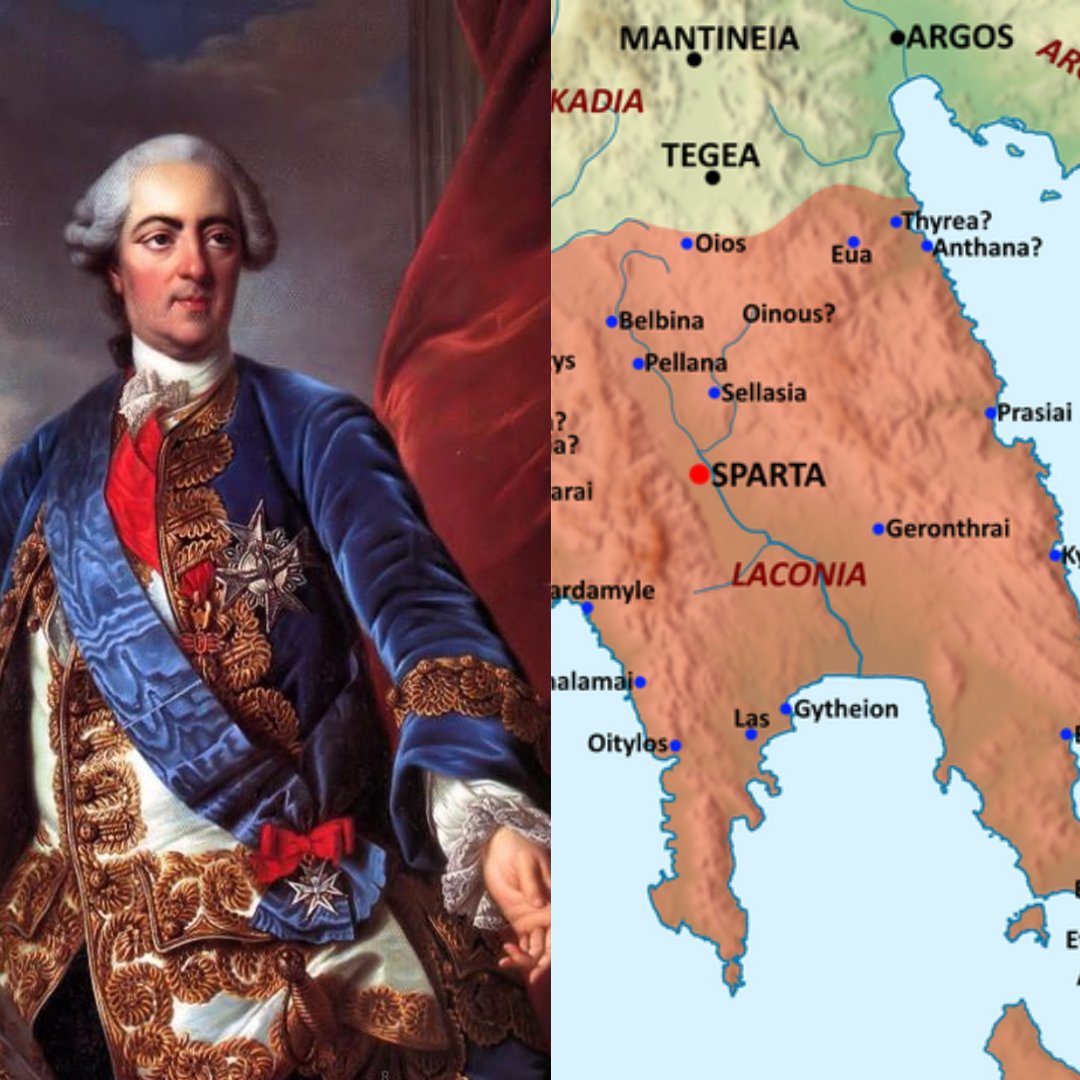
One of the greatest cultural crimes in Greek history happened in Sparta. In the 1730s, the French scholar Michel Fourmont was sent by the French crown to Greece. His mission was to copy ancient inscriptions and document classical antiquities. What he left behind in Sparta was one of the most shameful acts in the history of archaeology and a crime against the Greek culture and history.
Fourmont fabricated more than 1,200 inscriptions, many of them obvious forgeries that mixed impossible names, anachronistic formulas, and linguistic errors. To create the appearance of authenticity, he ordered the destruction of ancient Spartan structures and artifacts.
Marble blocks covered with authentic inscriptions were deliberately shattered. Priceless originals were smashed so that his fakes could take their place in scholarly collections.
Sparta, already reduced to ruins after centuries of neglect, still retained rare physical traces of its legendary past. Entire categories of authentic Spartan texts, possibly unique in the Greek world, vanished forever.
For decades, his fabricated inscriptions were cited as serious evidence. Scholars built theories on lies. It took until the 20th century, particularly through the rigorous work of epigraphists like Louis Robert, for the full scale of the fraud to be exposed. By then the damage was irreversible.
Today, Michel Fourmont is remembered as a man who came to study Sparta, my homeland, and instead silenced it. His actions represent one of the greatest cultural crimes in Greek history. The deliberate erasure of a civilization’s material memory, dressed up as scholarship.
In a letter to Count Maurepas, Fourmont boasts that he destroyed the inscriptions so that they would not be copied by a future traveler:
"For over 30 days now - 30, 40, even 60 workers - have been dismantling, destroying, erasing the city of Sparta. I have only 4 single towers left to demolish… For the moment, I am occupied with the destruction of Sparta’s last antiquities. You understand what joy I feel. But Mantinea, Stymphalia, Tegea, and especially Nemea and Olympia deserve to be thoroughly uprooted. I’ve made many expeditions in search of the ancient cities of this land, and I’ve destroyed several. Among them Troezen, Hermione, Tiryns, half the acropolis of Argos, Phliasia, Pheneos… I have entered Mani. For six weeks now, I’ve been occupied with the total destruction of Sparta. By tearing down its walls, its temples, leaving not a stone upon a stone, I will make even its location unknown in the future, so that I can be the one to make it known again. That way, I will glorify my journey. Is that not something? Sparta is the fifth city I have destroyed. I am now occupied with the destruction of the deepest foundations of the temple of Amyklaean Apollo. I would have destroyed other ancient sites just as easily, if only I had been allowed to. I completely demolished the tower. Of the travelers who came before me, I don't recall a single one daring to demolish towers and other large buildings!"
According to the information he himself provides, in Sparta alone he paid for 1.200 daily wages to demolish the monuments and buildings that still survived.
Fourmont was then planning to move on to Olympia, a visit he had actually scheduled. But fortunately, he was recalled to France and left Greece.
The barbarity and the damage caused by the Frenchman were irreparable.
As a Greek from Laconia, I wish that this inhumane barbarian, may never rest in peace.
♰🇨🇳 Feast of Our Lady of Sheshan 🇨🇳♰
Our Lady of Sheshan pray for us 🙏
Our Lady, Help of Christians pray for us 🙏
Our Lady Queen of China pray for us 🙏
🎥 National Shrine-Basilica of Sheshan, Shanghai, China 🇨🇳
Completed in 1935 under the direction of Belgian missionary-architect Alphonse De Moerloose. It features a 38-meter bell tower topped by a 4.8-meter bronze statue of the Madonna and Child, which weighs approximately 1.8 tons. The interior can seat 3,000 worshippers and features an altar made of marble inlaid with gold and jade.
In 1874, Pope Pius IX granted a plenary indulgence to pilgrims who visited the shrine in May, a tradition that continues today with tens of thousands of visitors annually.
Sadly, since early 2025, the Chinese government has prohibited pilgrimages that cross provincial boundaries; only formal pilgrim groups from within the Shanghai metropolitan area are allowed, and they must register online for approval.
Egypt is demolishing parts of Cairo’s 1,200-year-old Al-Qarafa Cemetery—one of the world’s oldest continuously used necropolises—to make way for roads and modern infrastructure.
Al-Qarafa, often called the City of the Dead, is one of Cairo's most extraordinary historic landscapes. Established after the Arab conquest of Egypt in the 7th Century, it evolved over more than 1,200 years into a vast necropolis containing mausoleums, mosques, madrassas, and tombs of sultans, scholars, military leaders, and ordinary citizens. Today, the cemetery complex stretches for miles and forms part of Historic Cairo, a UNESCO World Heritage site recognized for its exceptional Islamic architecture.
In recent years, portions of Al-Qarafa have been demolished as part of major transportation and infrastructure projects intended to reduce congestion in a metropolitan area now home to more than 20 million people. The work has sparked debate among preservationists, archaeologists, and residents, who argue that some destroyed structures represented irreplaceable pieces of Egypt's cultural heritage.
The cemetery is notable not only for its monuments but also because generations of families have lived among the tombs, creating a unique community intertwined with one of the world's oldest continuously used burial grounds.
Al-Qarafa contains funerary monuments from multiple Islamic dynasties, including the Fatimids, Ayyubids, Mamluks, and Ottomans, making it one of the richest concentrations of medieval Islamic architecture anywhere in the world.
That water clarity is an engineering decision, and the math behind it is wilder than the video.
Roman aqueducts ran on gravity alone. No pumps, no pressure systems. Engineers carved channels with a gradient so shallow it borders on absurd. The Pont du Gard in southern France drops 2.5 centimeters over 275 meters. That's roughly the thickness of a coin over the length of three football fields. They surveyed that accuracy with plumb lines and wooden leveling instruments.
The clarity you're seeing is a direct product of flow velocity. Too steep and the water erodes the channel walls, picks up sediment, turns brown. Too flat and it stagnates. Roman engineers targeted a slope of about 20 centimeters per kilometer, which kept the water moving fast enough to stay fresh but slow enough to stay clear. Before the water reached the city, it passed through multi-chamber settling tanks where velocity dropped near zero. Suspended particles sank. Clean water flowed out the top into the next chamber. Repeat three or four times.
Pliny specified the minimum slope in writing. Vitruvius published the exact mortar ratio for hydraulic cement: one part lime to two parts volcanic ash for underwater work. The pozzolana from Pozzuoli reacted with water to form a calcium-aluminum-silicate compound that actually gets stronger the longer it sits submerged. Modern concrete degrades in water. Roman concrete bonds with it.
Scale the whole system and it gets harder to process. Eleven aqueducts fed Rome at its peak. Combined output: roughly 1 million cubic meters of water per day. That works out to about 250 gallons per person for a city of one million. Modern New York delivers about 125 gallons per person per day. Ancient Rome had access to double the per capita water supply of the largest city in the United States, running entirely on slope and stone.
The Trevi Fountain in Rome is still fed by one of them. Two thousand years, same source, same gravity, same water.
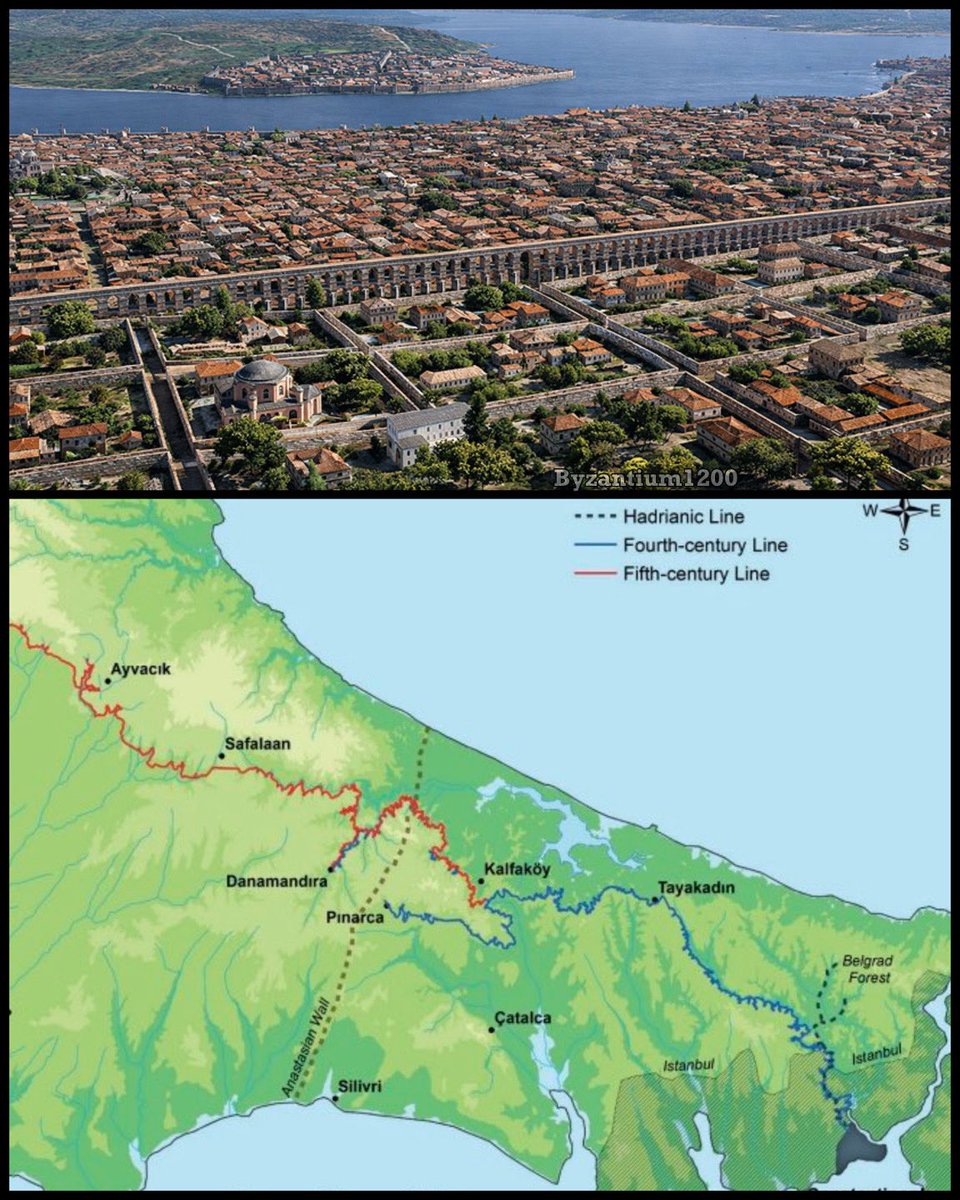
The “longest water supply line from the ancient world” was that made for Constantinople!
It was “at least 2.5x the length of the longest recorded Roman aqueducts.” Constantinople was strategically perfectly located, but water was lacking and required engineering solutions🧵
When they call you Islamophobes, I want you to remember that 200 years ago, in Chios, 42.000 Greek Christians were massacred by the Muslim Turks and 52.000 were sold into slavery. Please don't forget.
The Forest of Butovo— Where over 1000 clerics were executed
The Butovo Forest was an execution site of the Soviet secret police located near Drozhzhino in Leninsky District, Moscow Oblast from 1938 to 1953.
Butovo was used for mass executions and mass graves during Joseph Stalin's Great Purge, with 20,761 prisoners of various nationalities documented as being transported to the site and executed.
In the winter of 1937 a group of priests, including an old bishop, were transported in the "black crow" (Stalin's closed trucks of the Communist secret police) to the scene of the execution. The ground was icy, hard as a rock.
The guards, with their faces covered, ordered them to come out. The procedure was regular, cold and fast. However, something happened that the municipalities did not expect.
As they were set at the edge of the plough, the bishop, with a trembling but clear voice, began to sing "Christ is Risen".
The other priests, instead of crying or asking for mercy, joined him. Their chants echoed in the forest, breaking the absolute silence of death.
An officer yelled to stop, marking the bishop in the face. He looked at him in the eyes with a peace that seemed eerie. "We forgive you, my children," he whispered, "for you do not know what you do." Every time a priest fell into the gap, the next would pick up the hymn from where the previous one had left off.
With the last priest standing, the congregations were frozen. It wasn't the fear of death that shook them, but the lack of fear on the part of their victims. The last priest made the sign of the Cross, blessed his shooters, and fell into the pit before the final bullet was even heard.
It is said that for years later, the inhabitants of the surrounding areas avoided approaching the Butovo Forest. They said that at nights, when the wind was blowing from the north, you could still hear the heavenly chants coming from through the earth.
Today, a magnificent temple is erected on that spot. At its foundations are guarded thousands of objects found in the excavations: small crosses, etc., witnesses to a faith not defeated by bullets.
From the book: Testimonies of Butovos - the Calvary of the Russian New Martyrs.
In the 1620s, Jesuit missionaries in China discovered an ancient stone stele buried beneath vines
It described a “Luminous Religion” [Christianity] brought to the Tang Dynasty in the 7th century by monks of the Assyrian Church of the East, before later suppression
"They seized my baby and sliced him in two with a knife.
My second child woke up ... They split his head with a machete."
THIS IS THE REALITY FOR NIGERIAN CHRISTIANS.
When will the world wake up?!
“Genocide!” cries the Left…
…except when Islamists are committing genocide against Christians in Nigeria, Sudan, Syria, Myanmar, Libya, the Congo, Burkina Faso, Bangladesh, Pakistan, Somalia, Yemen, Iran, and Afghanistan.
1400 year old cross discovered in Abu Dhabi.
The Church of The East, from its Mesopotamian core, spread as far as the Gulf, India & China.
While many in Iraq & Syria are trying to erase this history, it’s beautiful to see this history rediscovered & protected in the Gulf.
✝️ This is what Cultural Genocide of the #Christian Heritage looks like.
Over 2,000 #Armenian🇦🇲 churches wiped out since the 1915 Armenian Genocide.
In #Artsakh🇦🇲, churches are still being razed today-deliberate erasure of the #Christian identity.
And the world scrolls past.




![chunguskitten's tweet photo. In the 1620s, Jesuit missionaries in China discovered an ancient stone stele buried beneath vines
It described a “Luminous Religion” [Christianity] brought to the Tang Dynasty in the 7th century by monks of the Assyrian Church of the East, before later suppression https://t.co/tmVT6yjKHr](https://pbs.twimg.com/media/HHad8kaX0AEmSoo.jpg)





![chunguskitten's tweet photo. In the 1620s, Jesuit missionaries in China discovered an ancient stone stele buried beneath vines
It described a “Luminous Religion” [Christianity] brought to the Tang Dynasty in the 7th century by monks of the Assyrian Church of the East, before later suppression https://t.co/tmVT6yjKHr](https://pbs.twimg.com/media/HHad8kgXkAE0XG4.jpg)


