Don't leave just yet. There's a growing movement to push back against wo. Bishop Sutton commissioned me to write a book defending the traditional View on women's ordination and I'm waiting to hear back from the Bishops on their edits before it is published. Pray that it will be sometime soon.
...And here is My bishop saying that our province will NEVER be orthodox. I am done with the ACNA & currently looking elsewhere. I'll ask my priests what their plan is & we'll see if My parish will leave or if I have to leave my parish.
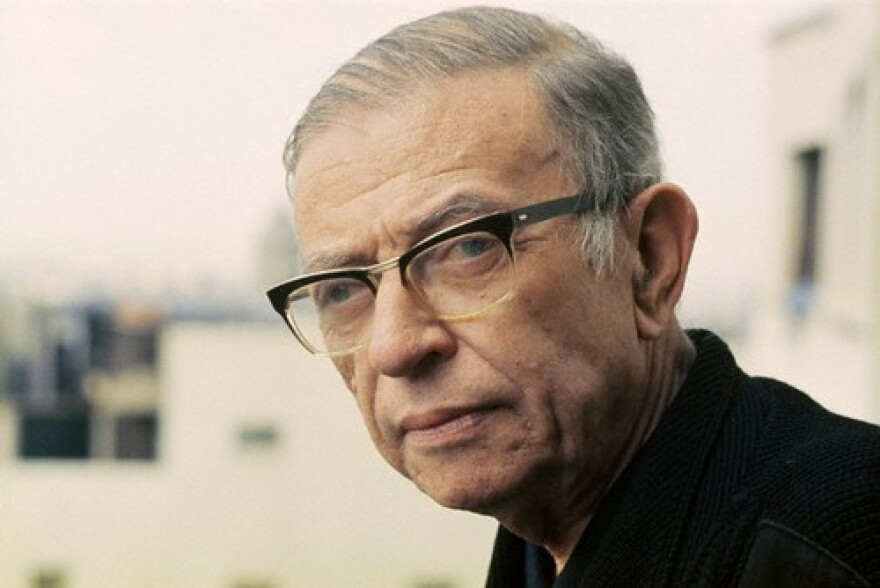
In 1968, while teenage Red Guards beat their professors to death with clubs in Beijing courtyards, Jean-Paul Sartre sat in Paris calling Mao's Cultural Revolution a model of revolutionary democracy. The most celebrated intellectual in France looked at a country burning its own libraries and saw liberation. He sold the Maoist newspaper La Cause du Peuple on French street corners himself, holding it aloft like a sacrament.
Consider what he was endorsing. Between 1966 and 1976, the Cultural Revolution killed somewhere between 500,000 and two million people. Schools shut down across the entire country. Students dragged teachers onto stages, hung placards around their necks, forced them to kneel on broken glass, then murdered them. The historian Bian Zhongyun, vice-principal of a girls' school in Beijing, died on August 5, 1966, beaten by her own students with nail-studded clubs. Sartre called this the people governing themselves.
You should understand why a man this intelligent got it this wrong. Sartre believed knowledge served power, that truth was whatever the revolution required, that the individual existed to be dissolved into the collective will. So when Mao abolished the distinction between teacher and student, between expert and mob, Sartre cheered. He had spent decades arguing that bourgeois reason was a class weapon. Here was a regime taking him at his word and clubbing the reasoners to death.
This is what economic illiteracy buys you. A university, a price, a contract, and a peasant's grain stockpile all carry knowledge that no central planner can seize or replicate. Mises explained the calculation problem in 1920. Hayek explained dispersed knowledge in 1945. Sartre had access to both and chose the dunce cap of the collective instead, then handed out its propaganda on the Rue de Rennes.
He died in 1980, mourned by 50,000 followers, never having retracted a word about Mao. The professors of Beijing got no such funeral. They got a ditch, and a philosopher in Paris explaining that their murder was freedom.
Study is a spiritual discipline, and so even reading Arthurian romances can spur one to heavenly things. E.g., Lancelot in The Knight of the Cart is pursuing love even at the cost of personal shame. Love and sacrificing for the beloved overcome cultural taboos. The power of love is stronger. Poems about eros are transfigured into agape by reading life in light of divine love.
"I was very much a product of a Protestant Hellenism ... Greek, not Latin, was the key to my faith. In this way, the gravitational pull of the world of the Bible made me increasingly interested in the ancient New East and the Roman Empire that had formed the background to the New Testament."
-Peter Brown
Peter Brown after his first visit to Oxford: "Scholars have become medievalists for a variety of reasons - a nostalgia for a Catholic past lost at the Reformation, or a taste for courtly legends, or an interest in the distant beginnings of institutions that are still with us today. I became a medievalist through my eyes."
And: "Only later did I learn that those All Souls towers were pseudomedieval towers - brilliantly designed 'citations' of Perpendicular Gothic architecture, built in the eighteenth century by the architect Nicholas Hawksmoor."
By then, it was too late. He'd been smitten - for which the world may be grateful.
En 1938, des chercheurs de Harvard ont lancé l’étude la plus ambitieuse de l’histoire en suivant la vie de 724 personnes, de leur adolescence jusqu’à leur décès, afin de découvrir ce qui rend réellement une personne heureuse et accomplie.
Pendant des décennies, ils ont analysé leurs cerveaux, leurs salaires, leurs relations et leurs traumatismes. Après 85 années de données, ils ont mis en évidence une corrélation surprenante, à laquelle personne ne s’attendait.
La réussite professionnelle à l’âge adulte ne dépendait ni du quotient intellectuel, ni de la richesse des parents, ni des notes scolaires. L’un des prédicteurs les plus puissants du succès était quelque chose de très simple : faire des tâches ménagères durant l’enfance.
Sortir les poubelles ou faire la vaisselle n’est pas seulement une question de propreté ; c’est un entraînement du cerveau. L’étude, connue sous le nom de Grant Study, a révélé que les tâches domestiques enseignent une leçon qu’aucune école ne peut reproduire : « l’éthique de la contribution ».
Lorsqu’un enfant doit arrêter de jouer pour mettre la table, il apprend que le monde ne tourne pas autour de lui. Il comprend qu’il fait partie d’un écosystème et que son effort est nécessaire au bon fonctionnement du groupe.
Les chercheurs ont découvert que les enfants qui participaient aux tâches devenaient des adultes qui :
– savent reconnaître ce qui doit être fait et le font sans qu’on le leur demande (initiative) ;
– éprouvent davantage d’empathie pour le travail des autres ;
– gèrent mieux la frustration et le report de la gratification.
À l’ère de la « parentalité hélicoptère », où l’on évite que les enfants s’ennuient ou travaillent, Harvard nous avertit qu’en les protégeant des tâches ennuyeuses, nous leur retirons les fondations de leur future compétence professionnelle.
Si vous voulez que votre enfant devienne un adulte accompli, ne lui achetez pas plus de jouets éducatifs. Donnez-lui un balai.
Source : Harvard Study of Adult Development (Grant Study) et Julie Lythcott-Haims (How to Raise an Adult).
Universo Sorprendente.
Aside from the Rocky Horror Service Book offering for the World Cup (thanks CofE comms for the perfect sermon fodder) it is noticeable how much better liturgical books looked back in the day. Here is a BCP of 1639: Laudian beauty of holiness on the page. @prayerbook_soc
“Tax the rich”
We already do.
“Make the rich pay their fair share.”
They already do.
These slogans are catchy but inaccurate. They reveal that someone is misinformed on taxation in the United States.
Anglicanism is the only meaningful hope for a healthy mix of universal non-racialized churchmanship, and Protestant political theology in the US. It’s also in the worst shape of any major Protestant communion. Not great Bob!
@BovrilG@MyEarTrumpet You're really onto something here and it explains a lot of works of natural history in the 19th century and isn't keeping with fictional portrayals of 19th century clergyman.
Elon just created 4,400 millionaires in a single day.
400 of them are now worth over $100 million.
These aren't VCs. They're SpaceX employees, and the list includes welders, technicians, and cafeteria staff, because for two decades the company paid every level of the workforce in stock instead of higher salaries.
Juan Hernandez immigrated from Mexico and took a $28 an hour contractor welding job in 2015. He says he didn't even know what SpaceX was. The company gave him a $10,000 equity grant and let him buy more shares through payroll deductions. That stake is now worth $880,000.
Trevor Hise's parents wanted him to take a stable job at General Electric. He picked SpaceX instead, stayed 12 years, and accumulated over 100,000 shares. At the $135 listing price that's $13.5 million. He's 37 and semiretired. His words: "The magnitude of this has been ridiculous."
The most telling detail came before the listing. Over 100 employees quietly banded together and negotiated a group wealth management deal covering up to $5 billion, because none of them had ever needed a wealth manager before.
Software IPOs have minted millionaires for 30 years. This is the first one where the money went to the factory floor.
Here's a list of the reasons women provide for why they got an abortion.
The least common explanation was incest, followed by rape. The most common was that having a baby would be a lot to handle.
Tom Bombadil is the most mysterious character in The Lord of the Rings.
He's the oldest being in Middle-earth and completely immune to the Ring's power — but why?
Bombadil is the key to the underlying ethics of the entire story, and to resisting evil yourself...
Tom Bombadil is an enigmatic, merry hermit of the countryside, known as "oldest and fatherless" by the Elves. He is truly ancient, and claims he was "here before the river and the trees." He's so confounding that Peter Jackson left him out of the films entirely.
This is understandable, since he's unimportant to the development of the plot. Tolkien, however, saw fit to include him anyway, because Tom reveals a lot about the underlying ethics of Middle-earth, and how to shield yourself from evil.
The hobbits meet Bombadil early on in their quest, before they reach Bree and the Prancing Pony Inn. He rescues Merry and Pippin from Old Man Willow, and invites the hobbits to stay at his house in the Old Forest.
There, the hobbits realize something strange about him: the Ring has no power over Bombadil whatsoever.
When he wears it, he remains visible. He treats it as a plaything, making it disappear with a magic trick. Indeed, at the Council of Elrond, Gandalf rejects the idea of giving the Ring to Tom, for he would likely misplace it or forget about it entirely.
So just who is he, exactly?
When Frodo asks this very question to Tom's wife Goldberry, she simply responds "He is." It's a cryptic answer that echoes God's famous answer to Moses in the Book of Exodus: "I am who I am."
Thus, many theorize that Bombadil is God, some kind of angelic being, or even the spirit of the Music of the Ainur (due to the fact that he is constantly singing). But Tolkien's letters reveal something considerably more interesting…
In April 1954, Tolkien wrote:
"The story is cast in terms of a good side, and a bad side, beauty against ruthless ugliness, tyranny against kingship… but both sides in some degree, conservative or destructive, want a measure of control.But if you have, as it were, taken a 'vow of poverty', renounced control, and take your delight in things for themselves without reference to yourself… then the questions of the rights and wrongs of power and control might become utterly meaningless to you, and the means of power quite valueless…"
So, Bombadil is a representation of what it means to take pure delight in the world around you — to experience people and things simply as they are, without any thought for what they could be or how you could use them. And this is why the Ring has no power over him.
To Bombadil, the One Ring is simply a ring, and the possibilities of what can be achieved through its power are of no importance. He is able to resist its evil precisely because he is entirely content with the world around him.
At the end of the story, having accomplished what he set out to do in Middle-earth, Gandalf pays Tom a visit before returning to the Undying Lands:
"I am going to have a long talk with Bombadil: such a talk as I have not had in all my time."
If Bombadil is the epitome of simply enjoying life and being, Gandalf is the epitome of doing. He guides the hobbits, fights the Balrog, and runs up and down Middle-earth to help destroy the One Ring.
But now that he's finally liberated from doing, he immediately heads to Bombadil's. He does so with a sense of relief, as if he's at last able to access a purer and higher mode of being — a sort of innocence that cannot be fully experienced by those consumed by doing.
Of course, by this Tolkien doesn't disparage the value of action. The entirety of LOTR displays the importance of rising up against evil, even in the face of all odds. But with the inclusion of Bombadil, he does remind readers that fighting isn't all there is.
Bombadil reminds us that while it's important to strive and *do*, it is just as important to occasionally step back and *be*. Indeed, your ability to do so plays a crucial role in helping you resist the allure of evil…
Read the full piece here:
https://t.co/aqK2daehIL
The unsung hero of The Lord of the Rings...