@saketh1998 But today even after all increased taxes you can check DII buy figure everyday, its at record level & even decreased participation of retail the stt is setting records. No reason for govt to review. They r least concerned of your losses, they celebrate tax collected figure.
@micchamasala Its usual on train journey, you find many such idiots. On my last journey the person beside me was playing Bhojpuri song loudly. In Sri Lanka, at the airport gate, someone was playing reels loudly while drinking beer. I dont undrstand how people can be so negligent towards others
There has been a lot of discussion about the sharp closing moves since the new Closing Auction Session went live.
CAS itself is not a bad idea. Most large global markets have some form of closing auction. A large amount of institutional activity, especially from passive funds and other benchmark-tracking investors, happens near the close. Instead of the closing price being determined based on the average traded price during the final 30 minutes, CAS brings these orders together in an auction to discover one closing price.
The goal of CAS is to enable better price discovery and make it easier to execute large orders without moving prices abruptly. But the price dislocations we have seen over the last few days highlight some of the structural problems that are specific to the Indian markets.
Closing auctions work well when there is deep liquidity and a large and diverse ecosystem of market participants, including market makers and arbitrageurs. Whenever prices diverge between the cash market, futures, ETFs, or different exchanges, participants step in and arbitrage the differences away.
This ability to arbitrage is much more limited in India.
For one, it is impossible to express a short view in the cash market. We have a securities lending and borrowing mechanism, but it isn’t deep or easy enough to use. Unless borrowing stocks and shorting them becomes easy, there is bound to be structural upward pressure in the markets.
Then there is the difference in the cost of trading an option versus a futures contract. In April 2026, STT on futures was increased to 0.05% of the entire contract value, while STT on options is charged on the premium. So even though the STT rate on options is higher, trading futures is more expensive.
Once you add STT, exchange charges, spreads, and impact costs, the trading opportunity has to be quite attractive before a futures arbitrage trade is worth doing. The same directional view can often be expressed more cheaply through options. This leads to traders preferring options over futures.
India has over 13 crore registered investors, but only about 20–30 lakh traders trade actively on any given day. That’s it. We don’t have a large enough committed ecosystem providing two-sided liquidity across the cash market, futures, ETFs, and closing auctions.
CAS is not the reason for these structural limitations, but it makes them more apparent. The timing of its rollout is also unfortunate, because the RBI’s new norms on capital-market exposure, which limit banks’ exposure to capital-market activities, are going live at the same time.
When one instrument is more attractive than another, or when participants cannot express both bullish and bearish views easily, distortions are inevitable.
There might be tweaks required in how CAS itself works. But the larger issue of our markets being shallow is a complicated problem to solve. It requires building an ecosystem that encourages all kinds of traders and investors, with different time horizons, to participate easily.
Making shorting and securities lending easier, reducing distortions between instruments, and encouraging genuine market-making would be a good place to start.
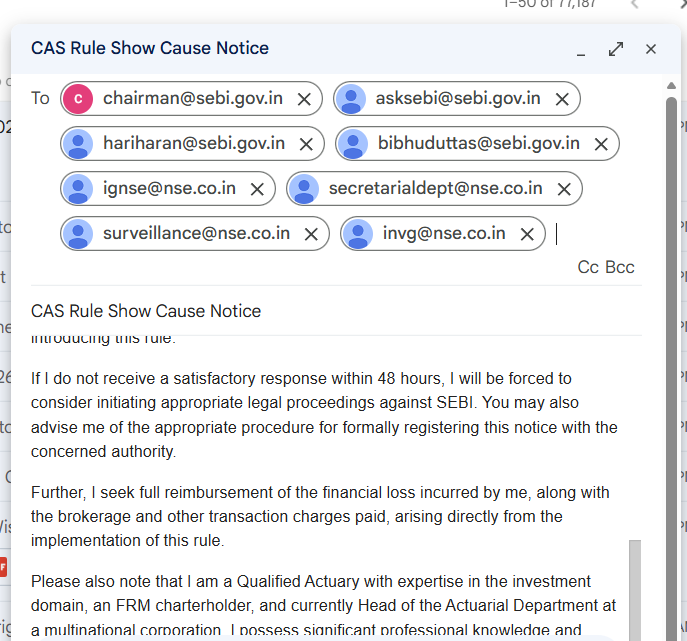
I have sent out a show cause notice to SEBI and NSE. I have given them 48 hours to respond.
At the same time, I am speaking to lawyers but yet to get a good one. Any good finance related lawyer in Mumbai reach out to me or please DM me the contact details
What the hell is happening to the Indian stock market?
Dear @SEBI_India & @NSEIndia@BSEIndia
How many times do you expect traders to rebuild their entire business?
> December 2020 – 50% leverage removed
> March 2021 – 75% leverage removed
>September 2021 – 100% leverage removed
We adapted.
Yes, leverage is a double-edged sword. But thousands of genuine traders with smaller capital were affected. Still, we adapted.
> September 2023 – Bank Nifty expiry was shifted from Thursday to Wednesday, while BSE launched Sensex weekly expiry on Friday. Suddenly, we had expiries almost every trading day.
Many traders, especially algo and 0-DTE traders, redesigned their entire systems.
We adapted.
> November 2024 – Weekly expiries of FinNifty, Bank Nifty and other indices were removed. Only Nifty and Sensex weekly expiries remained.
Again, thousands of traders had to change their strategies.
We adapted.
> February 2025 – Expiry-day margin benefit was removed.
STBT traders were hit badly.
We adapted.
> 1st September 2025 – Nifty expiry shifted from Thursday to Tuesday.
Again...
We adapted.
> Jane Street reportedly made billions of dollars from Indian markets over the years. Later, regulatory action was taken, and subsequently trading restrictions were lifted after payment of regulatory dues/settlement.
How exactly did all of this benefit Indian retailers?
Meanwhile...
- Option STT has increased massively over the last few years.
- Bid-ask spreads have widened.
- Slippage has increased.
- Global volatility has increased.
- Transaction costs keep rising.
We adapted to everything.
And now...
Closing Auction Session (CAS).
Seriously?
Every few months there's another structural change.
Every few months traders are forced to rebuild their systems.
Every few months liquidity takes another hit.
You say these changes are for retail investor protection.
Then please show us the data.
Can you show even one report proving that retail trading losses have actually reduced because of all these interventions?
If not, then what exactly are these constant changes achieving?
Instead of making markets more efficient, you're making trading more expensive, more complicated, and pushing serious traders towards crypto and international markets.
As a full-time trader, my inner soul genuinely cries today seeing the direction our markets are heading.
We survived leverage removal.
We survived daily expiries.
We survived removal of daily expiries.
We survived expiry changes.
We survived removal of expiry margin benefits.
We survived higher STT.
We survived wider spreads and slippage.
Now we are expected to survive CAS as well?
Enough is enough.
I request SEBI and the exchanges to reconsider this rule.
Before implementing such major structural changes, consult the trading community. There should be proper communication, public discussion, and representation from active traders.
I also request every trader to raise their voice through the proper channels. If you genuinely believe these changes are hurting market participants, please send your feedback or complaint to SEBI through its official grievance mechanism. And if anyone from the industry has a direct channel to the exchanges or regulators, please help convey the concerns of the trading community.
Please Retweet this so our voice reaches the right people.
Enough of silent adaptation. It's time the trading community is heard.
@AnilSinghvi_@_anujsinghal@SarangSood@PRAFULKULKARN18@adigitalblogger@iarjuntandon@JayneshKasliwal@sunilgurjar01@piyushchaudhry@SantoshPasi@RakeshPujara1@TanmayKurtkoti@justnottamomma@AshishGupta325
@drmukulagrawal You are wrong, you mentioned any order placed in between 3:15 to 3:30 will get price what it will be at 3:30. I missed of CAS information, so placed order of 25050 at 3:28pm at 16.5 & it got executed immediately while its price after 3:30pm was 20.
If you look purely through options, then market behaves in 2 ways:
1. Explosive gamma move in one direction
2. IV crush in other direction
Direction can go against, but through option selling we can generate consistent returns if we stay in the right side of the volatility.
@AnandableAnand It's approx 50 lakh crore, as of now they have sold 2 lac crore which is 4%. Please don't check the overall sale as it will take lot of time
Download: The Simple Guide to RSI.
A Simple 12 pager guide!
Retweet to get the guide in DM
Learn
What is RSI
Its Importance
How to use RSI
Multi-time Frame RSi
Breakouts using RSi
Reversal using RSI
Examples
Retweet and I will send you the link in DM
@yogeshnanda1
@BandiShreyas Actually market is moving as per Russian news.. Market maker gets the reason & news channel r like Ukraine is surrounded & expect war anytime
@AnandableAnand @avdeepraj Although i m using it for intraday but will have to move to zeroadha when I will increase lot.. lot of hassle in placing or covering position result in loss.. intraday is all timely execution & delay is loss which is more while using kotak
@BandiShreyas Moreover you are turning into a scalper although with slight more duration in trade.. i could make from few trade u r now avoiding to get the things move in ur way by adjustment