A foundation sends grants to researchers in 9 countries.
International wires can see: 5-day delays, 4% fees, and 2 payments rejected for lack of banking access.
That infrastructure failure has a dollar cost.
Frame’s architecture seeks to simplify this.
$CRCW
A freelance designer.
Clients on 5 chains.
Three wallets.
Bridge fees every time a payment moves.
Hours managing infrastructure instead of work.
The friction is real and it compounds.
The layer that removes it collects the value.
$CRCW
Managing multiple wallets, bridges, and payment paths creates friction across the digital economy.
Frame was designed to simplify that infrastructure into one interoperable environment.
#interoperability#DeFi
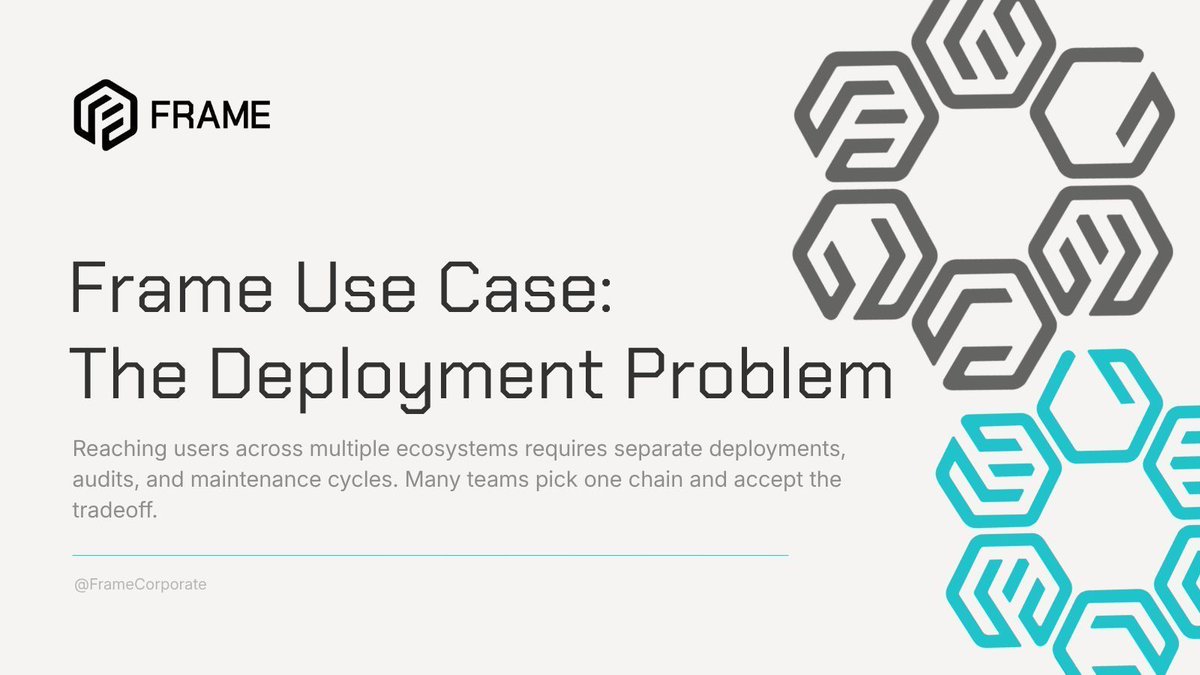
Fragmented blockchain infrastructure acts like a developer tax.
Teams often manage separate deployments, audits, and maintenance cycles just to reach users across ecosystems.
Many choose one chain and accept the tradeoff.
Frame was built to reduce that complexity. #blockchain
Multi-chain deployment has traditionally required separate audits, codebases, and maintenance cycles.
Frame was designed to reduce that overhead through unified infrastructure.
#Web3#infrastructure
Cross-chain infrastructure does not need to rely on custodial asset transfers.
Frame was designed so connected chains can settle directly, without holding assets in transit.
#DeFi#infrastructure
A tokenized real estate deal.
$2.4 million held in a custodial bridge for 48 hours while settlement cleared.
That is the standard architecture.
Frame holds no assets in transit, reducing transit-layer risk.
$CRCW
Cross-chain liquidity is one of those problems that looks solved from the outside and isn't. 🌐
Every ecosystem has its own pools, its own pricing, its own slippage. Moving between them means either accepting bad rates, using a bridge or splitting the trade across multiple transactions and hoping the price doesn't move between them.
Unified liquidity across chains is one of the infrastructure problems Frame is being designed to sit at the centre of rather than work around. 🏗️
Global payroll is notoriously difficult for a 14-country remote team.
Frame gives businesses a way to settle across connected chains without correspondent banks, custodial transit, or multi-day wire delays.
#blockchain#payments
A 200-person remote team. Fourteen countries. Payroll runs every two weeks.
International wires can take days and add unnecessary friction to moving value globally.
Frame was designed to simplify cross-chain payments and coordination across blockchain ecosystems.
$CRCW
Crypto has a perception problem that the industry mostly created itself. 📊
The loudest voices have historically been the ones promising the biggest returns on the shortest timelines, and when those promises didn't land the credibility damage spread to everyone building seriously in the same space. 📢
Infrastructure that aims to be used at institutional scale can't be built on that foundation.
Trust takes longer to build than a token launch and it doesn't come back quickly when it breaks. 🏗️
When a new chain launches, the market gets more opportunity and more complexity.
Frame is built for a connected model where new ecosystems can expand access instead of adding another isolated destination.
#blockchain#Web3
Cross-chain activity introduces architectural complexity across networks, liquidity, and settlement.
Frame is designed around a different approach focused on unified routing and reducing reliance on assets moving through intermediary pathways.
#blockchain#Web3
Bridge risk is not only about user experience. It is also about architecture.
TCC’s focus with Frame is infrastructure designed to reduce reliance on wrapped assets, fragmented liquidity, and assets held in transit between networks.
$CRCW #blockchain#Web3
As new blockchain ecosystems emerge, the market need for connectivity increases.
TCC sees Frame as infrastructure designed for that reality: a way to connect ecosystems as digital asset activity expands.
$CRCW #blockchain#Web3