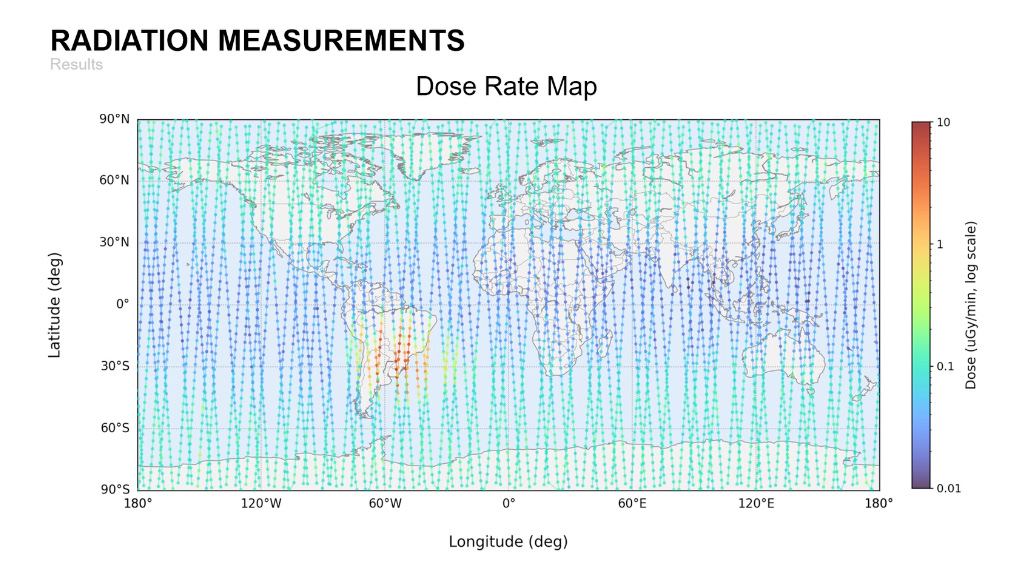
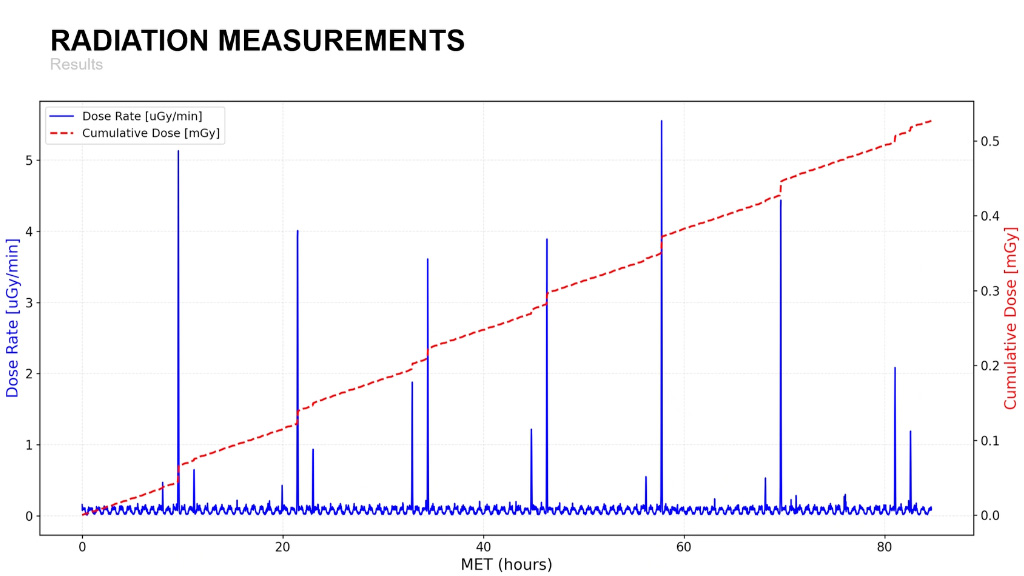
Prior to fram2, many people were concerned about polar radiation. However, it was actually the South Atlantic Anomaly that contributed a significant portion of our radiation dose.
A spike is visible each time we flew along ~45°W longitude. By flying in a polar orbit, we actually spent less time crossing the SAA than we would have in a 51.6° ISS-like orbit.
My Fram2 interview with the Pilot of the Mission!
I have been waiting for over a year to talk to some of the four amazing humans who were the first to orbit the poles on a SpaceX Crew Dragon last year. I really loved this interview, hope you enjoy too.
https://t.co/9k3xlL7fBb
Honored to receive the Astro Award presented by Everyday Astronaut. Today, it’s hard to picture space culture without @Erdayastronaut, @NASASpaceflight, and @DJSnM. I’m old enough to remember the days of Spacevidcast / TMRO, Bad Astronomy and Universe Today, when space on the Internet felt smaller and fragmented. Then Everyday Astronaut arrived and changed everything. He doesn’t just cover launches. He has helped educate an entire generation about space and how spaceflight works, keeping imagination alive while anchoring it in reality. Without his work, our sense of possibility would be far narrower, and we likely would never have come together as a community in the first place. I really hope one day someone will give dearMoon a second life, and perhaps one day Tim himself will become a real astronaut and receive his Astro Award. Either way, future missions will fly a little higher because of what he has built.
🇳🇴 HRH Princess Ingrid Alexandra received Jannicke Mikkelsen, the first Norwegian woman in space.
Mikkelsen shared her experiences from the Fram2 Space Expedition, which earlier this year carried out the very first manned space mission in polar orbit.
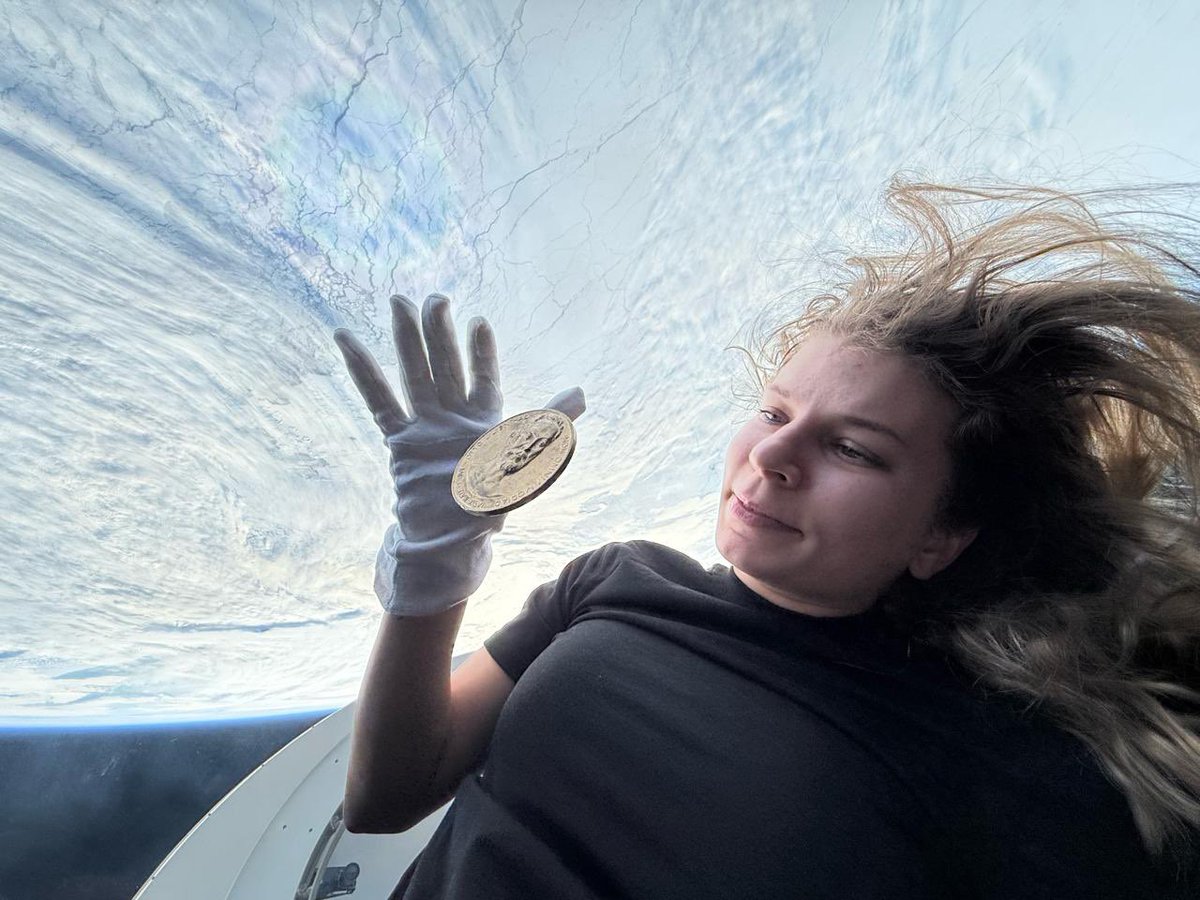
During the audience, she presented a Norwegian flag that has been part of the journey 56 times around the Earth, over both the North Pole & the South Pole.
Die erste Deutsche Astronautin @rprogge hat uns heute in Bonn besucht. Danke für den inspirierenden Vortrag und die fantastischen Einblicke in deine #Fram2 -Mission! Und danke für das signieren deines Portraits für unsere Astronauten & Astronautinnen-Galerie!
Heard Island and McDonald Islands (ISO 3166-2:HM) is one of the most difficult countries/territories on ISO 3166 for any human to legally set foot on. You would probably have to organize your own scientific mission in order to be granted access. Our crew member, @icetrek Eric Philips, was lucky enough to set foot here in 1996.
Another is, remarkably, U.S. Minor Outlying Islands (ISO 3166-2:UM), as the @USFWS has not issue any permits in recent years, with a notable exception of President Obama’s visit to Midway Atoll in 2016. I also searched for Bouvetøya (ISO 3166-2:BV) while in orbit, unfortunately, it was covered by clouds.
When I saw this with my own eyes, one thought that came to mind was the famous opening line from A Tale of Two Cities by Charles Dickens: It is the best of times for fishing, it is the worst of times for fish…
Title: DracoStyle [Evolved]
Feat. very special guest: The spacecraft itself
As an intermezzo between the science: A short synth session, blending technology into music, to also give the arts some room on the mission. A little freestyled at the end!
@framonauts and original track title by @satofishi
Ever wondered what information your saliva holds? Turns out, quite a bit!
Project: Saliva sampling for stress response 🫧
Question: How does stress quantifiably influence us in unknown environments?
Fun facts:
- Saliva can be used to measure a multitude of interesting markers: Hormones, enzymes and even DNA
- One drop of saliva was shown to contain more than 5,000 proteins, making it rich in information
- In particular, stress can be measured via a hormone called Cortisol
- Cortisol spikes during stressful situations
- Saliva might even replace blood sampling as an easier go-to solution
Institutes: LMU University Munich, Lusófona University Portugal, University of South Wales
Find the full list of projects here: https://t.co/UdY6Kmgh7v
@framonauts
Another fun (and active!) series of experiments on our @framonauts mission.
Project: Efficient Exercise 💪🏻
Question: How can we a) shorten necessary exercise time and b) develop a portable device for use in space?
Fun facts:
- We tested blood flow restriction (BFR) training with a compact resistance device
- BFR limits blood return from muscles, simulating high-load workouts using much lighter weights
- This causes micro-damage in muscle tissue (similar to regular intense exercise) triggering growth and repair
- In microgravity, regular exercise is essential to prevent muscle atrophy and bone density loss
- Astronauts currently exercise 2+ hours a day - our goal is to reduce that without losing benefits.
- The tested device is lightweight, portable, and could save valuable time and space onboard missions
Institutes: Northumbria University, Sheffield Hallam University
Find the full list of projects here: https://t.co/UdY6Kmgh7v
#fram2
Music creds: jiglr - Lapse
We clearly see large leads (cracks) in the Arctic Ocean ice below @rprogge while on orbit.
Here’s how we cross narrow leads while skiing to or from the North Pole.
I got to talk to the FRAM2 astronauts while they were in polar orbit! This was the first ever crewed mission over the north and south poles. Stick around to the end to see my footage of them splashing down from a plane! @framonauts