Thrilled to be emceeing this 250th Revolutions in Science Symposium @theNASciences@smithsonian in DC on June 25th, and interviewing chemical engineer/inventor Robert Langer and @NobelPrize winner @francesarnold! https://t.co/CWOTzHarlh
Honored to be a part of this year's C&EN Talented 12 cohort! All credit goes to my research group https://t.co/Kez8PQ178K for their supreme efforts in pushing the boundaries of what enzymes can do, and to the support of my mentors @uclachem@CaltechCCE@IISERPune@ChemistryUIUC
Researchers in Science report a kilogram-scale synthesis of enlicitide, a peptide drug for lowering low-density cholesterol that is in a Phase 3 clinical trial.
This new synthesis route leverages engineered enzymes and crystallization of key intermediates, substantially cutting down the number of reaction steps while improving yield. Learn more in a new #SciencePerspective: https://t.co/2g5nUA7d9G
Many experiments in biology happen one protein at a time, which means synthesizing DNA one gene at a time. This is fine for tens of genes. For thousands, the cost is unsustainable.
Introducing uSort-M: a method to isolate and sequence-verify thousands of genes at low cost
Our review on AI for protein engineering is out now, about this too-fast-moving field full of hype and overclaim, yet one that is having a real impact on the world and can be described in a coherent manner without histrionics
https://t.co/woOWuyTV5R
What if AI could invent enzymes that nature hasn’t seen? 👩🔬🧑🔬
Introducing 🪩 DISCO: Diffusion for Sequence-structure CO-design
14 rounds of directed evolution and over a year of wet lab work. That's what it took to engineer an enzyme for selective C(sp³)–H insertion, one of the most challenging transformations in organic chemistry.
DISCO surpasses this with a single plate. No pre-specified catalytic residues, no template, no theozyme, no inverse folding, just joint diffusion over protein sequence and structure.
📝 Blog: https://t.co/j9Za0JigfO
📄 Paper: https://t.co/ficrYNBBrM
💻 Code: https://t.co/p81sSwoaPH
Congrats to my colleagues in the @francesarnold lab @jarridrb and @ChengHaoLiu1 and their co-authors for their fantastic work pushing the new frontier in enzyme design space!
I am cheering you on as if you did 20 uninterrupted strict pull-ups 💪
What if AI could invent enzymes that nature hasn’t seen? 👩🔬🧑🔬
Introducing 🪩 DISCO: Diffusion for Sequence-structure CO-design
14 rounds of directed evolution and over a year of wet lab work. That's what it took to engineer an enzyme for selective C(sp³)–H insertion, one of the most challenging transformations in organic chemistry.
DISCO surpasses this with a single plate. No pre-specified catalytic residues, no template, no theozyme, no inverse folding, just joint diffusion over protein sequence and structure.
📝 Blog: https://t.co/j9Za0JigfO
📄 Paper: https://t.co/ficrYNBBrM
💻 Code: https://t.co/p81sSwoaPH
"At @time8machine, we believe in the usefulness of 'useless' knowledge. As Nobel Laureate Frances Arnold reminds us, the knowledge we explore purely for the sake of curiosity today is often the foundation for the essential breakthroughs of tomorrow. We are here to do the exploring that the future will depend on."🗝
I am honored to be joining the Scientific Advisory Board of the @UN https://t.co/gk0cz7dT4y
The Secretary-General's Scientific Advisory Board and its associated global network of scientific institutions advise UN leaders on breakthroughs in science and technology – how to harness the benefits of these advances and mitigate potential risks. The Board provides independent insights on trends at the intersection of science, technology, ethics, governance and sustainable development to support UN System organizations in anticipating, adapting to and leveraging scientific advancements in their work for people, planet and prosperity.
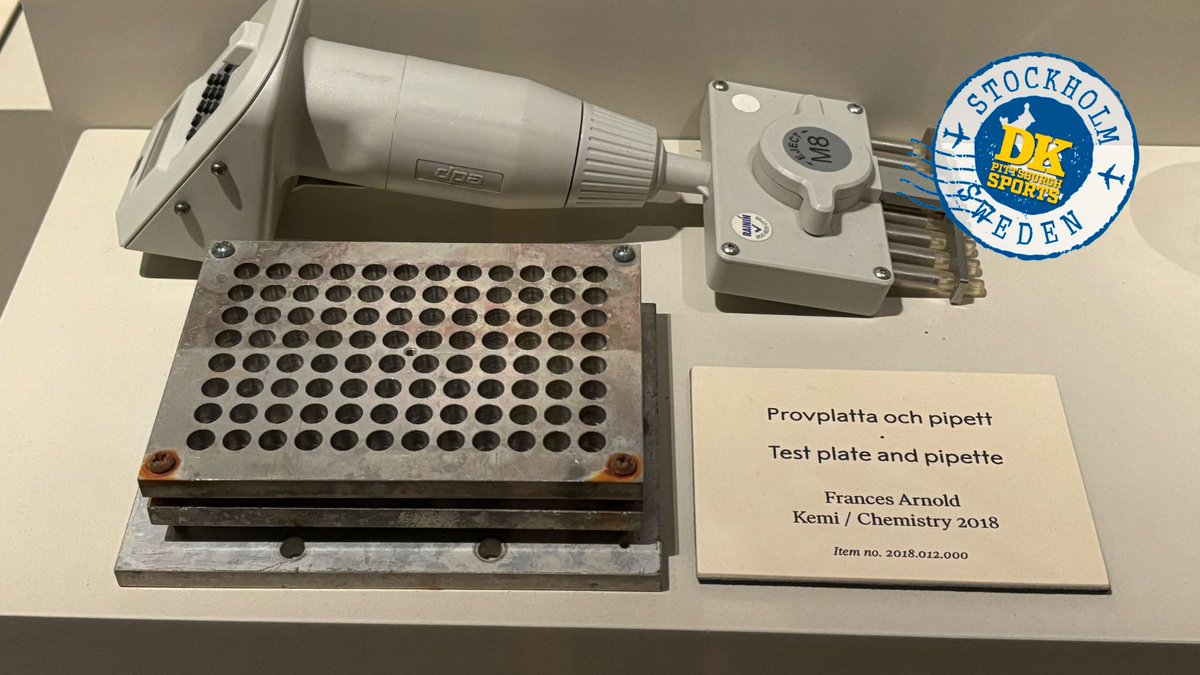
Stockholm is home to the Nobel Prize Museum, which has an exhibit on Pittsburgh's own Frances Arnold -- the first American woman to win the Nobel Prize in Chemistry!
More FREE coverage of the #Penguins' trip to Sweden: https://t.co/5gIf6mxqFo
One of the quiet failures of our time is how rarely we humanize science.
We celebrate breakthroughs and technologies, but too often we lose the people behind them. The curiosity, doubt, persistence, and moral weight that shape real discovery. When science feels abstract, it becomes easy to dismiss or distrust.
Through��New Heroes, a long-form project created with @theNASEM, I set out to do the opposite. To slow down. To listen. To photograph scientists, engineers, and medical leaders as humans first.
This collection brings together some of the most inspiring minds of our time, including Jennifer Doudna, @francesarnold, Saul Perlmutter, Steve Chu, David Baker, @demishassabis, Carolyn Bertozzi, etc...
The goal isn’t hero worship. It’s connection. When we see the people behind the work, science becomes relatable, accountable, and worth defending.
The full body of work lives on https://t.co/YuBRXFhRPH, where the stories can unfold beyond a single image.
If we want a future guided by evidence and wisdom, we need to tell better stories about the people doing the work.
https://t.co/50KSN00dM2
Excited to co-found @Merge Labs!
TLDR: We’re developing a new paradigm for BCI using molecules instead of electrodes. If you’re excited about this and want to contribute in protein engineering, synbio, delivery, immunology, ultrasound, devices, neuroscience, or data/ML/AI, we’d love to hear from you.
https://t.co/YbMqQwePWv
https://t.co/XEG7p4NOCI
🧵
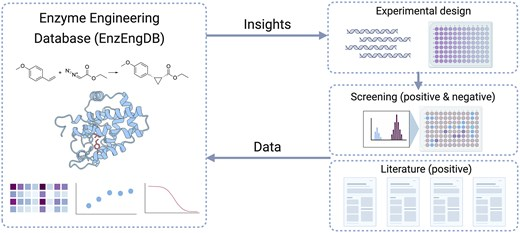
Enzyme Engineering Database (EnzEngDB): a platform for sharing and interpreting sequence–function relationships across protein engineering campaigns
@francescazfl@jsunn_y@francesarnold@arianemora_
"Science provides creative new solutions."
Frances Arnold gave us her takeaways from today's Nobel Week Dialogue: Health For All.
If you missed the live event, you can watch it here: https://t.co/oPpbBvdJIn
Frances Arnold (@francesarnold) pioneered the process of directed evolution — mimicking natural selection to create new enzymes that have changed everything from agriculture to laundry. https://t.co/HfYoahWLub
Thrilled to share the first paper from our group at UCLA, online today in Science: “Biocatalytic, Asymmetric Radical Hydrogenation of Unactivated Alkenes”
@uclachem@ScienceMagazine
https://t.co/YCtGp91kd2