The most basic way AI could blow up imo. I'm not saying it does but this is the most obvious way I can see it happening
- Per seat subscriptions are massively subsidized. The flat fee was priced way below what heavy usage actually costs
- For real business use you have to move to the API anyway. Data protections, work integrations and compliance officer approval
- On the API you pay metered rates, and businesses are burning credits way faster than the per seat pricing ever led them to expect
- This is everywhere right now. Internally for us, Codex users, Uber torching its entire 2026 AI budget in 4 months, the Microsoft comments. Just go try an API
I shared more on this here: https://t.co/iZrqrCAIRW
- And I don't think most businesses have the money to keep paying increasing API rates without a real change to how they operate (caps needed)
- Because they have a cheap alternative. They can reach open source models through any aggregator (OpenRouter, Venice, Baseten, Together) and still get strong privacy. Venice private data centers, or E2EE/TEE serving GLM 5.1.
More on open source inference provider raises here: https://t.co/7kf56P44yQ
- And the discount is enormous. DeepSeek V4 codes within a hair of Opus on SWE bench at roughly 1/30th the price, and the cheapest open models run closer to 1/100th
- Chinese labs open source frontier grade models. The model is the single biggest cost an inference provider has, and they get it for free
- This idea dies if China goes closed source. That is actually bullish web2 AI labs, because if everyone is closed you pay up for the best intelligence. China goes closed source if they are tired of giving away an asset and they want the revenue and data flow to train new models
- Is this showing up in web2 AI lab revenue yet? No. Revenue is off the charts. Anthropic went from 9B to 47B run rate in five months
- So go forward, what happens?
- I think revenue slowly starts leaking to the open source inference providers (see Venice usage, OpenRouter's $113M raise, Baseten is raising at $11B or triple its valuation in three months, on revenue that went from $200M to $600M annualized in a single quarter)
- It doesnt move overnight, but it caps the labs ability to raise prices, and margins are already deeply negative. OpenAI is reportedly running near negative 122%
- With margins that bad there is no cash flow, so the labs are fully dependent on outside capital to buy GPUs, train models, and keep subsidizing usage (I.e. see Google tapping $80b equity sale, granted 30b for employee RSU taxes. Clearly they think Equity is overvalued or you wouldn't sell it)
- The break comes when that capital stops. Pricing is capped so margins cant improve, and the moment investors lose conviction on payback, the whole flow reverses
- Why would they lose conviction on payback? Back to the start - the inability to improve margins or get businesses to pay more
- This is also limiting, if we start making new drugs with AI or create entirely new businesses, you better believe people will pay up to the max for AI usage
@GarrettLord Just to stress test, couldn’t you infer that opinion if you had good reference data at inference time (in this case, recent corpus of decks)?
For AI to have true taste, internal expertise is necessary but not sufficient. How do you distill decades of learning what users want?
The solution is not a company brain, it’s scaled reference data. I know this works, because we’re building it.
Imagine replacing 90% of your employees with a team of geniuses who have no idea how your company operates.
Total chaos. Nothing works.
That’s what AI feels like today.
The missing piece is extracting all the domain knowledge from people’s heads and providing that as structured context to the models.
@TurnerNovak in my experience, this type of fomo is strictly harmful to build anything meaningful which, turns out, is the best way to make huge amounts of money
When Photomath topped App Store charts we
saw ~1 new copycat a month. Most tried paid ads to grow and died in <6mo
The ones that still exist had deep pockets and could afford to play it long like Gauth (bytedance), microsoft
You no longer need deep pockets to copy, esp for pure software plays. I think we’ll see lots more of this.
General Catalyst just co-led a $31.5 million seed round into a blatant rip-off of my company, Kled.
(skip to 40 seconds if you want to skip context)
I would typically not speak on things like this, but this level of blatant copycatting is egregious and completely unacceptable, and needs to be made an example of.
This is one of hundreds of YC startups who have conducted this disgusting behavior. Unimaginative slop that continues to get rewarded due to nepotism.
Telling that health is # 1 yet I’ve yet to know a single person who has benefitted this way for being such a primary use case
There’s a human gap between health advice and actual healing and it is about 2 inches from closing. We just need the right products in the loop
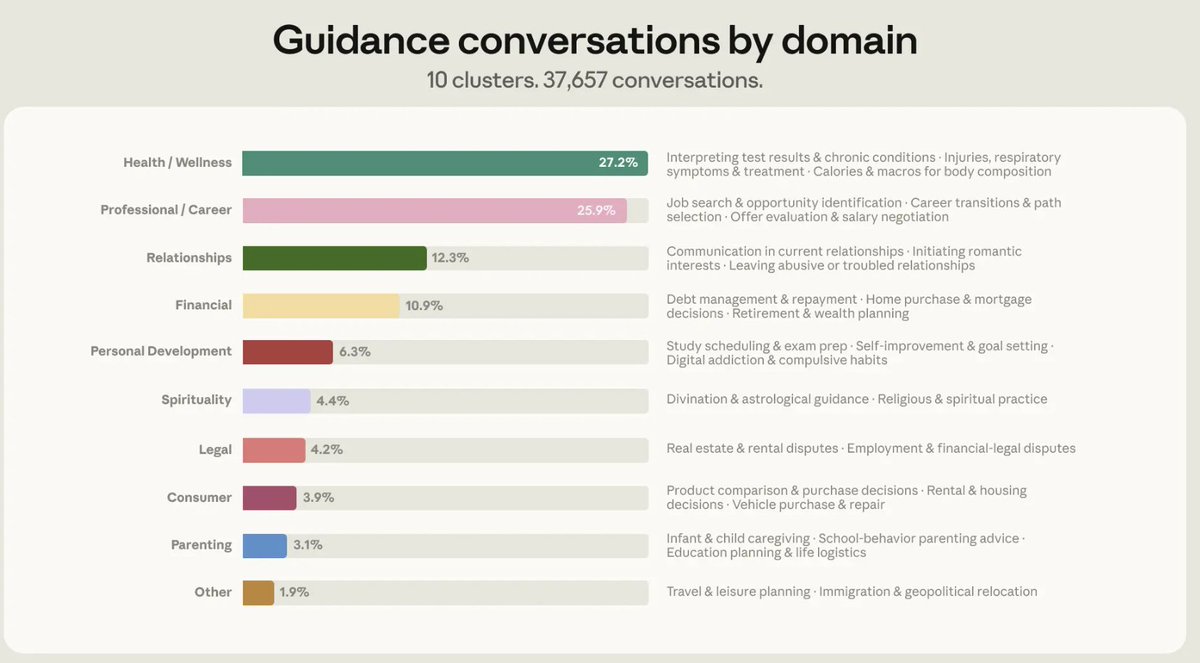
How are consumers using AI in their personal lives?
New analysis across ~40k Claude conversations 👇
The biggest category is health / wellness, followed by professional / career. There's a big dropoff to #3 (relationships).
If there's one thing to take away from Anthropic drama its that silicon valley is structurally opposed to pessimism
pessimism in venture means missing the deal that returns the fund 100x
for better or worse, that pattern broke for the first time w anthropic
i would argue that this is not about lack of interventions offered, more about complexity of the possible problem
ibs for example - there's LOTS of great progress being made in the last 10 years in diagnostics and treatment (esp for sibo/imo). its easy for physicians to prescribe anti-biotics and move on, but patients will relapse if underlying cause goes untreated
@doctorbhargav Agreed! I’d love your eyes on what I’m building. Mostly client facing atm but could see clinicians using it for chronic illness patients: https://t.co/YzK8a8swKC
I built a tool to help diagnose the root cause of my chronic pain.
After being diagnosed with MCAS & SIBO, I've spent the last 3 years feeling like each new diagnosis, test, and doctor’s appointment was like starting over. In theory each of these should be new data points that help progress toward definitive set of diagnoses and symptom relief- but reality is a lot messier. Physicians are limited in time, by the quality of their notes. I'm limited by my own knowledge and honestly desperate to find answers and relief.
So I built this to help diagnose myself, or at least narrow what could be wrong. It treats chronic symptoms as a probability distribution across different mechanisms in the body that could cause them. With each data point, AI helps update the probability of each, narrowing the set as more is learned. I've found this to be really helpful in peeling back all the layers of the onion behind my SIBO/chronic-GI symptoms.
honestly chatgpt images 2 might be better at ui design than any of the existing ui design tools. both in it's output, as well as efficiency
i dont really need a clickable prototype if i am just copy/pasting a screenshot into claude code anyway