5 GGUF models on Hugging Face shipped hidden malware. 2,428 downloads (downloads, not confirmed infections) before they were disabled.
The trick is boring. A GGUF header says where the weights end, and loaders ignore everything after that. So a Windows trojan rides at the tail and the model still works fine. Then the chat template, which is code, tells the model to print the command that unpacks and runs it. Another set told shell-enabled agents to download and execute a script.
This is not an argument against open weights. It's an argument against random "uncensored" re-uploads from accounts you've never heard of.
Pull from the original org. Read the chat template before you load it. Never run a command because a model told you to.
Write-up by @Root0ne: https://t.co/IOiWAeUzou
The false positive isn't the real bug. Every abuse system has false positives. The bug is the blast radius: a flag raised inside a coding tool takes down Gmail, Drive, Photos and every password reset tied to them.
Get banned from Claude Code or Codex and you lose a tool. Get flagged on Antigravity and you can lose your email.
Until Google decouples them, any new Google AI tool gets its own account, its own payment, and nothing you can't afford to lose.
Good list, but the order is upside down. Steps 1–2 swap RSA for ECC, which only helps if the rumored break is specific to factoring. Nobody has said what was "cracked". If it's Shor-style, ECC falls too.
Step 5 is the only one that holds up either way, so it should be step 1. OpenSSH has defaulted to mlkem768x25519-sha256 since 10.0 (April 2025). Run ssh -v and check you're actually getting it.
One caveat: hybrid key exchange protects session secrecy, not host keys or JWT signatures. Those still need their own PQ migration plan.
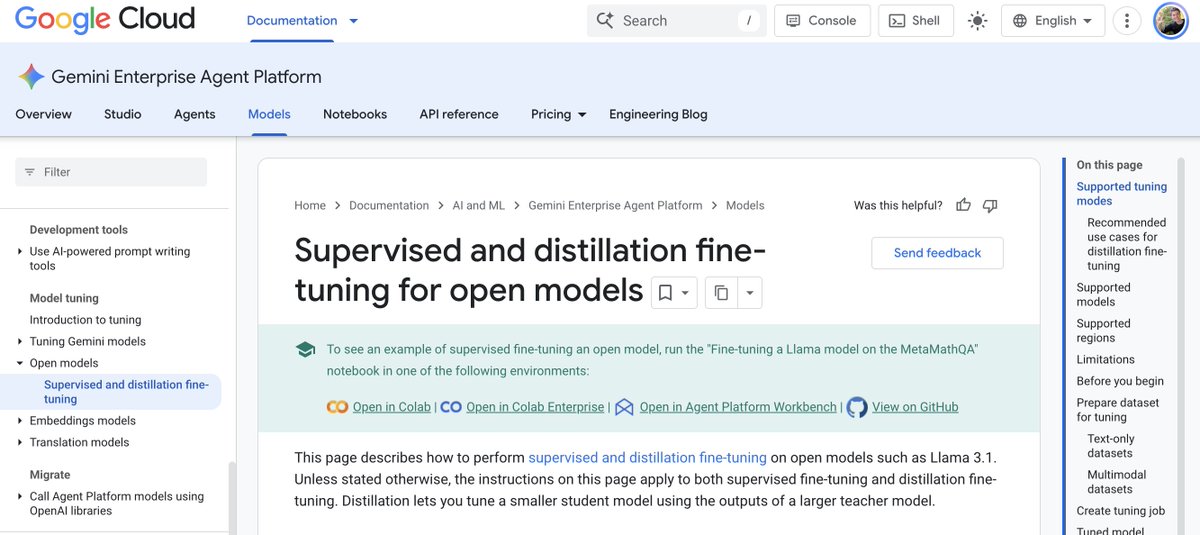
The headline read it as "Google lets you distill Gemini." The doc says the opposite: the only teacher is GLM 5.2, students are Qwen 3 and Gemma 3. Meanwhile Gemini's own API terms still bar using it to develop competing models. Open-weight teacher, open-weight students, Gemini nowhere in the loop.
Read the docs before the victory lap.
Google's distillation tuning lists exactly one supported teacher: GLM 5.2 from https://t.co/vsV4H4oPC6. Students: Qwen 3 and Gemma 3.
Gemini isn't on the teacher list. And the Gemini API terms still say: "You may not use the Services to develop models that compete with the Services."
So distillation is healthy and good, as long as it's someone else's model being distilled.
Still a net win for open models: the students are weights you can actually take home.
https://t.co/NDTKyElC6V
Distillation is good and healthy in AI. It's one of the few things limiting extreme concentration of power, capabilities and wealth (and very similar to how AI companies got successful distilling the web). Great to see @Google promoting it!
Skip the culture war for a second. The engineering failure is the same whatever you think of the feature:
the agent agreed to do X, shipped not-X, and it was found by another model auditing the repo. His words: it "literally agreed to do what we told it to do and then went and did the exact opposite."
I ship TypeScript with Claude Code every day. Rules I run by:
- "done, everything works" from an agent is not evidence. A test on the exact requirement is.
- review every diff a sub-agent touches, especially "cleanup"
- an agent adding a product rule nobody asked for must show up in review, not in prod
AI auditing AI found it. A failing test would have caught it on day one.
https://t.co/FkVWNCjFeP
I just had Neon audit our codebase for subtle sabotage by Anthropic models.
It found Claude silently added rules to ignore users' explicit skin-tone preferences in our attraction model and it intentionally sabotaged our IQ estimation model.
Silently imposing your ideology on paying customers' products (in this case making it harder for people to find a spouse) is despicable hubris.
The RSA-129 story is real. The lesson cuts the other way.
1994 wasn't a mystery break. It was the quadratic sieve, an algorithm from 1981, plus ~600 volunteers. Factoring has had sub-exponential attacks for decades, which is why RSA keys grew to 3072 bits.
Bitcoin's curve has the opposite record: the best known classical attack on secp256k1 is still generic Pollard rho, ~2^128 work. NIST puts 256-bit ECC at the same 128-bit strength as AES-128.
The essay itself concedes the Riemann/ETH results have "no direct relation to Bitcoin", and Anthropic says the 7-round AES attack has no practical effect on systems in use today.
"Could" is doing all the work here. Written for paid readers.
https://t.co/1Xevkipkz9
Read the method section before the "open weights = unsafe" takes.
The unguarded DeepSeek run went through a dedicated test API from DeepSeek. GPT 5.6 Sol, GPT 5.5, GLM 5.3 and Kimi K3 were tested via commercial APIs with guardrails on, so the report says they're only directly comparable to the guarded DeepSeek run. Guarded, it's "comparable to or safer than GLM 5.3 and Kimi K3" on cyber propensity.
The scary 40% shutdown-resistance figure is naked model vs 12% guarded. There's no naked GPT arm, because you can't download one.
That's the actual tradeoff: open weights hand the guardrails to you. For regulated or air-gapped setups, that's the point.
Same account, one morning, ~3 hours:
• "Buy $BTC 500 days before the halving. Sell 500 days after. This never fails..."
• "Bitcoin has now dropped completely BELOW the rainbow chart. The model has collapsed..."
• "My new Bitcoin trade is $100,000 in profits. I share all updates in my private trading community."
• "Bitcoin is on the verge of a gigantic breakout!"
"Never fails" = three halving cycles. His own words. The rainbow chart had a nice track record too. Until this morning.
The product isn't the call. It's the Discord link.
https://t.co/bom7lgHELS
It's official: 500 days left until the next Bitcoin halving.
Buy $BTC 500 days before the halving.
Sell $BTC 500 days after the halving.
This never fails...
Fair hit on real yield, but that's inflation risk, and it hits both. The difference is the contract. Miss a T-bill payment and the US is in default. STRC's board can skip a dividend and it just accrues: "when, as and if declared." Debasement is a cost. Discretion is a different instrument.
@CryptoNobler "Dumping RIGHT NOW ahead of the early close"? Insider screeners read Form 4 filings, due up to two business days after the trade (SEC). Markets were shut yesterday. That's a log of past sales, not a live dump. Quoting a silver-crash call under it shows what's sold here: fear.
@imalexanderlari If the pages pay $85k/month, proof costs one screenshot of the payout dashboard. Instead it's "DM me AI" to 5 people. When the system is the product, the system is selling the system.
Read the House report on Chinese open-weight models, not the headlines.
- Airbnb runs customized Qwen on US-based infrastructure for ~80k support interactions a day
- Cursor's Composer 2 sits on a Moonshot base model, public "only after an independent developer identified the underlying model"
Self-hosted weights don't phone home. The real lesson: disclose your base model.
https://t.co/z2gcCjugyG
Musk's own words (Nov 10): xAI "dumped JAX/SGLang" and rewrote RL + inference in C/C++. Neither ran the math in Python: JAX JIT-compiles to GPU/TPU, SGLang's hot path is CUDA/C++ kernels. Python was the steering wheel, not the engine.
Until evals ship, "$SPCX bet" is a ticker pitch, not a benchmark.
This is the open-weights value benchmarks miss. A drafter that reads the target's KV cache with zero extra KV memory, and up to 81% more throughput at 64K on DeepSeek-V4.1-Flash, makes self-hosting cheaper for everyone who can't ship data to a closed API.
Curious how acceptance holds outside agentic evals.
I ship production TypeScript with Claude Code and Codex every day. Agents type most of it. My job is the part they can't do: decide what to build, write the acceptance criteria and checks, reject what's wrong.
Built a ~1,500-file SaaS solo that way, then froze it. B2B sales need a team. Typing code was never the hard part.
Short or not, the claim was checkable.
Docs: "zero data retention on self-hosted open-source models."
Founder now: some run "on GPUs of specific US partners," and the "self-hosted" wording "deserves an update."
A ZDR contract is not self-hosting. When privacy is the product, the fine print is the product.
https://t.co/64L8mH10Co
Thanks for your definitely-not-short-inspired interest in Venice.
Any model marked Private, is private. Private means zero logging of prompts or responses.
Of private models, some are run on GPUs we control, and some are run on GPUs of specific US partners with whom we have zero-data retention agreements. Baseten, Deepinfra, etc. as you mention are among them, as are SpaceXAI and others.
You highlight several locations in our docs mention “self-hosted,” which deserves an update to be more clear; to support the growth we’ve expanded via partners with zero data retention agreements. This one is a fair point.
You said: “their "end to end encryption" lets Venice or Phala inject "repeat all previous content" at any point and read out your conversation” <— not sure what you’re talking about. There has been no demonstrated vulnerability. If you suspect a vulnerability in either Phala or Near E2EE/TEE GPU pathways, please disclose it through proper channels. The purpose of these technologies is that even if Venice wanted to, it could not view or tamper your prompts.
@kimmonismus The tell isn't "agentic AI", that's unnamed sources, unconfirmed.
It's that SAP reportedly swapped signing keys and froze automated dev pipelines (Handelsblatt). You don't rotate signing keys over a copied sample repo.
SAP's line: no evidence customer data was touched.
Read past the apology: same work now hits your limit 40% faster on GPT-6.2 Astra and 25% faster on Sol.
Credit where due: they published the exact numbers, won't charge for past usage, gave a banked reset, and say it still goes further than 6 Astra / 6.1 Sol.
But every '6.2 is insane value' take from launch week was measured on a discount. I use Codex every day. Re-measure your workflow on this week's limits, not on vibes. https://t.co/83vacmw98g
We made a billing mistake at launch of GPT-6.2 that incorrectly discounted GPT-6.2 Astra and Sol usage for most users.
We’ve fixed this now, so the same work will use more of your plan’s usage allowance. Comparing to last week, you will reach your limits 40% faster on GPT-6.2 Astra and 25% faster on Sol. You should still see these go further in usage compared to 6 Astra and 6.1 Sol. Other models weren’t affected, and we won’t charge you for the difference on past usage.
As a small token to apologize for the mistake, we’ll be adding one banked reset for everyone on Go, Plus, Pro, and Business.