Four quantum numbers alone force the chemical elements into this diamond lattice of shells and orbitals. The integer n labels each shell.
s, p, d and f orbitals hold 2, 6, 10, 14 electrons from the quantum number l.
This geometry solves the multi-electron Schrödinger equation. It dictates semiconductors in chips, catalysts in chemistry, and materials for quantum devices.
What appears as a table of matter is pure quantum mathematics made visible.
The deeper you go, the less “solid” matter looks.
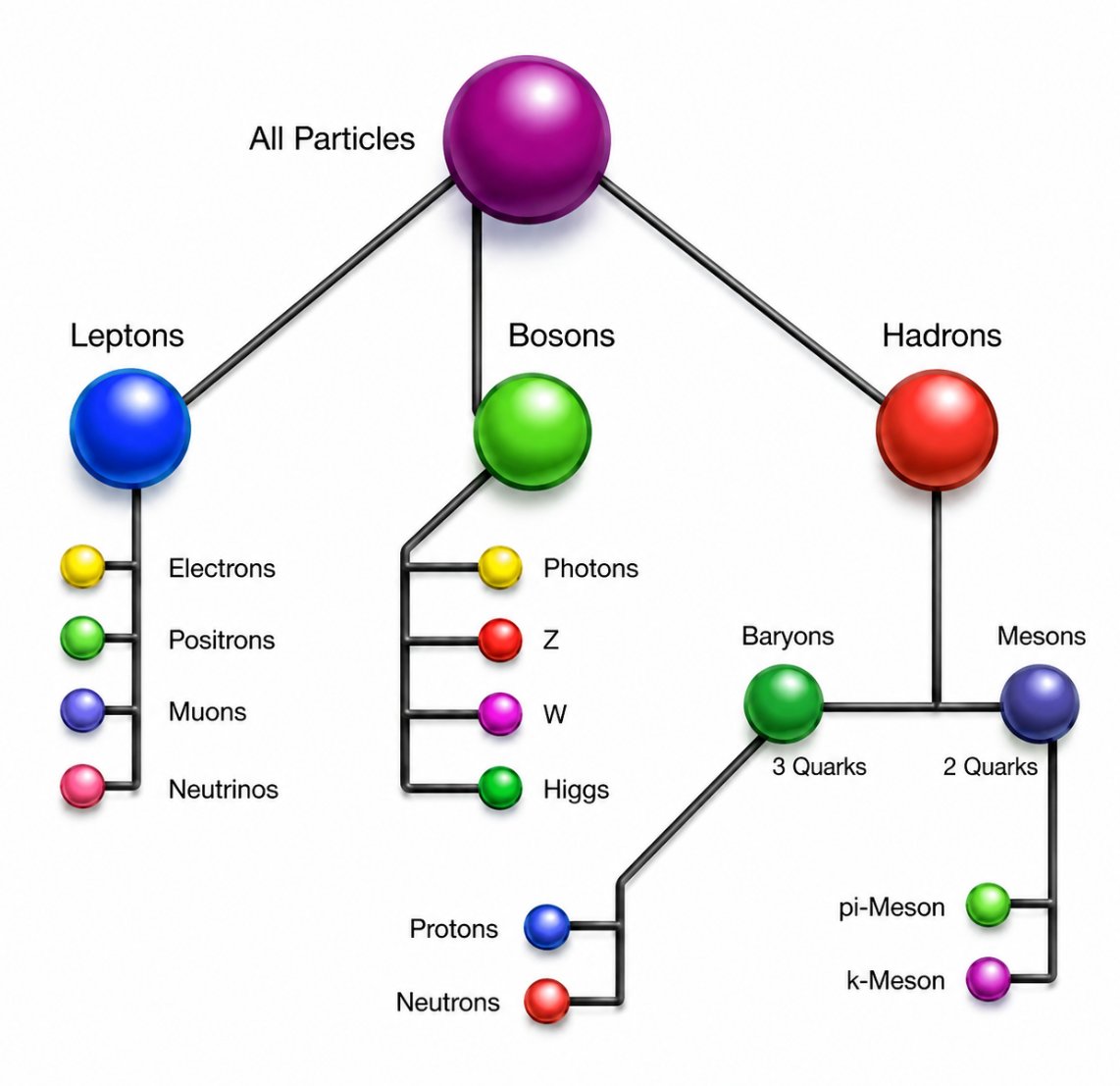
Electrons and neutrinos are fundamental particles. Protons and neutrons are composite, built from quarks, while mesons are quark–antiquark states. And the Higgs and gauge bosons belong to a completely different part of the particle zoo.
Every continuous flow hides expansion and rotation.
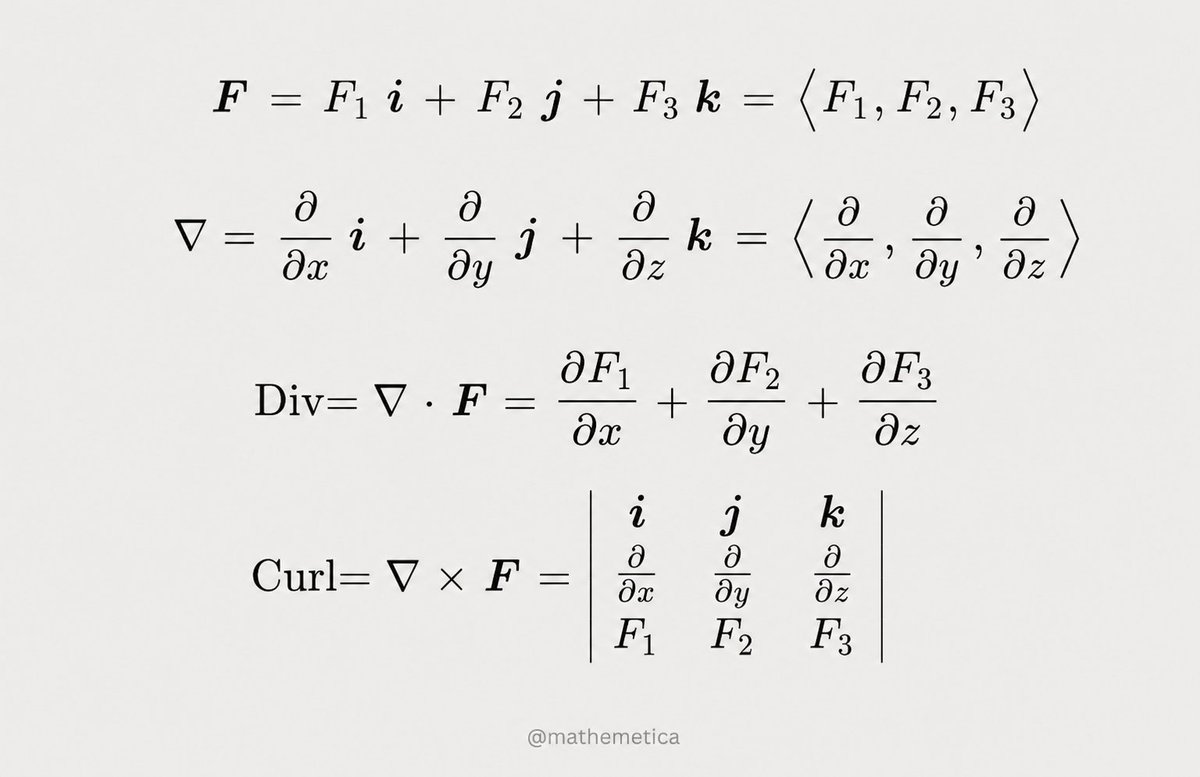
Divergence quantifies the net source or sink:
∇ · F = ∂F₁/∂x + ∂F₂/∂y + ∂F₃/∂z
Curl measures the local spinning:
∇ × F = | i j k |
| ∂/∂x ∂/∂y ∂/∂z |
| F₁ F₂ F₃ |
These operators form the heart of Maxwell’s equations for light and magnetism, and power fluid simulations in aerospace design and weather models.
Invisible structure becomes computable insight.
Where have you seen divergence or curl shape a physical system outside pure math?
e appears in mathematics through four primary characterizations.
It is the limit as n→∞ of (1 + 1/n)^n, linked to maximum compounded growth. It also equals ∑_{n=0}^∞ 1/n!.
The integral from 1 to a of dx/x defines ln(a), and ∫_1^e (1/t) dt = 1. The derivative of e^x equals e^x.
It is used to model continuous compound interest in finance and exponential growth in biology and physics.
Leonhard Euler (15 April 1707 – 18 September 1783) was a Swiss mathematician, physicist, astronomer, engineer, and logician who is widely considered one of the greatest mathematicians of all time. He was born in Basel and studied at the University of Basel under the guidance of Johann Bernoulli.
In 1727, Euler joined the Saint Petersburg Academy of Sciences in Russia, where he began producing groundbreaking work in mathematics and science. He later worked at the Prussian Academy of Sciences in Berlin before returning to Saint Petersburg, where he spent the rest of his career...
Vector calculus in its purest form: the gradient, divergence, and curl.
These three operators are the language we use to describe how fields change in space. The gradient shows the direction and rate of steepest increase for a scalar like temperature or pressure. Divergence tells us whether a vector field is spreading out or squeezing in, exactly what you need for fluid flow or electric fields. Curl captures the local rotation or swirling motion inside the field, the reason magnetic fields form loops around currents and why vortices appear in rivers or air.
From weather modeling and aerodynamics to Maxwell’s equations and optimization algorithms, these are the tools that turn raw math into real-world predictions.
Maxwell's equations, formulated by James Clerk Maxwell in the 1860s, are four fundamental equations that describe how electric and magnetic fields interact and propagate. They unify previous discoveries in electromagnetism, including Coulomb's law, Ørsted's discovery of the magnetic field around a current, Ampère's law, and Faraday's law of induction. Maxwell's introduction of the displacement current completed the theoretical framework, predicting that electromagnetic waves travel at the speed of light and thus revealing the electromagnetic nature of light itself. Oliver Heaviside later simplified Maxwell's original 20 equations into the four vector equations used today, which underpin modern technologies such as radio, television, and telecommunications.
Everything from lightning to your phone signal, from sunlight to radio waves… all of modern civilization is built on these four lines of math.
Together with the Lorentz force, they are the complete foundation of classical electromagnetism.