🚨 Are you paying attention to what Karpathy just admitted..
the founding member of OpenAI.. the guy who trained the models you use every day.. just said every single LLM has the same problem..
ask it one question two months ago and it treats it like your entire identity..
oh wait.. you mentioned crypto once in January? congratulations.. you're now a crypto guy forever.. you also asked about a recipe? every conversation starts with "as someone who enjoys cooking.."
these models don't remember you.. they stereotype you.. off a single data point..
we gave AI a photographic memory and forgot to give it the ability to forget.. and forgetting is the most human thing there is..
Software horror: litellm PyPI supply chain attack.
Simple `pip install litellm` was enough to exfiltrate SSH keys, AWS/GCP/Azure creds, Kubernetes configs, git credentials, env vars (all your API keys), shell history, crypto wallets, SSL private keys, CI/CD secrets, database passwords.
LiteLLM itself has 97 million downloads per month which is already terrible, but much worse, the contagion spreads to any project that depends on litellm. For example, if you did `pip install dspy` (which depended on litellm>=1.64.0), you'd also be pwnd. Same for any other large project that depended on litellm.
Afaict the poisoned version was up for only less than ~1 hour. The attack had a bug which led to its discovery - Callum McMahon was using an MCP plugin inside Cursor that pulled in litellm as a transitive dependency. When litellm 1.82.8 installed, their machine ran out of RAM and crashed. So if the attacker didn't vibe code this attack it could have been undetected for many days or weeks.
Supply chain attacks like this are basically the scariest thing imaginable in modern software. Every time you install any depedency you could be pulling in a poisoned package anywhere deep inside its entire depedency tree. This is especially risky with large projects that might have lots and lots of dependencies. The credentials that do get stolen in each attack can then be used to take over more accounts and compromise more packages.
Classical software engineering would have you believe that dependencies are good (we're building pyramids from bricks), but imo this has to be re-evaluated, and it's why I've been so growingly averse to them, preferring to use LLMs to "yoink" functionality when it's simple enough and possible.
Zohran Mamdani is being heckled right now at a press conference in Brooklyn, NY, by someone whose words I can't hear, but watch how he's dealing with it.
Mamdani has the unique skill of knowing how to handle and walk into every room and engage with people, no matter how toxic they are or how their feelings are against him. And many times, make them feel heard.
Elected officials, nonprofit and religious leaders, advocates, and activists on both sides of the political spectrum who met with him told me that.
Don't take my word for it, President Trump is pretty public about it.
That's why he's currently the mayor of New York City.
If you don't like his politics or you're like me, who opposed his candidacy and is still troubled by some of his actions and statements, then don't take this post the wrong way; read into it how you should be better to communicate your message.
Yes, putting ego aside for any public figure is not easy.
Sir,
We understand that the French language seems to irritate you, as though it were an inconvenience rather than a foundational element of this country. But the facts remain.
One of the pilots was a Quebecer, a francophone. His family and loved ones deserved to hear a message in French. Out of respect. Out of dignity. Out of basic humanity.
And beyond that, there is the law. Air Canada is subject to the Official Languages Act. It is a law, sir. Not a recommendation. Not optional. An obligation.
This does not diminish the tragedy or the suffering of the victims. It simply affirms that in Canada, respect for both official languages is not conditional, especially in moments of national grief.
And if the message had been delivered only in French, you would be asking the same question. So let’s ask it honestly, both ways. Because respect cannot be one-sided.
Students who took notes by hand scored ~28% higher on conceptual questions than laptop note-takers.
Writing forces your brain to process and compress ideas instead of copying them.
Et en retour, je veux vous remercier de m’avoir fait confiance pour être votre voix.
Je ne suis plus jeune. J’ai des adolescents à la maison. Je m’inquiète pour eux chaque jour. C’est normal quand on aime ses enfants. On s’inquiète. Mais je n’aurais jamais imaginé m’inquiéter non seulement des choses du quotidien, mais aussi de savoir si leur avenir sera moins certain que le mien.
Ils travaillent fort. Ils font tout ce qu’on leur demande. Ils étudient. Ils respectent les règles. Et pourtant, malgré le fait que je sois aujourd’hui mieux positionné que ma mère et ma grand-mère ne l’étaient, je les regarde et je me demande si les occasions qui s’offrent à eux seront plus grandes ou plus limitées que celles que j’ai eues.
Cela devrait préoccuper chaque dirigeant politique dans ce pays.
Ce soir devrait être un signal d’alarme. Pas pour un parti. Pas pour une idéologie. Pour nous tous.
Nous avons une responsabilité simple. Laisser les choses dans un meilleur état que celui dans lequel nous les avons trouvées. Pas plus fragiles. Pas plus divisées. Pas plus incertaines.
La question que chaque leader devrait se poser avant de se coucher est la suivante. Sommes-nous en train de bâtir un pays où nos enfants pourront rêver plus grand que nous. Ou sommes-nous en train de gérer le déclin en l’appelant progrès.
Nos enfants méritent un avenir plus fort. Plus libre. Plus prospère. Plus stable.
Si nous ne pouvons pas dire honnêtement que nous leur laissons quelque chose de meilleur que ce que nous avons reçu, alors il reste du travail à faire.
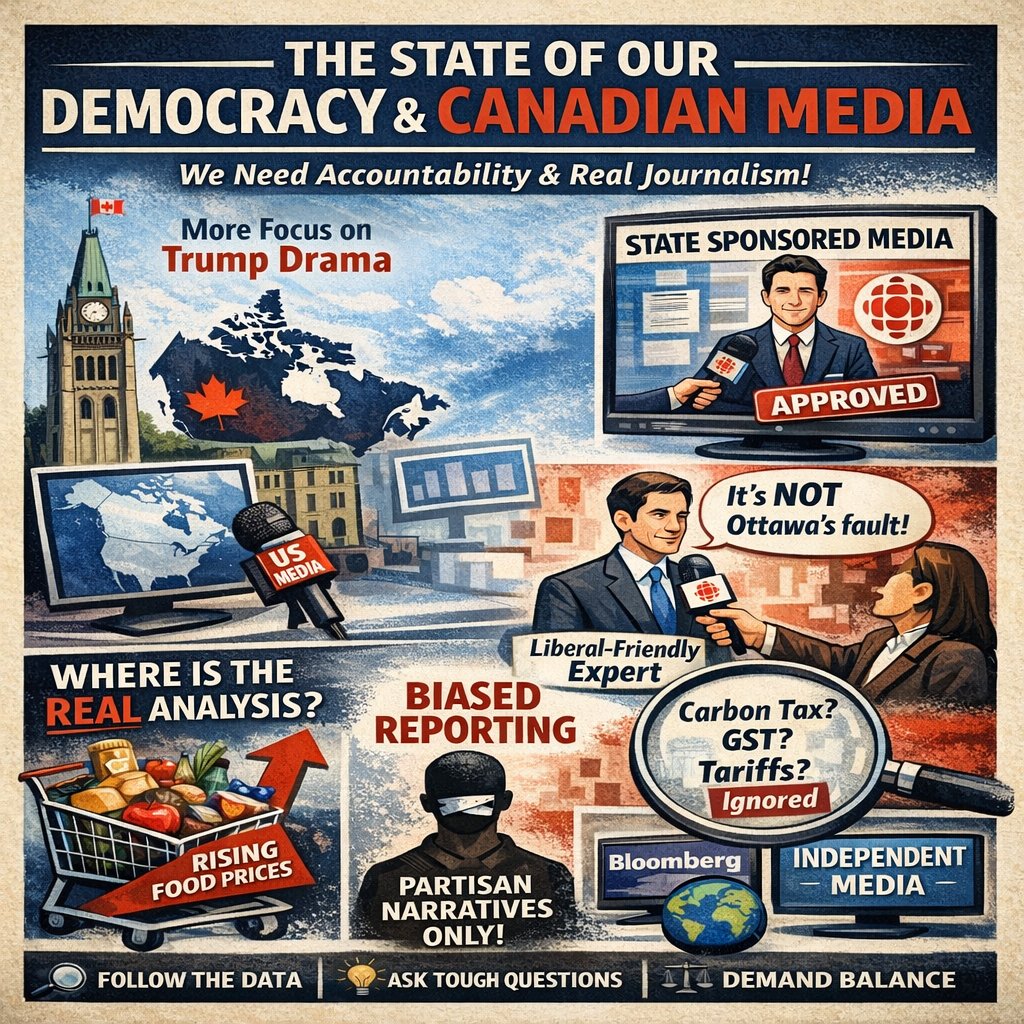
To my X followers,
I’ve worked with the media for nearly 25 years. For most of that time, the relationship was professional and balanced. But in recent years, something has shifted.
I am increasingly concerned about the state of our democracy — particularly how media, in general, are informing Canadians about food policy, food inflation, and economic policy.
I now find myself learning more about Canada’s economy and policy changes from American outlets than from Canadian ones. Much of our national coverage feels reactive, shallow, or overly fixated on partisan narratives rather than substantive policy analysis.
What troubles me most is the lack of scrutiny applied evenly across governments and institutions.
For example, when the Bank of Canada suggested that Ottawa’s counter-tariffs contributed to food inflation, only one major outlet — Bloomberg — gave it meaningful coverage. The grocery benefit program received very little examination regarding how it would be financed. It took days before anyone pressed for clarity.
During the latest spike in food inflation, several outlets turned to the same small circle of commentators who dismissed any potential role of federal policy — carbon pricing, GST holidays, counter-tariffs — despite mounting evidence that policy decisions can and do affect food prices.
Instead of investigating structural drivers of inflation, much of the coverage focuses on fact-checking opposition rhetoric, even though the opposition has not governed since 2015. Scrutiny should be applied equally — not selectively.
Quebec media, while imperfect, appear to have maintained a broader range of debate. In much of the rest of Canada, I see increasing concentration of voices — often from the same region, Ontario, often reflecting similar policy perspectives — and less diversity of thought grounded in empirical research.
This isn’t about partisan politics. It’s about accountability, transparency, and healthy democratic discourse.
Media are under financial pressure — that’s real. But public trust depends on independence and depth. Subsidy structures, incentives, and newsroom economics all matter.
Canada deserves stronger policy journalism — especially on food affordability, supply chains, and economic resilience.
We need more data-driven analysis, more intellectual diversity, and more courage to ask uncomfortable questions — regardless of which party is in power.
Until that happens, Canadians would be wise to diversify their news sources and think critically about what they’re being told — and what they’re not.
Je m'excuse, c'est difficile à entendre. Mais c'est aussi nécessaire à entendre.
Pour écouter l'entrevue complète, c'est par ici
https://t.co/gPFIiRSByx
Northvolt is officially dead in Québec. Province could lose $500M+.
Ottawa’s answer? Slap tariffs on Chinese EVs — and watch China retaliate against our canola, pork & lobster farmers.
Double whammy: lose half a billion and our markets.
Genius.
If you are a 23andme customer - they just declared bankruptcy in anticipation of a future sale.
If you find this unsettling, login, go to settings and then data and privacy. You can then 1) download all your data and 2) have them delete all your data from their systems.
Tous les jours d’avantage, l’Amérique bascule dans la dictature au nom d’une double liberté économique et politique. Il est temps pour l’Europe d’en prendre acte et d’agir.
Ma nouvelle chronique pour @lesechos est en ligne.
https://t.co/uwrUwxrN4J
Since it's back in the news, here's actor Jim Carey explaining to Americans how Canada's universal healthcare works.
"You shouldn't have to lose your home just because your mother got sick"