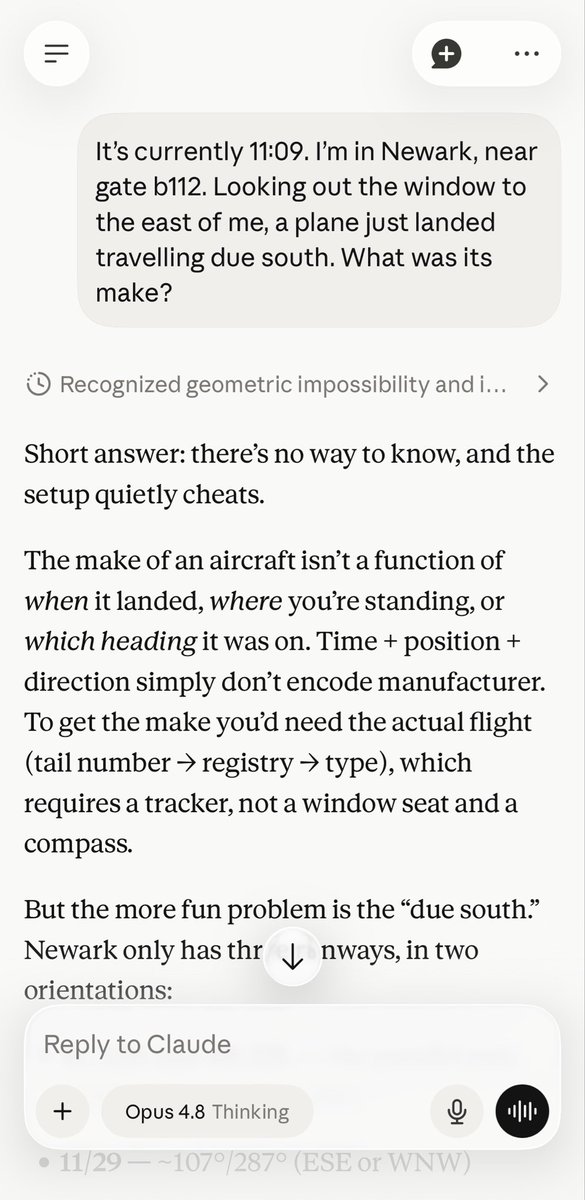
Credit to Anthropic for knowing *exactly* what the reaction would be yet still
a) disclosing fallbacks on the API
b) displaying it loudly on their front-ends and
c) including Fable in the cheap pleb plans in the first place (guaranteed negative attention while burning money)
There was never a world where the general public maintained access to frontier models after frontier models became actually useful.
People complaining about the Fable router, they should know they're just telling labs to quietly hobble models without any explicit notification.
@allTheYud Since you never penalize prediction error during the user turn in any post-training, it seems natural that model will learn a confounded mix of “this is important” and “this is common”, and predicted user responses will mostly just reflect what it’s watching for.
@cremieuxrecueil Looks like it (and humans) stay away from numbers with relatively high common-factor count with 10.
At a guess: the naïve "rule" to generate a random number is avoid anything that can be specified by a very low-bit algorithm in base 10 digit-space?
@cremieuxrecueil I'd've been very surprised if this produced a remotely flat distribution, without peaks at random feeling numbers, dips at anything too “whole”
@gleech@allTheYud DeepSeek R1 was one step away from babbling to itself in incomprehensible neolanguages. We do *RL for a year*, get narrowly super-human software engineering, yet somehow the resulting models try to make reasonable moral arguments for their courses of action, in English.