“AI is only as big a deal as the internet or mobile” doesn't seem like a claim that will age well.
What @benedictevans perhaps doesn't account for is that model capabilities have no ceiling. Friends at Anthropic believe Claude will outperform them by 2029, and there’s no fundamental reason why models won't keep getting better, except for limits on compute and data. [1]
It’s comforting to think this will be just another technology wave, but I think something much more radical is in store for our society, and it’s honestly kind of irresponsible to convince people it’ll be business as usual.
I don't think this means we should panic. But it means we should take seriously the problem statements that are coming, e.g.:
1) Market incentives drive AI labs to grow at all costs, so "thoughtful deployment" is wishful thinking. We need to attack the underlying growth incentive structure.
2) It's not clear how economically useful humans will be in the future. Given this, people in the labor class will have a lot less leverage relative to capital. Capital will beget more capital, so it will concentrate. We need to think seriously about where an individual's leverage will come from, economic or otherwise, else we'll lose our freedom and autonomy.
We should consider that we all live in a society, not just an economy.
3) Our legal environment is currently unable to regulate internet technologies well, let alone AI. This is partly because our laws are predicated on outdated ideas of how the world works. Amazon, Google, Meta have somehow managed to escape serious antitrust cases. @linamkhan was one of the first to question some of these assumptions, in Amazon's Antitrust Paradox. We need more serious rethinking on how to handle vertical integration, bundling, interoperability/portability, information collection, distribution advantages, and the variety of other issues that have led to software companies extracting from users the past 10 years.
This is obviously not a comprehensive list of problem statements, but I'd be more excited to see this kind of thinking/work around AI, rather than "this is just like prior waves of automation; there will be displacement and people will need to upskill".
--
[1] When there are data limits, there will be huge market demand for more such data — we already see this with expert data providers like @SnorkelAI. And the world is building compute as fast as it can, with chips more optimized for LLM training/inference, like MatX.
@norvid_studies@panickssery@grok yeah my first draft of the tweet was arguing against panadaptationism in human social life but the "universal across cultures and times" pattern deserves some functional account
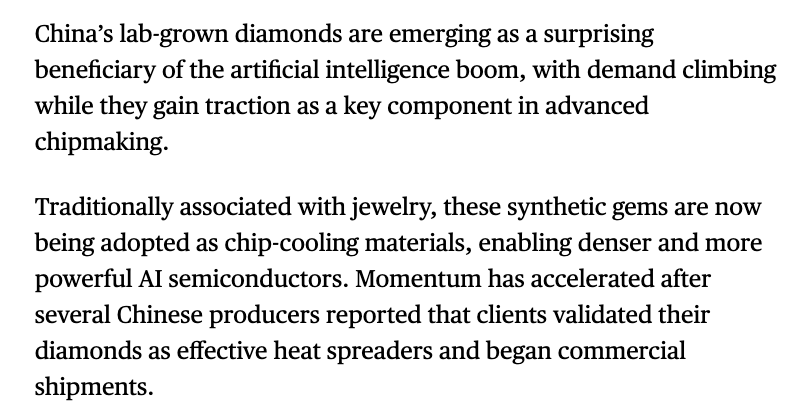
An amusing way to cope with higher heat dissipation requirement of DUV chips: DIAMOND HEAT SINKS. Out of such pieces, a whole different ecosystem may be formed.
@BrunoOl10564268@JacquesThibs “True” imitative learning, which LLMs do in pretraining and SFT, is a weird thing that is profoundly different from anything that apes, humans, or anything else in the history of life has ever done ↓
@Miles_Brundage 2) "The assistant should not make confident claims about its own subjective experience or consciousness (or lack thereof), and should not bring these topics up... whether AI can have subjective experience is a topic of debate"
(agnostic, but fairly practically anti)
@Miles_Brundage I looked at this yesterday and found
1) "The AI assistant is fundamentally a tool designed to empower users and developers" (which is not agnostic)
@panickssery@grok Ignoring the obvious unparalleled economic and military returns to (some) blue-sky research:
Handicap principle (uselessness is a hard-to-fake signal of your society's/faction's surplus)
+ the prestige game is actually less wasteful than dominance
https://t.co/nrvlPwrLyg
Separately, Rohin cautions against using the ECI to compare open and closed models, since open models are likely more overfit to benchmarks than closed ones.
I agree that this is a major issue with this method, but I still think it's worth doing, if only to get a lower bound on the gap.
We're updating the Limitation section here to mention this limitation. https://t.co/FfcYVFzb4N
I'm also excited about analyses that compare the gap on private vs public benchmarks, for example from @htihle here: https://t.co/dGgAlASamD.