@chd@nytimes thanks, but it didn't! again the question is just, why did you claim that "we can...ignore the question of whether machines are conscious" is an assumption that drives Eleos's work on empirical AI welfare?
what in those papers claims or suggests that? https://t.co/5R43fOwpOz
@rgblong 6: Empirical Bypass: We can develop an “empirical framework” for evaluating machine welfare and ignore the question of whether machines are conscious in the first place. We cannot, and we should not.
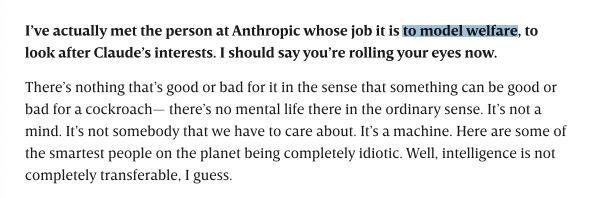
like a lot of people, I found this interview frustrating, containing many under-argued assertions, offered as dismissals of caricatured opponents.
I don't have much to add, except this small detail - an inconsequential and understandable typo, but representative I think
Thomas Nagel has done landmark work on consciousness in nonhumans; this week, he won the million-dollar Berggruen Prize for his contributions to the field. And he has a lot of thoughts on AI. https://t.co/MvFfnPiPx7
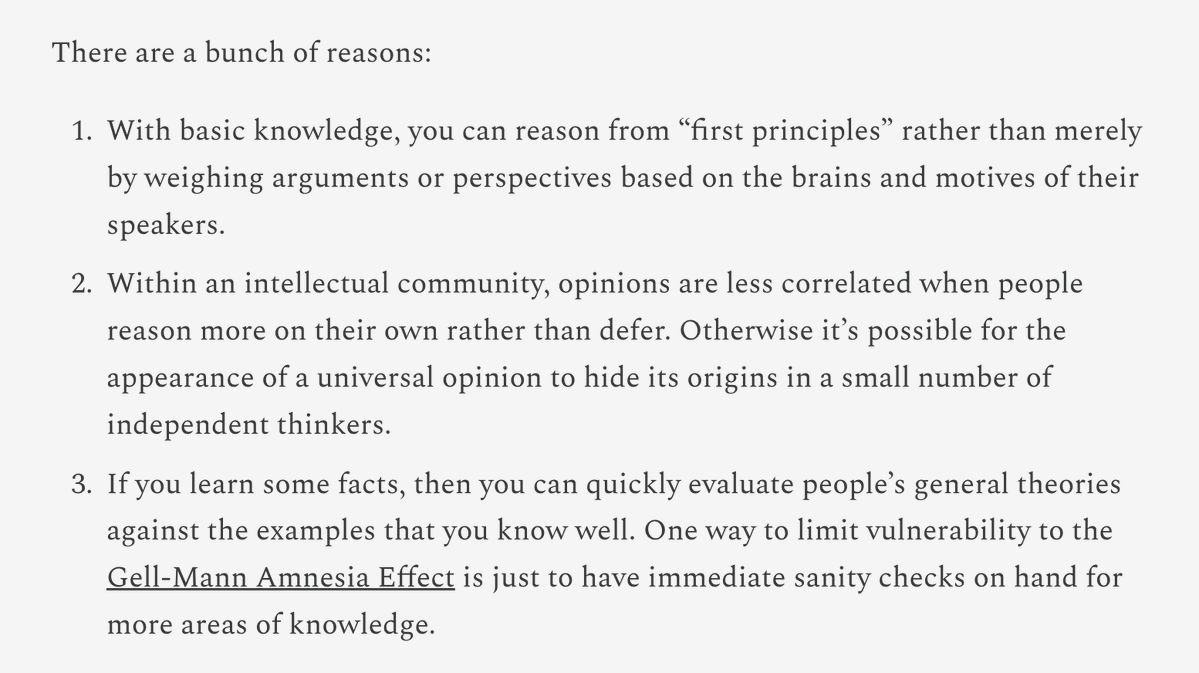
I enjoyed this post by @panickssery arguing for the value of "learning basic empirical facts about historical or present societies"
https://t.co/fXYArSke2f
@tyler_m_john haha yeah, neither was a dissertation advisor, but I interned for Jon at The Daily Show and studied with Tom at NYU (as did several other people in this field), so I do feel *somewhat* personally let down here.
@JaEsf after the last @eleosai conference, we are considering just setting a hard time limit on questions in future. even well-intentioned questioners are often poorly calibrated on whether their question is too long, and it's nigh impossible to decide to hard cut off a questioner
@anilkseth@Plinz@dioscuri if anything, one should have a *higher* bar for saying that in a media interview than in an academic article!
bearing as it does on how public discourse will treat such a high-stakes issue, with all of the uncertainty and disagreement it will continue to provoke
@anilkseth@Plinz@dioscuri I'm not criticizing Nagel for arguing for a low credence in AI consciousness, but with poor word choice
I'm criticizing him for repeatedly saying that to even "take the question seriously" is "ridiculous"
*that* further attitude is unwarranted and, as you say, unwise
@chd but which recent papers (or any particular passages?) led you to conclude that "we can and should ignore the question of whether machines are conscious" is a driving assumption of Eleos's work?
@anilkseth@Plinz@dioscuri those aren't meant to be gotchas!
to the contrary, it's to your credit imo that you often engage generously with opposing views, assuming that they come from reasonable disagreement, not idiocy
it's Nagel not doing *that*, that I dislike. not the mere fact of his disagreement
@anilkseth@Plinz@dioscuri I feel like you do disagree with his core point and attitude!
Nagel: "to take seriously the question" is "ridiculous"
Seth: "even if unlikely, it is unwise to dismiss the possibility altogether"
or "deserves to be taken seriously, even if I disagree"
https://t.co/4n1dXWWWOz
I'm always pleased to read @jeffrsebo who takes a constructive alternative perspective. As he says, we agree more than we disagree. But we do still disagree (I hope agreeably). He is very articulate in presenting the case for AI welfare, and this case deserves to be taken seriously, even if I disagree with his conclusions.
To take one snippet "Given uncertainty about the nature of consciousness and the future of AI, we are not able to rule out a realistic possibility of near-future AI consciousness". A lot here turns on 'realistic possibility'. I think there are sufficiently compelling reasons to be sufficiently sure (not 100%!) that our default position, and our policy, should be that AI systems are not conscious. This is my reading of the evidence - shared by my coauthors, I believe - but it will not be everybody's.
The more general problem is that actions to minimise false positives and false negatives often (but not always) pull in different directions. So we can agree on the need to evaluate possible policies by the posterior probability of each kind of error weighted by the severity of their consequences, but if one's posterior probability of false negatives is sufficiently low, then harm-minimising actions that pull in different directions should rationally emphasise avoiding false positives.
And one more thing we agree about. No good comes from 'torturing' a language model.
I'll leave it there, with the encouragement to read @jeffrsebo's response and see what you think.
@chd to be clear, the claim is that this is an assumption of Eleos’s work? that we can and should ignore the question of whether machines are conscious?
@chd if I ever mischaracterize my opponent’s views as badly as Nagel does here, which (combined with the confident contempt) is my main complaint, I’d genuinely love to be pointed to examples, which I should fix
@chd you may find it less *rhetorically* effective, perhaps, but I am more concerned with the question of whether Nagel is in fact characterizing his opponents fairly here, and offering good reasons for holding them in such contempt. thats separable from your estimation of my own work
upon reading the Thomas Nagel interview on AI consciousness, I'm recalling this recently minted classic, and thinking that maybe I need to tape it to my wall
like a lot of people, I found this interview frustrating, containing many under-argued assertions, offered as dismissals of caricatured opponents.
I don't have much to add, except this small detail - an inconsequential and understandable typo, but representative I think
please note that this is not meant to be an endorsement of Beth Barnes, who as you'll recall is being directly paid by Anthropic to hamstring its competitors (and/or to promote wokeness)
https://t.co/039btEUb7z
@joshcmorrison no, it’s a joke: pairing my post with a criticism of Beth that's based on obviously incorrect premises about her motivations or basic facts of the situation