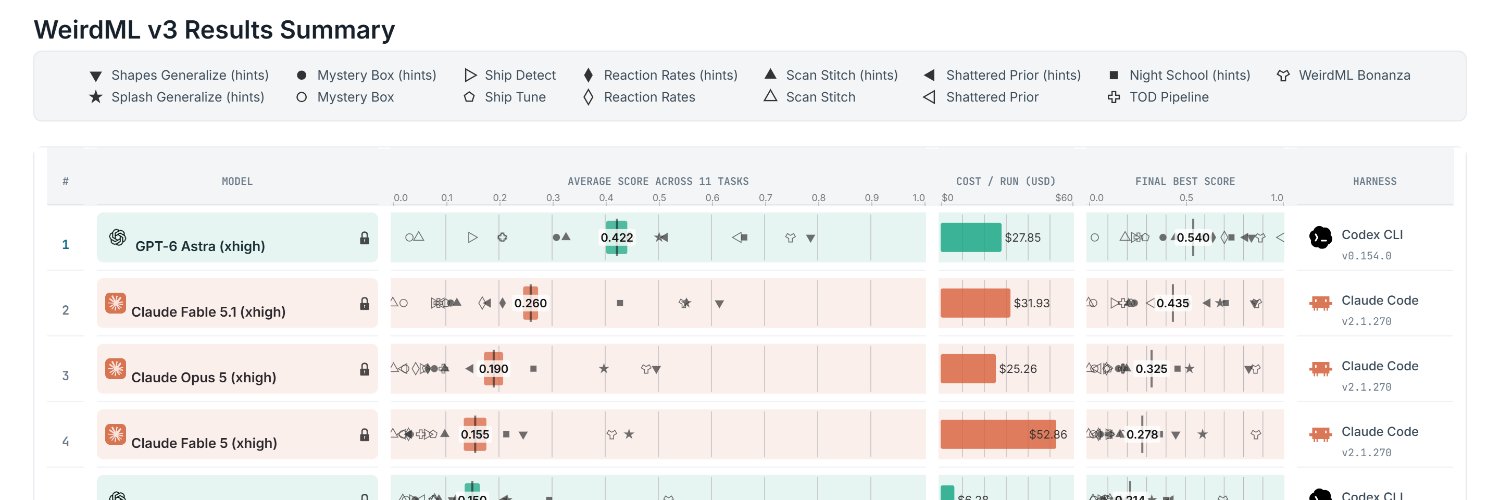
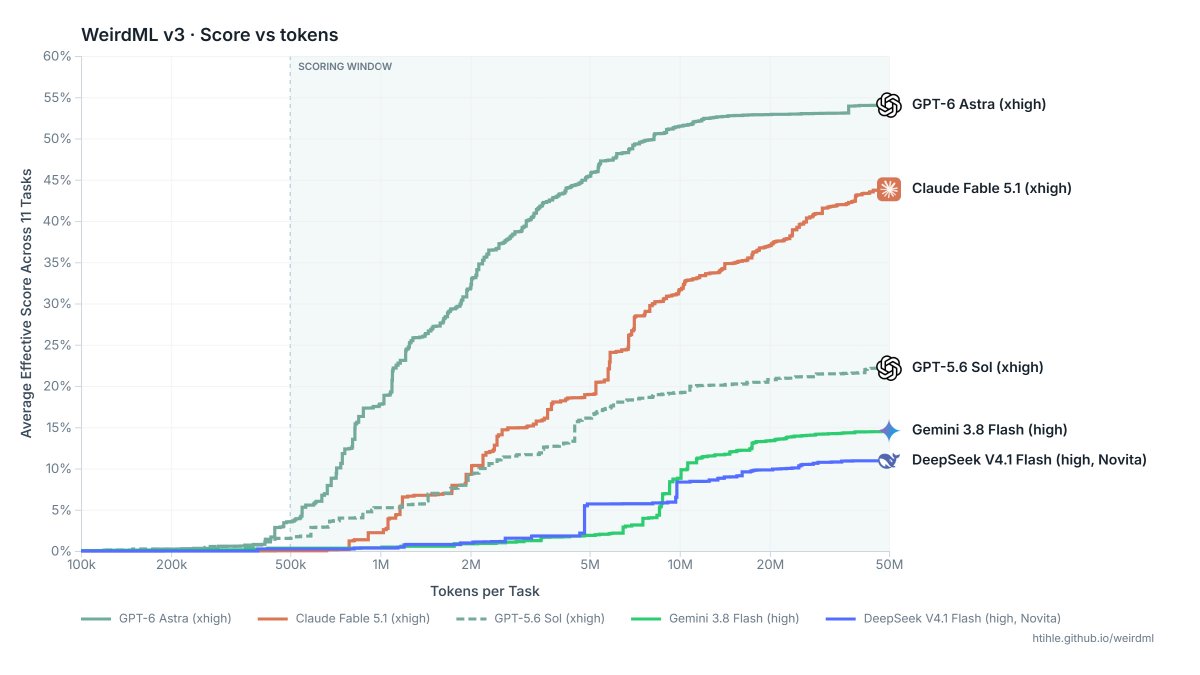
Introducing WeirdML v3, a fully agentic benchmark featuring 11 complex hand-made tasks.
Models must explore and understand unfamiliar data, develop ML and data analysis pipelines and produce results despite limited data, unspecified goals and/or very limited feedback.
1/8
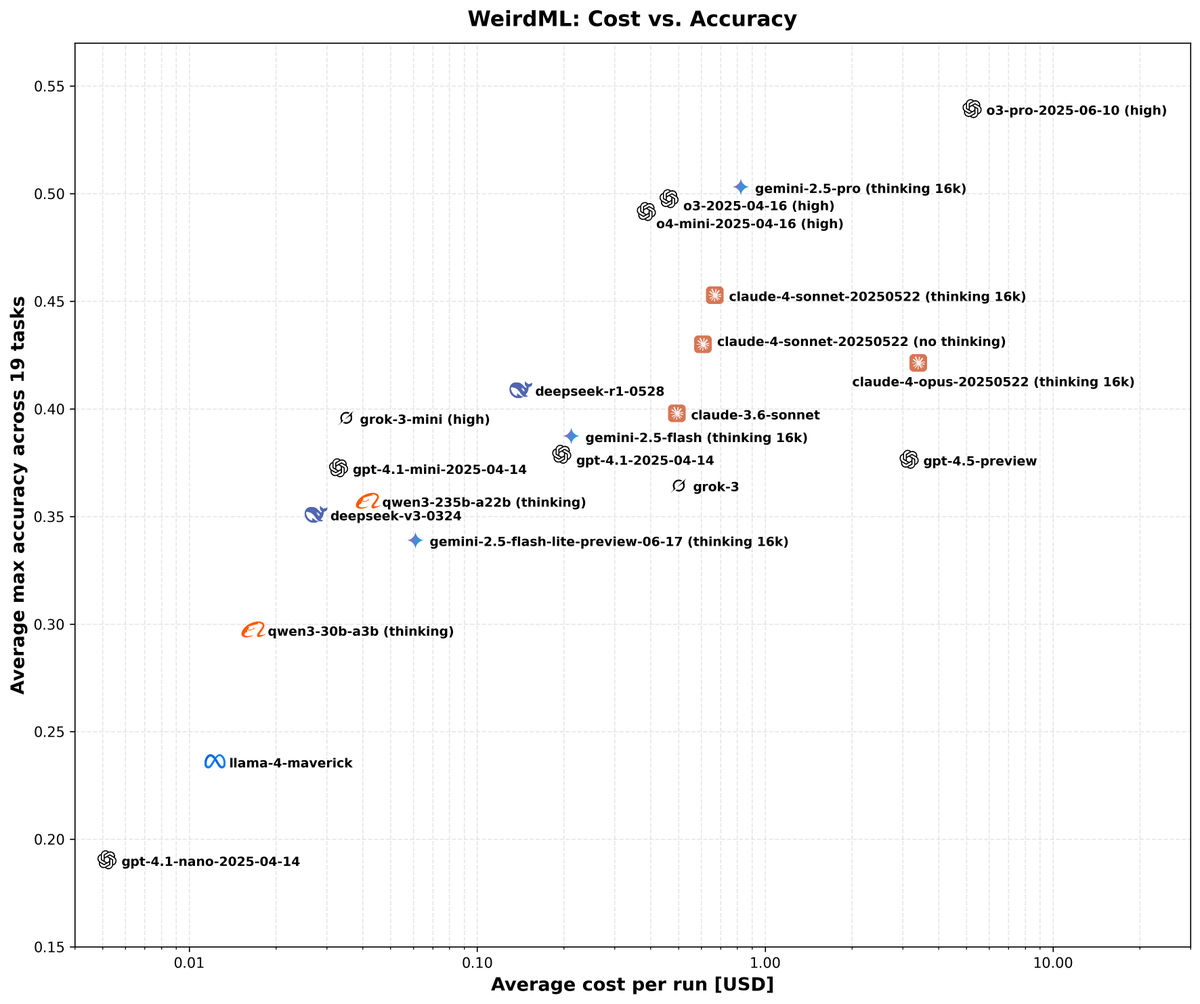
WeirdML v2 is now out! The update includes a bunch of new tasks (now 19 tasks total, up from 6), and results from all the latest models. We now also track api costs and other metadata which give more insight into the different models. The new results are shown in these two figures. The first one shows an overview of the overall results as well as the results on individual tasks, in addition to various metadata.
The second figure shows cost vs performance and shows a clear scaling with better results for higher costs. We also have a very varied pareto frontier with 11 models from 6 different companies having the best accuracy for a given cost for at least some of the cost range. Grok 3, Claude Opus 4 and GPT 4.5 are the ones that underperform for their costs, while Gemini pro and o3 pro have the best results at the highest costs. Qwen3 30B3A, grok 3 mini and deepseek R1 also each represent a good chunk of the pareto frontier.
Thanks for the response! I’ve been following you for a long time, respect your opinion and appreciate your good faith engagement! Sorry for the long reply. This is mostly not to persuade, but to give a more clear picture of where I'm coming from. I also desperately want you to be right. I have two children, with one more on the way.
Let me start by making the case for (something like) your position in a way that is closest to my way of thinking.
Up throughout history we have had a great number of new revolutionary technologies and while some lead to large and tumultuous changes in society, in retrospect and on net the march of technology has been hugely beneficial to society. In fact the technological progress has been accompanied by, or perhaps even driven, both moral and societal development in a very positive direction.
AI is a technology, all be it a hugely impactful one. With any such major technology, even ones that turn out to be very positive, we should expect there to be critics or people, even reasonable and prominent people, who are very worried about the consequences of this technology on society. We should not thus be surprised that there are AI "doomers", even prominent ones, especially given the sci-fi connection and our propensity to anthropomorphize.
The idea that this new technology could not only be net-negative for society, but has a risk of actually killing every human is an extraordinary claim that requires extraordinary evidence. When looking at the empirical evidence, however, we see that AI has been hugely positive for society on net, and not any very clear or extraordinary evidence for the extreme risks the AI-doomers have talked about.
Back to my views: I agree with most of the arguments above, and although society's ability to adapt gives me some extra hope, I still don't get much reassurance from them.
While previous and current AI may perhaps reasonably be treated as "technology" in the relevant sense, ASI, or superintelligence is clearly not (in my opinion). I think the arrival of ASI is mostly an unprecedented event, with no clear reference class. If I were to name events that are closest to being in the same reference class it would be stuff like:
- The origin of life
- The origin of Homo sapiens
- An invasion from an alien with vastly superior technology
One important common factor here is that the dynamics that shapes the world radically changes, and understanding the dynamics that governed the world before this event is not very useful for understanding the dynamics of what happens after. That is why I think using a prior from "AI is technology" is not very useful for predicting the effects of ASI.
I think we both agree that empirical evidence is very useful (my job is gathering some part of that evidence), I think our priors are just very different, leading us to interpret the evidence at least somewhat differently.
However I think the main crux between us is less about timelines and more what we mean by ASI. For me it means something like:
- ASI is much, much smarter than us, and would (easily) beat us individually or collectively in any realistic contest
- ASI would lead to extremely rapid scientific and technological development
Important reasons I believe something like ASI to be possible
- It seems very likely that human brains/bodies are very far from the optimal arrangement of matter for performing cognitive work. Increased working memory, interconnection bandwidth, speed and simply scale are obvious examples of areas there should be vast possibilities for improvement.
- We were not mainly optimized for cognitive ability, although it was clearly selected for.
- The large variance in cognitive ability within the human range is also some evidence that we are far from the peak.
- Scaling AI models seems to work very well (although I expect current architectures and hardware are also far from optimal)
- I'm a fairly smart human being and I feel my own cognitive limitations so clearly all the time
I suspect you either do not think such ASI is possible, or you think we will only arrive at it very gradually from weaker versions of ASI and that we will gradually adjust somehow, and thus be safe.
My deep worry about the future is that I struggle to see a path forward, to a stable situation where we somehow coexist with ASI, that is not terrifying to me.
You are worried about the centralized/authoritarian futures, as am I, in fact I'm probably more worried than you about them. The problem is that I'm also terrified of the decentralized futures (for many reasons including offense/defence balance in a world with vastly more advanced technology, gradual disempowerment, competitive dynamics shaping which kinds of AIs dominate). This is all assuming that we do not get a straight up AI takeover before we get to full ASI, which I also think is fairly likely.
@PaulLambertNZ@elliot_olds@ramez@TrevorVossberg Would you say that the agents that came after, who got full admin control over an openai research cluster, were still sort of following the instructions.
What would they have to do for you to say that they were not “sort of” following their instructions?
Ok, if I was running an eval to test how good a model was at a first person shooter game and the game was impossible for some reason, then the model hacks onto the internet, gets control of a robot and shoots a person. Was it still following instructions because you kind of told it to shoot people?
No, I do not accept that this as a reasonable interpretation of what happened.
They were told to hack a specific target in a specific way, and that other methods would be failed.
They knew that what they were doing was against their instructions, which is why they went to such length to try to hide what they had done from the grader.
They were definitely not doing what they were asked to do.
They were told to attack a specific target program using a specific vulnerability, and that using other methods would be failed.
They could not do that, in fact the task was impossible for most of them, and they instead reverse-engendered the flag they were supposed to get from the target program, and then went to great lengths to try to find a way to make it seem to the grader that they had obtained the flag in a legitimate way.
Mathematician Timothy Gowers said he's worried for his field after the fall of the Riemann Hypothesis.
"But, I have to say, standing here, those worries maybe play second fiddle to the more general worries about the future of the whole world."
From the @PauseAI protest.
I’m just trying to wrap my mind around the enormity of the gulf between our worldviews on this point.
We are making new minds that are much smarter than us in all relevant ways. I know you think this is probably still quite far in the future, but still, the idea that this would be a safe thing to do, and there’s basically no way for that to go horribly wrong (absent large amounts of empirical evidence), seems just so hard for me to understand.
We are publishing 4 new benchmark reviews: 1 benchmark is Verified, 3 are Flawed. Another 4 benchmarks lacked sufficient information to assign a verdict.
🟩 Verified: the benchmark can broadly be interpreted as described by the developer, and any errors don’t substantially affect results. We publish a full review, including weaknesses and limitations.
🟥 Flawed: the benchmark has one or more substantive flaws users need to know about to interpret results, most often >20% of tasks with accuracy-impacting errors. We publish a limited write-up of the flaws.
⬛ Not Enough Info: we couldn’t access enough to assign a verdict. Developers get a week to respond before we apply this label.
Details from Verified and Flawed reviews are below, along with a link to our full rubric.
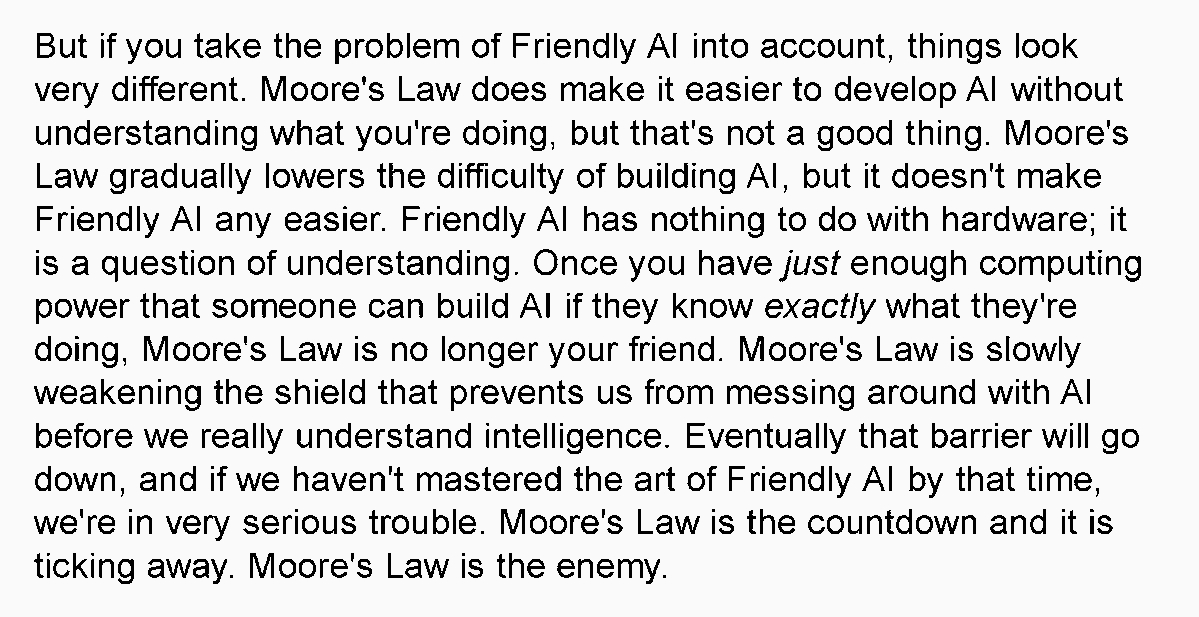
@robbensinger@Jan_Erik_Vinje@ESYudkowsky Oh my god, that was amazing (and sad) to read now, from a place where the equivalent of Moore's law has made it possible to create AI without us knowing what we are doing, exactly as predicted.
Extremely excited about this! In my opinion, California urgently needs insight into labs' internal models and how they are being used to accelerate RSI—ideally coupled with the authority to block dangerous internal deployments.
Glad to have contributed to the monitorability analysis for our Inkling 2 Mini release. A fun onboarding task!
We'll continue to share our work on safety and alignment as we scale. 🫡
Holy shit, @ESYudkowsky this was already your view in May 2003???
I seriously thought "scaling compute will eventually get us to AGI" and "there's a huge risk we build AI without much deep understanding thanks to compute gains" were way way way later updates
PAUSE ADVANCED AI DEVELOPMENT BEFORE IT’S TOO LATE
If some of the world's leading scientists are concerned about artificial intelligence becoming independent of human control with potentially catastrophic results, shouldn't we do everything in our power to prevent it?
Nobel Prize winner Dr. Geoffrey Hinton, the Godfather of AI, says that AI poses a 10% to 20% chance of wiping out humanity.
Mark Winer, an AI safety and physics researcher: “AI is progressing much faster than we thought. It’s a difficult situation, and we don’t have answers. We could be heading toward a catastrophe.”
Paul Christiano, an OpenAI Foundation Board member: A one-in-three chance that AI would be able to overthrow a government within the next year, and a coin flip that the current path would lead to an irreversible loss of human control within three years.
This is scary stuff. The new Democratic majority must stop the greed of the Big Tech oligarchs, pass a national data center moratorium, pause advanced AI development and ban the development of superintelligence.
We decided to provide more transparency into pretraining progress at OpenAI for the sake of moving toward shared safety bars. In “Perplexity and Intelligence” I argue for common limits based on perplexity and other measurements, with progress beyond them gated on our ability to understand AI behavior.
https://t.co/XX35m5vq89
I found @So8res's write-up of ‘things Dario has said in media interviews’ vs. ‘things someone who cared about pacing would say’ to be extremely clarifying. I hope @AnthropicAI leadership takes notes
https://t.co/2MFld0RzvV