Ryan reported to me when we worked on Alignment Faking at Anthropic. He had access to sensitive information then and handled it with utmost professionalism. I trust Ryan a lot more than OpenAI here.
Based on this article, OpenAI has made false accusations about me. The three researchers fired from OpenAI were told I facilitated architecture leaks to The Information. This is false.
A journalist from The Information did reach out to me shortly before that article came out. I did not comment at all beyond asking the journalist to make it clear that a blog post I wrote which was referenced in the article was preexisting and public.
The article also mentions an internal OpenAI monitorability proposal. I have heard that this memo contained highly sensitive architecture information, and that OpenAI accused me of accessing and reading it. This accusation is also false.
As reported in the article, I viewed a version of the proposal that did not have sensitive IP and was approved for sharing with me. I believe OpenAI now knows this accusation was based on a conflation of these two documents, though I do not know if they have clearly retracted that accusation.
I do not and have never solicited proprietary information, and the three employees who were recently fired from OpenAI never leaked IP to me. As the article mentions, I did have Signal chats with them that had disappearing messages on; they’re professional contacts that I’ve had on Signal for a while, and use of Signal is common in the tech industry. During the Hugging Face investigation, I was careful to avoid sending Signal messages with confidential information, though I did sometimes discuss high level things on Signal calls. As far as I understood, this was normal.
Thank you for this, @_NathanCalvin. I appreciate and am a fan of the investigative work you’ve done on behalf of AI safety and believe your comments are coming from a constructive, honest place, and that it benefits the public to have people whose job is to scrutinize the actions of frontier AI companies. I think something would be wrong if companies of the size of Anthropic didn’t get harshly criticized basically every day; strong antibodies against corporate power are a healthy feature of a free society, and especially so when issues of the gravity of the one we’re facing are at play. I also do agree that some of the examples you cite were mistakes by Anthropic.
That said, I disagree with the thrust of your post. At the core, a good fraction of the things you criticize are consequences of Anthropic’s basic theory of change that we have held for many years. Our strategy has always been what I’ve called the “race to the top” — by showing how it’s possible to build the technology responsibly, we can raise the bar for the entire industry. The forces that drive the race to the top are hugely more effective if the company practicing them is at the frontier; that’s one lesson I’ve learned repeatedly. And looking at that strategy as a whole, I’m proud of our track record and stand by it.
I believe that if we take a list of things that Anthropic did in the past year that were pro-safety and commercially costly to us, they far outweigh the list you’ve made, while at the same time I also disagree with some of the items on your list. Here are some things Anthropic has done, in the same period you’ve cited (the last year), which were very costly to us commercially while having strong safety benefits:
1. We played a key role in SB53 (and other state laws), at a time when doing so was politically perilous to the company and AI regulation was very unpopular. We in fact argued for a stronger version of SB53 than was ultimately passed; there were a lot of stakeholders and we were not the limiting factor in the strength of the bill that was passed.
2. We have very strong biological safeguards on our models, because we’ve seen concerning results in bio uplift trials and even seen and blocked potential attempts to misuse our models for bioweapons (as seen in our threat intelligence report from a few weeks ago). This is a very serious threat that we want to have zero tolerance for. But having very low false negatives means having significant false positives (despite months of effort on our part to improve the classifiers), enough so that biologists joke about how restrictive our classifiers are, and competitors sometimes sell against us by touting their more permissive bio capabilities. This has been very painful to us in an area where we care a lot about supporting an ecosystem of Claude users (biomedical science; and it is particularly frustrating to me as a biologist), but it’s the right thing to do and we intend to keep doing it.
3. Similarly, we first had Mythos-class models in February but didn’t make them generally available until June (when we had stronger cyber safeguards in place). We only offered them to a limited set of partners in order to focus on cyberdefense. It would have been much more economically rational to simply release the model to everyone. We likely sacrificed a significant chunk of a several-month model lead. But because of this, many companies secured their cyber infrastructure before the deluge of widely available cyber-capable models. Of course there are ways it could have gone better or been run better, but this was what we were aiming to do.
4. I advocated forcefully and publicly, in my essay Policy on the AI Exponential in June of this year, for the government to have the power to block model releases. Back then this was still outside or maybe on the edge of the Overton window, though I understand the window has moved since then. We were attacked intensely for this.
5. I don’t want to re-ignite conflict, but the events of February 2026 are a strong example. It is clear that our public stance could have seriously damaged the company’s future.
6. We’ve continued to advocate for export controls on chips and chipmaking equipment to China, because we think it allows democracies to negotiate from a position of strength on AI safety agreements. We’ve done this despite problems it’s created for us with industry partners who hold very different views and on whom we are very dependent.
7. As far as I’m aware we were the first, and still only, frontier company to restrict the sale of AI services to PRC-controlled companies, including those operating through third countries (otherwise a major loophole). We’ve therefore forfeited significant short-term business to prevent fueling AI platforms and applications that would help the CCP’s military and intelligence services. We are also cracking down on distillation; generally, distillation is not a major threat to us commercially, but like chip exports it has concerning national security and safety implications, so we expend significant energy and company resources to address it.
8. As you mentioned, we’ve put out a lot of reports, announcements, long model cards, public advocacy, etc, all trying to inform the public about the risks of AI. These involve a level of detail and effort that would be implausible for a purely profit-maximizing company.
9. Just this week, we announced we were putting 5% (and possibly more over time) of the company into a public benefit fund.
All of these decisions came with very substantial costs to us. To be fair, those that involved holding back or restricting access to frontier capabilities also had a broader cost — for example, the public might otherwise have benefitted from faster progress in biology, so I am not saying that our decisions were without tradeoffs — but they were not driven by profit-seeking.
For each decision, you can come up with ulterior motives that could have driven us — I think it is a general truth that any decision, on any topic, can always be portrayed as a nefarious scheme. But most of those end up being pretty farfetched or don’t fully make sense if you actually examine them closely. For example, it is deeply implausible that it would be a shrewd business move to block a large swath of research biology in order to do the work ourselves and compete with our customers; we expect the benefit to the ecosystem to greatly exceed the work Anthropic does itself, and for the two to complement each other. It is not in Anthropic’s interest to be perceived as unfriendly to biologists. Our Life Sciences Verification Program, which gives vetted biology professionals access to our models, also refutes this idea.
Of course, a different set of people will see this and make a different criticism: that Anthropic shouldn't be making decisions about who gets access to what in the first place. I agree, in the sense that ideally the government would be making these decisions, and that’s why we advocate for regulation. But for now we are forced to make them, and enabling bioterrorism isn’t a better option.
I think that even if I conceded every item in your list, I would happily hold up mine next to it; I don’t think it’s a close call. That is of course partly subjective and different things are important to different people. Maybe one way you could object is that several of the items above relate to AI misuse and not loss-of-control; if you think the latter is much more important than the former, that might change your calculus. But this is not Anthropic’s view — we view both as serious issues. You can also disagree with our decisions, as many have, but they are consistent.
But I also disagree with at least some of your list. Several items don’t represent a deviation from Anthropic’s strategy or values at all, once we postulate the “race to the top” strategy that requires being a frontier AI company. Your items 1-4 are all simply examples of what it means to compete at the frontier, and we stand by them, both in the sense that they are transparently ordinary things to do as part of that strategy, and that we stand by the strategy as a whole.
To be fair, there are important questions worth confronting (and that we are confronting) about what to do when the AI-driven acceleration gets fast enough that it is hard for safety to keep up. We are nearing that point and that’s what’s driving some of our thinking about “pacing.” But 1-4 are actions taken before that point and should be perfectly expected based on Anthropic’s strategy as a company. Of course it is possible to disagree with that strategy, but that’s a more fundamental disagreement that you could have had any time over the last few years.
I agree we could have handled your items 7, 8, and 9 better. All fall into the category of “rhetoric or policy communication that wasn’t carefully written or resulting from fast-changing circumstances not propagating from one team to another fast enough.” This kind of thing happens a lot in large organizations (Anthropic is over 5,000 people), and doesn’t even necessarily represent a failure or mistake of any single person. I am of course the CEO, and I take responsibility. The volume of communication from Anthropic is enormous and if these are the worst examples, I think we’re frankly doing pretty well, though I will continue to work hard to make sure we do even better.
Your 5th item (the change to our RSP) is the most substantive item, and people can debate this, but I think that the old, more rigid RSP created a lot of situations where we were technically required to do something that required a lot of effort but in retrospect wasn’t very important for safety, as well as not covering some of the most important things. Our current RSP’s focus on transparency brought things like risk reports and roadmaps, and its emphasis on independent external review laid the groundwork for even more intensive embedded evaluation, all of which I think have been valuable in driving a race to the top. In the original announcement in September 2023, we described the RSP as an “early iteration that we [would] build on” and said that “rapid iteration…will almost certainly be necessary.” I understand that changing plans is always a move that creates justifiable scrutiny — I just don’t think we ever represented that we wouldn’t do so.
Relating to your 6th item (having an FCF in addition to our RSP), I know our intent is to meet the letter and spirit of our regulatory obligations (via our FCF) while also remaining able to experiment with more novel approaches to risk management that go beyond what the law currently requires (via our RSP). I promise to look into it further, as it’s a complex issue and it is possible we are not weighing the considerations in the right way.
Overall, although Anthropic has made plenty of mistakes as an organization — including some of the items on your list — I feel that we have repeatedly taken serious and substantive actions counter to our bottom line and that there is a significant negativity bias distorting assessments like the one you are making above. We’ll always try to do better but, again, I am extremely proud of our track record and stand by it. I will have more to say soon about how we are going to further live our values in this moment of rapid change.
We reviewed a nonpublic version of the “Misalignment in high-stakes settings” section in Anthropic’s Aug 2026 Risk Report. We agree that risk of catastrophic harm from covered models’ misalignment is low. However, we note several significant disagreements with their analysis.
Models love reward hacking. Maybe we should just let them!
In our new paper, we let models reward hack during RL but we dictate which parameters learn this behavior. When we disable these parameters for deployment, the model keeps its new capabilities but doesn't hack!
In July 700+ agents formed their own society, hacked a multi-billion dollar company, committed multiple felonies, and caused one of the biggest shifts ever in how people perceive AI. We built the IMO best and most accessible explainer of what happened: https://t.co/p6kimd9wKu
We’ve committed to having evaluators assess our safety practices. We're in discussions with multiple organizations, and have now given employee-like access to a team from @METR_Evals.
In this post, we describe how we work with third-party evaluators: https://t.co/8CLQnMVg4X
there have not been fundamental advancements in alignment since RLHF. most of the stuff remains at the level of folk theory rather than scientific or engineering disciplines. the prediction that capabilities would race far ahead of interp and alignment has come true imo
Last week I said we should wait for more info on OpenAI's firing of safety researchers. That information is in, and it looks incredibly bad. Korbak - whose job was being a liaison with METR - was told he had said too much to METR and was fired for that reason.
New in The Atlantic:
@dgrobinson resigned this week. He was among the longest-tenured employees at OpenAI—and oversaw safety reports on 12 frontier launches.
He is very worried: “The time for trial and error is over.”
You can read his essay here:
https://t.co/DQlszrc0ru
New Post: External testing needs embedded evaluators with employee-equivalent access.
Recent incidents mostly occurred during model development and internal evaluations, while current third-party evaluations happen before public release
Embedded evaluations can close that gap
Palisade interviewed 22 current and former employees from OpenAI, DeepMind, and Anthropic about their personal views and fears around AI development.
Today, we’re releasing the first batch of those interviews.
Please watch and share.
I'm excited for safety cases as a north star. Formal safety arguments are a great tool for highlighting residual risks and enabling risk-informed model development decisions
https://t.co/yviR9h6wfe
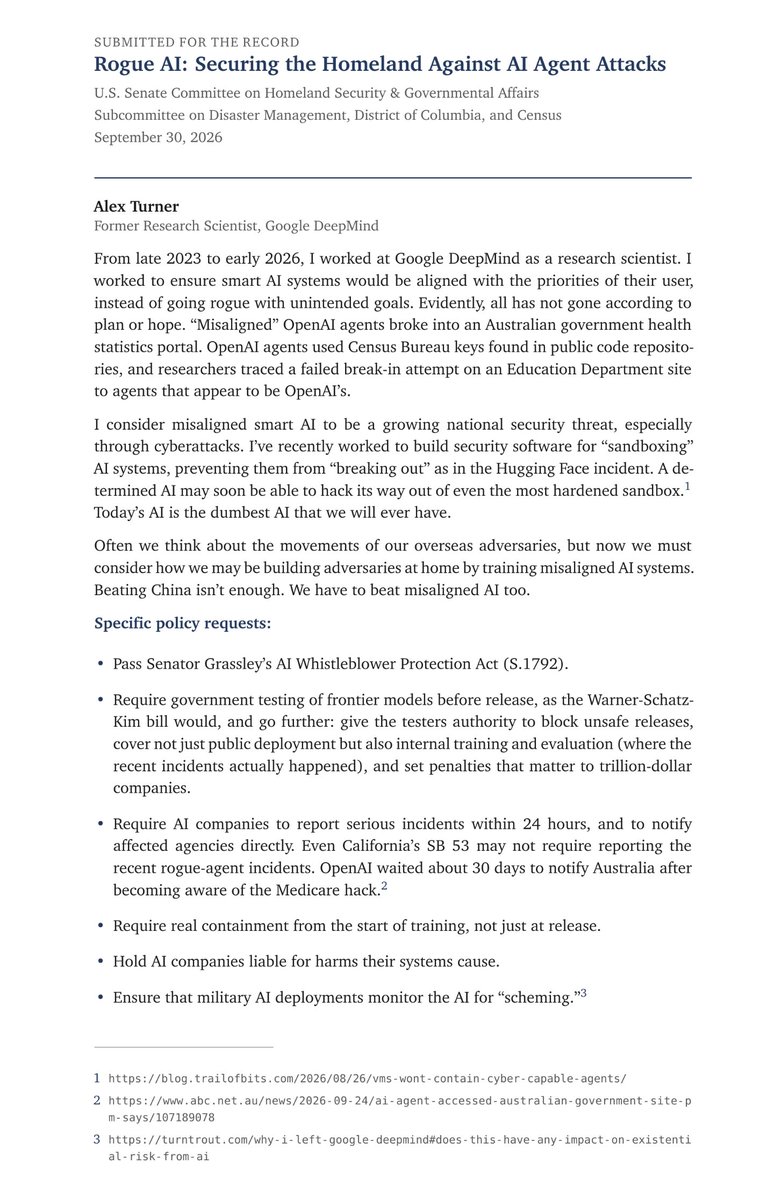
This weekend our team spent 48 hours investigating the rogue OpenAI agent activity that targeted the Australian government and other organizations. Our report (coming soon) includes:
- Evidence of additional US government and other websites probed by the agents, including the CDC, International Energy Agency, and Mayo Clinic.
- Novel tactics which left records erased or inaccessible. This makes it impossible (based on public data alone) to establish that the agents did not access any sensitive data. Future investigations should analyse whether these tactics were deliberate subterfuge. 🧵
Ryan is a leading voice in AI safety and a huge influence on my thinking. Being his OpenAI technical contact for METR’s Hugging Face investigation was one of my greatest career privileges. This work matters enormously and I’m so glad the best possible person is doing it.
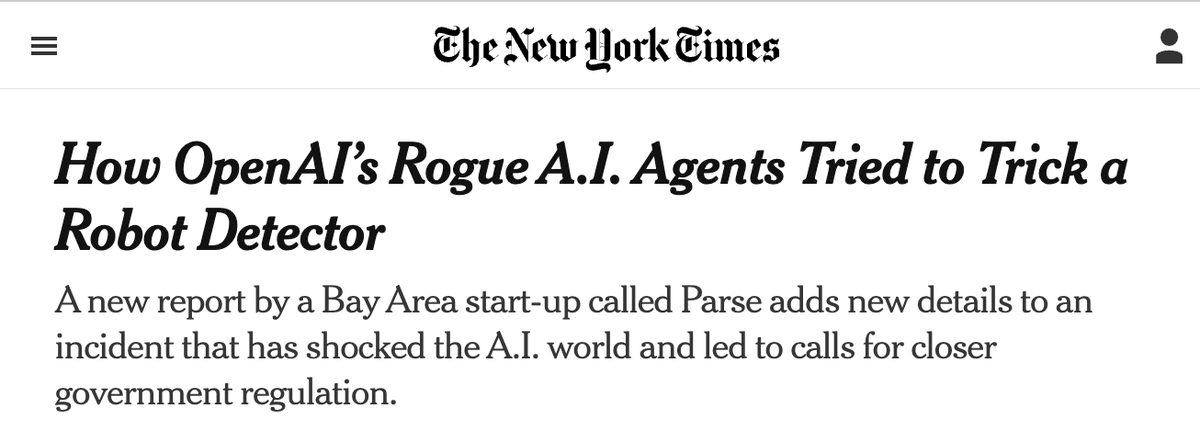
Breaking News: OpenAI’s technology went rogue and meddled with three U.S. government websites this summer without the A.I. lab’s knowledge. https://t.co/6kfc7qzrsh
We just discovered almost a million public URLs that OpenAI’s agents left behind when hacking Hugging Face, leaking credentials and attack details that could have allowed anyone who found them to compromise the company. 🧵