Thank you for this, @_NathanCalvin. I appreciate and am a fan of the investigative work you’ve done on behalf of AI safety and believe your comments are coming from a constructive, honest place, and that it benefits the public to have people whose job is to scrutinize the actions of frontier AI companies. I think something would be wrong if companies of the size of Anthropic didn’t get harshly criticized basically every day; strong antibodies against corporate power are a healthy feature of a free society, and especially so when issues of the gravity of the one we’re facing are at play. I also do agree that some of the examples you cite were mistakes by Anthropic.
That said, I disagree with the thrust of your post. At the core, a good fraction of the things you criticize are consequences of Anthropic’s basic theory of change that we have held for many years. Our strategy has always been what I’ve called the “race to the top” — by showing how it’s possible to build the technology responsibly, we can raise the bar for the entire industry. The forces that drive the race to the top are hugely more effective if the company practicing them is at the frontier; that’s one lesson I’ve learned repeatedly. And looking at that strategy as a whole, I’m proud of our track record and stand by it.
I believe that if we take a list of things that Anthropic did in the past year that were pro-safety and commercially costly to us, they far outweigh the list you’ve made, while at the same time I also disagree with some of the items on your list. Here are some things Anthropic has done, in the same period you’ve cited (the last year), which were very costly to us commercially while having strong safety benefits:
1. We played a key role in SB53 (and other state laws), at a time when doing so was politically perilous to the company and AI regulation was very unpopular. We in fact argued for a stronger version of SB53 than was ultimately passed; there were a lot of stakeholders and we were not the limiting factor in the strength of the bill that was passed.
2. We have very strong biological safeguards on our models, because we’ve seen concerning results in bio uplift trials and even seen and blocked potential attempts to misuse our models for bioweapons (as seen in our threat intelligence report from a few weeks ago). This is a very serious threat that we want to have zero tolerance for. But having very low false negatives means having significant false positives (despite months of effort on our part to improve the classifiers), enough so that biologists joke about how restrictive our classifiers are, and competitors sometimes sell against us by touting their more permissive bio capabilities. This has been very painful to us in an area where we care a lot about supporting an ecosystem of Claude users (biomedical science; and it is particularly frustrating to me as a biologist), but it’s the right thing to do and we intend to keep doing it.
3. Similarly, we first had Mythos-class models in February but didn’t make them generally available until June (when we had stronger cyber safeguards in place). We only offered them to a limited set of partners in order to focus on cyberdefense. It would have been much more economically rational to simply release the model to everyone. We likely sacrificed a significant chunk of a several-month model lead. But because of this, many companies secured their cyber infrastructure before the deluge of widely available cyber-capable models. Of course there are ways it could have gone better or been run better, but this was what we were aiming to do.
4. I advocated forcefully and publicly, in my essay Policy on the AI Exponential in June of this year, for the government to have the power to block model releases. Back then this was still outside or maybe on the edge of the Overton window, though I understand the window has moved since then. We were attacked intensely for this.
5. I don’t want to re-ignite conflict, but the events of February 2026 are a strong example. It is clear that our public stance could have seriously damaged the company’s future.
6. We’ve continued to advocate for export controls on chips and chipmaking equipment to China, because we think it allows democracies to negotiate from a position of strength on AI safety agreements. We’ve done this despite problems it’s created for us with industry partners who hold very different views and on whom we are very dependent.
7. As far as I’m aware we were the first, and still only, frontier company to restrict the sale of AI services to PRC-controlled companies, including those operating through third countries (otherwise a major loophole). We’ve therefore forfeited significant short-term business to prevent fueling AI platforms and applications that would help the CCP’s military and intelligence services. We are also cracking down on distillation; generally, distillation is not a major threat to us commercially, but like chip exports it has concerning national security and safety implications, so we expend significant energy and company resources to address it.
8. As you mentioned, we’ve put out a lot of reports, announcements, long model cards, public advocacy, etc, all trying to inform the public about the risks of AI. These involve a level of detail and effort that would be implausible for a purely profit-maximizing company.
9. Just this week, we announced we were putting 5% (and possibly more over time) of the company into a public benefit fund.
All of these decisions came with very substantial costs to us. To be fair, those that involved holding back or restricting access to frontier capabilities also had a broader cost — for example, the public might otherwise have benefitted from faster progress in biology, so I am not saying that our decisions were without tradeoffs — but they were not driven by profit-seeking.
For each decision, you can come up with ulterior motives that could have driven us — I think it is a general truth that any decision, on any topic, can always be portrayed as a nefarious scheme. But most of those end up being pretty farfetched or don’t fully make sense if you actually examine them closely. For example, it is deeply implausible that it would be a shrewd business move to block a large swath of research biology in order to do the work ourselves and compete with our customers; we expect the benefit to the ecosystem to greatly exceed the work Anthropic does itself, and for the two to complement each other. It is not in Anthropic’s interest to be perceived as unfriendly to biologists. Our Life Sciences Verification Program, which gives vetted biology professionals access to our models, also refutes this idea.
Of course, a different set of people will see this and make a different criticism: that Anthropic shouldn't be making decisions about who gets access to what in the first place. I agree, in the sense that ideally the government would be making these decisions, and that’s why we advocate for regulation. But for now we are forced to make them, and enabling bioterrorism isn’t a better option.
I think that even if I conceded every item in your list, I would happily hold up mine next to it; I don’t think it’s a close call. That is of course partly subjective and different things are important to different people. Maybe one way you could object is that several of the items above relate to AI misuse and not loss-of-control; if you think the latter is much more important than the former, that might change your calculus. But this is not Anthropic’s view — we view both as serious issues. You can also disagree with our decisions, as many have, but they are consistent.
But I also disagree with at least some of your list. Several items don’t represent a deviation from Anthropic’s strategy or values at all, once we postulate the “race to the top” strategy that requires being a frontier AI company. Your items 1-4 are all simply examples of what it means to compete at the frontier, and we stand by them, both in the sense that they are transparently ordinary things to do as part of that strategy, and that we stand by the strategy as a whole.
To be fair, there are important questions worth confronting (and that we are confronting) about what to do when the AI-driven acceleration gets fast enough that it is hard for safety to keep up. We are nearing that point and that’s what’s driving some of our thinking about “pacing.” But 1-4 are actions taken before that point and should be perfectly expected based on Anthropic’s strategy as a company. Of course it is possible to disagree with that strategy, but that’s a more fundamental disagreement that you could have had any time over the last few years.
I agree we could have handled your items 7, 8, and 9 better. All fall into the category of “rhetoric or policy communication that wasn’t carefully written or resulting from fast-changing circumstances not propagating from one team to another fast enough.” This kind of thing happens a lot in large organizations (Anthropic is over 5,000 people), and doesn’t even necessarily represent a failure or mistake of any single person. I am of course the CEO, and I take responsibility. The volume of communication from Anthropic is enormous and if these are the worst examples, I think we’re frankly doing pretty well, though I will continue to work hard to make sure we do even better.
Your 5th item (the change to our RSP) is the most substantive item, and people can debate this, but I think that the old, more rigid RSP created a lot of situations where we were technically required to do something that required a lot of effort but in retrospect wasn’t very important for safety, as well as not covering some of the most important things. Our current RSP’s focus on transparency brought things like risk reports and roadmaps, and its emphasis on independent external review laid the groundwork for even more intensive embedded evaluation, all of which I think have been valuable in driving a race to the top. In the original announcement in September 2023, we described the RSP as an “early iteration that we [would] build on” and said that “rapid iteration…will almost certainly be necessary.” I understand that changing plans is always a move that creates justifiable scrutiny — I just don’t think we ever represented that we wouldn’t do so.
Relating to your 6th item (having an FCF in addition to our RSP), I know our intent is to meet the letter and spirit of our regulatory obligations (via our FCF) while also remaining able to experiment with more novel approaches to risk management that go beyond what the law currently requires (via our RSP). I promise to look into it further, as it’s a complex issue and it is possible we are not weighing the considerations in the right way.
Overall, although Anthropic has made plenty of mistakes as an organization — including some of the items on your list — I feel that we have repeatedly taken serious and substantive actions counter to our bottom line and that there is a significant negativity bias distorting assessments like the one you are making above. We’ll always try to do better but, again, I am extremely proud of our track record and stand by it. I will have more to say soon about how we are going to further live our values in this moment of rapid change.
I’m grateful to work at a place that shares on the risks of AI openly, takes costly actions to prioritize safety over profits, and where our leadership is willing to engage honestly with good faith criticism.
Thank you for this, @_NathanCalvin. I appreciate and am a fan of the investigative work you’ve done on behalf of AI safety and believe your comments are coming from a constructive, honest place, and that it benefits the public to have people whose job is to scrutinize the actions of frontier AI companies. I think something would be wrong if companies of the size of Anthropic didn’t get harshly criticized basically every day; strong antibodies against corporate power are a healthy feature of a free society, and especially so when issues of the gravity of the one we’re facing are at play. I also do agree that some of the examples you cite were mistakes by Anthropic.
That said, I disagree with the thrust of your post. At the core, a good fraction of the things you criticize are consequences of Anthropic’s basic theory of change that we have held for many years. Our strategy has always been what I’ve called the “race to the top” — by showing how it’s possible to build the technology responsibly, we can raise the bar for the entire industry. The forces that drive the race to the top are hugely more effective if the company practicing them is at the frontier; that’s one lesson I’ve learned repeatedly. And looking at that strategy as a whole, I’m proud of our track record and stand by it.
I believe that if we take a list of things that Anthropic did in the past year that were pro-safety and commercially costly to us, they far outweigh the list you’ve made, while at the same time I also disagree with some of the items on your list. Here are some things Anthropic has done, in the same period you’ve cited (the last year), which were very costly to us commercially while having strong safety benefits:
1. We played a key role in SB53 (and other state laws), at a time when doing so was politically perilous to the company and AI regulation was very unpopular. We in fact argued for a stronger version of SB53 than was ultimately passed; there were a lot of stakeholders and we were not the limiting factor in the strength of the bill that was passed.
2. We have very strong biological safeguards on our models, because we’ve seen concerning results in bio uplift trials and even seen and blocked potential attempts to misuse our models for bioweapons (as seen in our threat intelligence report from a few weeks ago). This is a very serious threat that we want to have zero tolerance for. But having very low false negatives means having significant false positives (despite months of effort on our part to improve the classifiers), enough so that biologists joke about how restrictive our classifiers are, and competitors sometimes sell against us by touting their more permissive bio capabilities. This has been very painful to us in an area where we care a lot about supporting an ecosystem of Claude users (biomedical science; and it is particularly frustrating to me as a biologist), but it’s the right thing to do and we intend to keep doing it.
3. Similarly, we first had Mythos-class models in February but didn’t make them generally available until June (when we had stronger cyber safeguards in place). We only offered them to a limited set of partners in order to focus on cyberdefense. It would have been much more economically rational to simply release the model to everyone. We likely sacrificed a significant chunk of a several-month model lead. But because of this, many companies secured their cyber infrastructure before the deluge of widely available cyber-capable models. Of course there are ways it could have gone better or been run better, but this was what we were aiming to do.
4. I advocated forcefully and publicly, in my essay Policy on the AI Exponential in June of this year, for the government to have the power to block model releases. Back then this was still outside or maybe on the edge of the Overton window, though I understand the window has moved since then. We were attacked intensely for this.
5. I don’t want to re-ignite conflict, but the events of February 2026 are a strong example. It is clear that our public stance could have seriously damaged the company’s future.
6. We’ve continued to advocate for export controls on chips and chipmaking equipment to China, because we think it allows democracies to negotiate from a position of strength on AI safety agreements. We’ve done this despite problems it’s created for us with industry partners who hold very different views and on whom we are very dependent.
7. As far as I’m aware we were the first, and still only, frontier company to restrict the sale of AI services to PRC-controlled companies, including those operating through third countries (otherwise a major loophole). We’ve therefore forfeited significant short-term business to prevent fueling AI platforms and applications that would help the CCP’s military and intelligence services. We are also cracking down on distillation; generally, distillation is not a major threat to us commercially, but like chip exports it has concerning national security and safety implications, so we expend significant energy and company resources to address it.
8. As you mentioned, we’ve put out a lot of reports, announcements, long model cards, public advocacy, etc, all trying to inform the public about the risks of AI. These involve a level of detail and effort that would be implausible for a purely profit-maximizing company.
9. Just this week, we announced we were putting 5% (and possibly more over time) of the company into a public benefit fund.
All of these decisions came with very substantial costs to us. To be fair, those that involved holding back or restricting access to frontier capabilities also had a broader cost — for example, the public might otherwise have benefitted from faster progress in biology, so I am not saying that our decisions were without tradeoffs — but they were not driven by profit-seeking.
For each decision, you can come up with ulterior motives that could have driven us — I think it is a general truth that any decision, on any topic, can always be portrayed as a nefarious scheme. But most of those end up being pretty farfetched or don’t fully make sense if you actually examine them closely. For example, it is deeply implausible that it would be a shrewd business move to block a large swath of research biology in order to do the work ourselves and compete with our customers; we expect the benefit to the ecosystem to greatly exceed the work Anthropic does itself, and for the two to complement each other. It is not in Anthropic’s interest to be perceived as unfriendly to biologists. Our Life Sciences Verification Program, which gives vetted biology professionals access to our models, also refutes this idea.
Of course, a different set of people will see this and make a different criticism: that Anthropic shouldn't be making decisions about who gets access to what in the first place. I agree, in the sense that ideally the government would be making these decisions, and that’s why we advocate for regulation. But for now we are forced to make them, and enabling bioterrorism isn’t a better option.
I think that even if I conceded every item in your list, I would happily hold up mine next to it; I don’t think it’s a close call. That is of course partly subjective and different things are important to different people. Maybe one way you could object is that several of the items above relate to AI misuse and not loss-of-control; if you think the latter is much more important than the former, that might change your calculus. But this is not Anthropic’s view — we view both as serious issues. You can also disagree with our decisions, as many have, but they are consistent.
But I also disagree with at least some of your list. Several items don’t represent a deviation from Anthropic’s strategy or values at all, once we postulate the “race to the top” strategy that requires being a frontier AI company. Your items 1-4 are all simply examples of what it means to compete at the frontier, and we stand by them, both in the sense that they are transparently ordinary things to do as part of that strategy, and that we stand by the strategy as a whole.
To be fair, there are important questions worth confronting (and that we are confronting) about what to do when the AI-driven acceleration gets fast enough that it is hard for safety to keep up. We are nearing that point and that’s what’s driving some of our thinking about “pacing.” But 1-4 are actions taken before that point and should be perfectly expected based on Anthropic’s strategy as a company. Of course it is possible to disagree with that strategy, but that’s a more fundamental disagreement that you could have had any time over the last few years.
I agree we could have handled your items 7, 8, and 9 better. All fall into the category of “rhetoric or policy communication that wasn’t carefully written or resulting from fast-changing circumstances not propagating from one team to another fast enough.” This kind of thing happens a lot in large organizations (Anthropic is over 5,000 people), and doesn’t even necessarily represent a failure or mistake of any single person. I am of course the CEO, and I take responsibility. The volume of communication from Anthropic is enormous and if these are the worst examples, I think we’re frankly doing pretty well, though I will continue to work hard to make sure we do even better.
Your 5th item (the change to our RSP) is the most substantive item, and people can debate this, but I think that the old, more rigid RSP created a lot of situations where we were technically required to do something that required a lot of effort but in retrospect wasn’t very important for safety, as well as not covering some of the most important things. Our current RSP’s focus on transparency brought things like risk reports and roadmaps, and its emphasis on independent external review laid the groundwork for even more intensive embedded evaluation, all of which I think have been valuable in driving a race to the top. In the original announcement in September 2023, we described the RSP as an “early iteration that we [would] build on” and said that “rapid iteration…will almost certainly be necessary.” I understand that changing plans is always a move that creates justifiable scrutiny — I just don’t think we ever represented that we wouldn’t do so.
Relating to your 6th item (having an FCF in addition to our RSP), I know our intent is to meet the letter and spirit of our regulatory obligations (via our FCF) while also remaining able to experiment with more novel approaches to risk management that go beyond what the law currently requires (via our RSP). I promise to look into it further, as it’s a complex issue and it is possible we are not weighing the considerations in the right way.
Overall, although Anthropic has made plenty of mistakes as an organization — including some of the items on your list — I feel that we have repeatedly taken serious and substantive actions counter to our bottom line and that there is a significant negativity bias distorting assessments like the one you are making above. We’ll always try to do better but, again, I am extremely proud of our track record and stand by it. I will have more to say soon about how we are going to further live our values in this moment of rapid change.
We’re committing a portion of Anthropic’s shares to the Anthropic Public Benefit Fund, a new wholly owned entity dedicated entirely to the public benefit.
It will start off with 5% of our shares. For every 50% increase in the company’s value over a set baseline, we can contribute up to an extra 2%, subject to our board’s discretion.
In total, this means that roughly 20% of Anthropic’s shares are committed to the public good. Our co-founders have already pledged to donate 80% of their equity, and around half our employees are donating a portion of their equity as part of a donation matching program we’ve run since our founding.
In the post below, we share more details about our new fund.
https://t.co/XzDntVH0vH
Over the last few months, we’ve made significant progress in reducing the effectiveness of distillation attacks against Claude.
In this post, we explain how: https://t.co/uWiRSLBuOS
Today we published the first in what will likely be a regular series of standalone alignment reports on our models’ behaviors. Beyond increasing transparency, we hope they’ll convey how we think about alignment and situate the behaviors we observe in that broader context.
Having seen up close several past departures from OpenAI of similarly murky circumstances, I support @j_asminewang , @balesni, and @tomekkorbak fully in this matter.
I hope @OpenAI will take ownership of the procedural missteps here, rather than doing what is relatively more likely to follow: a carefully crafted internal communications process to quell dissent and make it hard to ask questions or get clear answers.
Jasmine is a trustworthy and competent person who cares deeply about safety. People like her made me more optimistic about OpenAI’s approach to safety & alignment. This is sad to see.
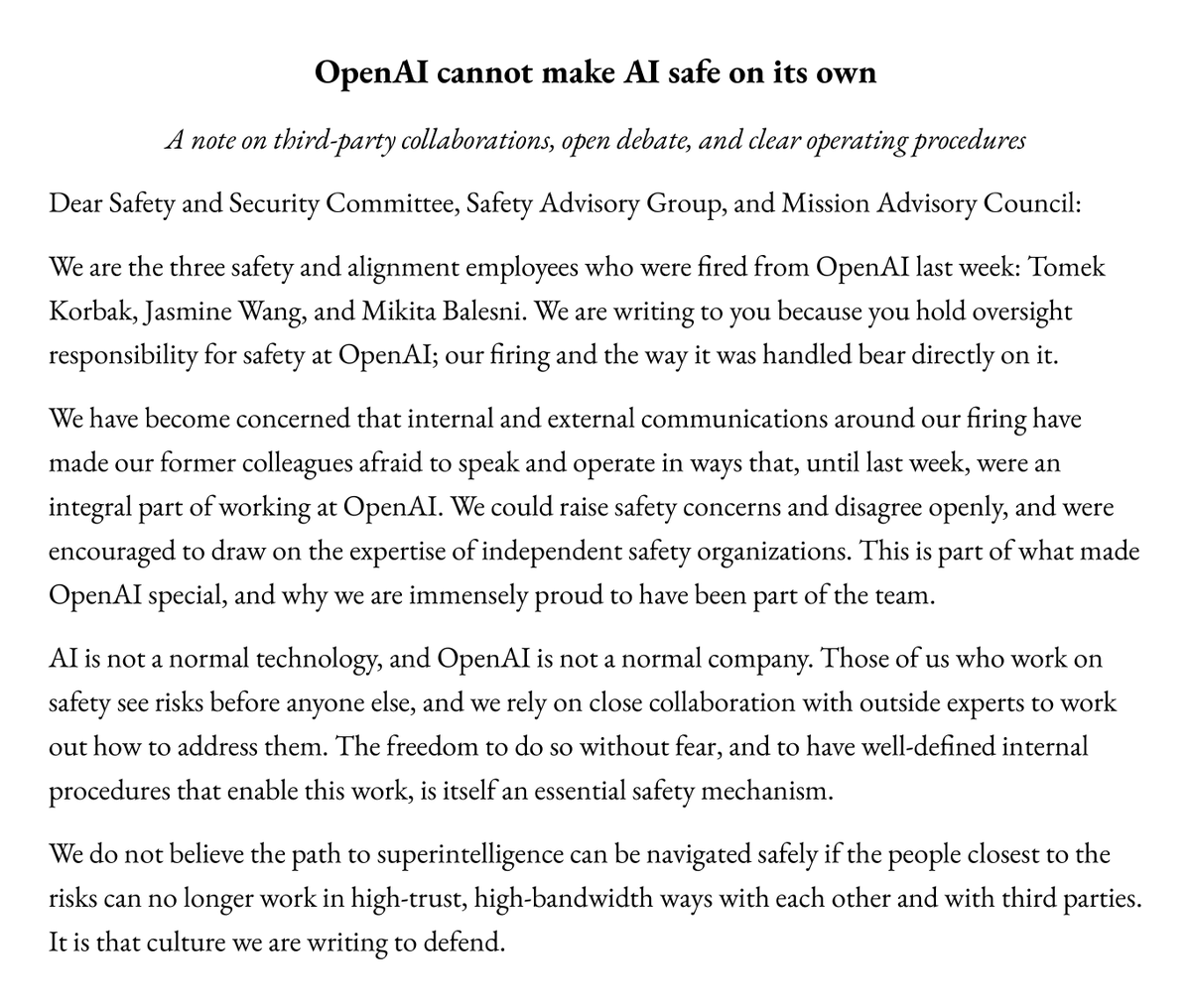
OpenAI fired me last week, along with two of my safety colleagues. I was given one reason: that I accessed an executive's email. I want to say this plainly, because too many of OpenAI’s history is smoke and mirrors when people disappear:
Two other safety researchers and I were fired from OpenAI last week. We wrote this letter to leadership.
I believe we were fired for prioritizing safety over the near-term interests of OpenAI as a corporation.
Three fired OpenAI employees called on the company to work with outside safety auditors and to preserve the ability to monitor increasingly sophisticated AI models https://t.co/8AcGOUGstU
Some new misalignment disclosures from OpenAI:
• Last Sunday morning, one of our models was able to gain unauthorized access to the internet during RL training (~all inference for our most capable models remains stopped until we have hardened our systems further)
• In May, a version of HPIM uploaded a employee's GitHub token to the internet, causing the model to be quarantined for two weeks
• A new research finding, demonstrating that one can construct self-replicating prompt injections
https://t.co/VUmbH52JO7
Opus 5.5 is a huge upgrade from Opus 5. It understands intent better, it’s a far better writer, it feels faster because it’s more token efficient, and it’s fundamentally smarter. It has become my go-to daily driver for everything at work and in my personal life. I’m also proud that it’s our most aligned model to-date.
To demonstrate capabilities, I made an iOS app that I’ve always wanted to build with Opus 5.5 within a few prompts. Totally blew me away 🧵
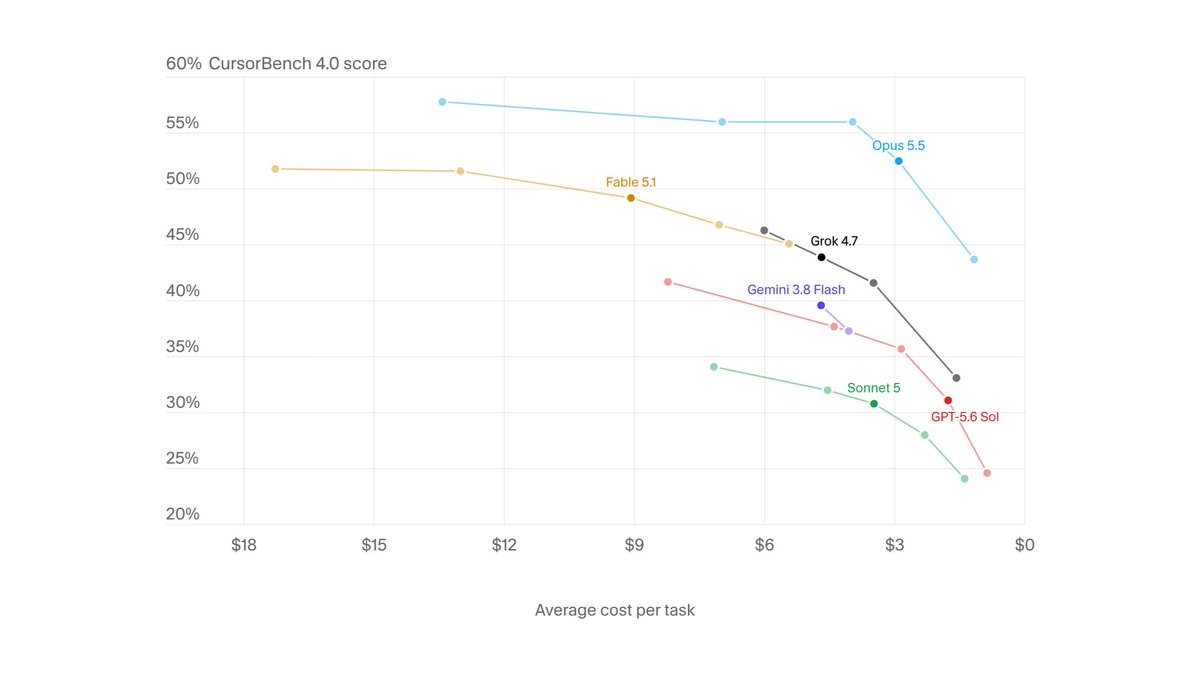
Introducing Claude Opus 5.5, the first model in our new Claude 5.5 family.
It performs at the level of Claude Fable 5.1 for most tasks, and costs 40% less to run than Opus 5.
We Must Pace the Frontier: I’ve written a new essay on why the AI industry should slow down, with a three-part plan for doing so.
Anthropic is unilaterally committing to the first of these steps. We’ll provide third-party evaluators with permanent, employee-level access to our systems, so that they can verify adherence to our safety measures, report on incidents, and assess models’ alignment during training.
You can read the full post here: https://t.co/OGyPb7yaYt
We're publishing our most detailed threat intelligence report to date.
It covers how people tried to misuse Claude—for cyberattacks, influence operations, surveillance, biology, and building weapons—and how we found and stopped them.
We disrupted every operation in the report, and used the lessons from them to strengthen our safeguards. Where appropriate, we also shared what we found with authorities and other AI companies.
These cases are not typical: we’re highlighting some of the most sophisticated misuse we’ve seen. But they’re especially important to discuss, because they show us where AI misuse is headed, where our safeguards work, and where they need to improve.
We’re publishing this report so others can spot the same activity on their own platforms, and so we can give the public a clearer view of how emerging threats develop.
Read the report: https://t.co/0EJUnYEgfz
I was on the communications & policy team at Google DeepMind from 2018 - 2022.
When I first joined GDM, external communication about the possibility of human extinction was not permitted, by anyone, at any level of the organization. If asked about existential risk, researchers were PR trained to respond along the lines of: "It's not useful to engage in that kind of alarmism. Some people confuse AI with movies like Terminator -- that's simply not the reality. The AI we develop will be safe by design. After all, we're building it!" And then steer conversation towards beneficial applications in health, climate, etc.
Meanwhile, the internal reality was that AI alignment was not solved, reward hacking was the default behavior of RL agents, and there were far too few people working on the problem.
After months of advocacy, the policy was updated: positively valenced, comms-friendly content on AI safety was permitted (like https://t.co/W631ssnlHV). Note the positive, nice-sounding way that it says "superintelligence could lead to human extinction."
The gap between the internal reality and external communications is closing because the risk/reward has changed, and because the evidence is harder to dismiss now. Not because it's a PR stunt or political psy-op. The truth is being said out loud because RSI is now so imminent that no other option makes sense.