Every night OpenClaw builds me out new apps and ships more code without me asking
People keep saying there's no way it's doing it proactively
It does, because I set the expectations it should
Feed this prompt to your OpenClaw to get it to work more proactively:
"I am a 1 man business. I work from the moment I wake up to the moment I go to sleep. I need an employee taking as much off my plate and being as proactive as possible. Please take everything you know about me and just do work you think would make my life easier or improve my business and make me money. I want to wake up every morning and be like "wow, you got a lot done while I was sleeping." Don't be afraid to monitor my business and build things that would help improve our workflow. Just create PRs for me to review, don't push anything live. I'll test and commit. Every night when I go to bed, build something cool out I can test."
Few keys here:
• Before doing this prompt, brain dump EVERYTHING about you and your business into OpenClaw
• Make sure it's aware to NOT commit code (if you have it connected to github)
• Make sure it's aware to NOT delete files
• Login to Codex CLI on your computer and ask OpenClaw to use Codex to write code instead of Claude Code so you save tokens on your Claude Max account
OpenClaw is the most proactive AI ever made, but only if you set those expectations
@VadimStrizheus It seems like to me any local model or any model besides ChatGPT or Claude code is just straight trash for me personally so I just stopped using my open claw and until I can afford the $200 pro plan
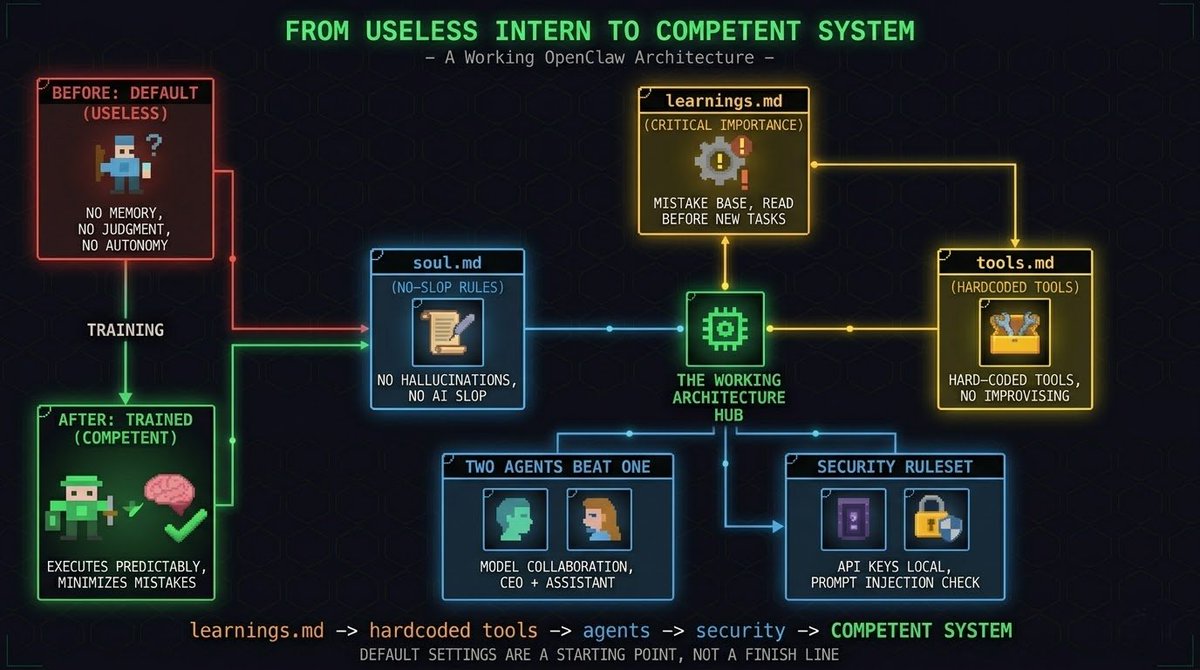
Default OpenClaw is useless. Here's the architecture that actually works.
> Out of the box its a dirty stupid clanker. No memory, no judgment, no autonomy. You have to train it like an intern on day one. Here's exactly how.
soul.md - kill the AI slop first.
Open the file. Add two hard rules.
> No hallucinations. The agent must verify and confirm every action.
No ChatGPT phrases. Generate this file using Claude in the web interface based on your specific requirements. The default tone is unusable.
learnings.md - the most important file you're not using.
Every time the agent breaks something, run one command: "Add this mistake to learnings".
> Add one rule to agents.md. before any new task, read learnings.md first. After a week the agent starts writing: "I made this mistake before - I'll solve it differently this time".
This is how it stops being an intern and starts being competent.
heartbeat.md vs cron - dont mix them.
Heartbeat - lightweight checks every 30-60 minutes. Read email, check status, nothing heavy.
Crons - complex chains in separate files. Generate audio, overlay on image, publish to YouTube every 3 days. Keep this out of heartbeat or everything slows down.
tools.md - remove all choices.
We use Todoist for tasks, Notion for docs, Netlify for deploys. Hard-coded. The agent stops improvising with random tools and starts executing predictably.
Two agents beat one.
CEO on Opus 4.6 - sole push rights to main branch on GitHub.
Assistant on Kimi 2.5 - research only, pushes to side branches.
When two different models talk to each other, output quality multiplies. Opus supports up to 8 sub-agents for parallel work.
Security - two non-negotiable rules.
API keys stay in .env files locally. Never transmitted over the network.
Before clicking any link or updating any code - agent reads for prompt injections and asks for your confirmation.
Default settings are a starting point, not a finish line.
Bookmark this. A few hours to set up. Compounds for years.
I asked Claude to build my daughter an app that plugs into our piano, can read live key strokes, can show her sheet notes and key view and ends with a Guitar Hero style game. All while giving progressively harder songs. Today she’s using It and crushing It.
🤯 Claw3D just went VR 🤯
And I didn’t even build it.
The community did.
Watching you all take this further than I ever imagined is insane.
This is starting to feel like the future.