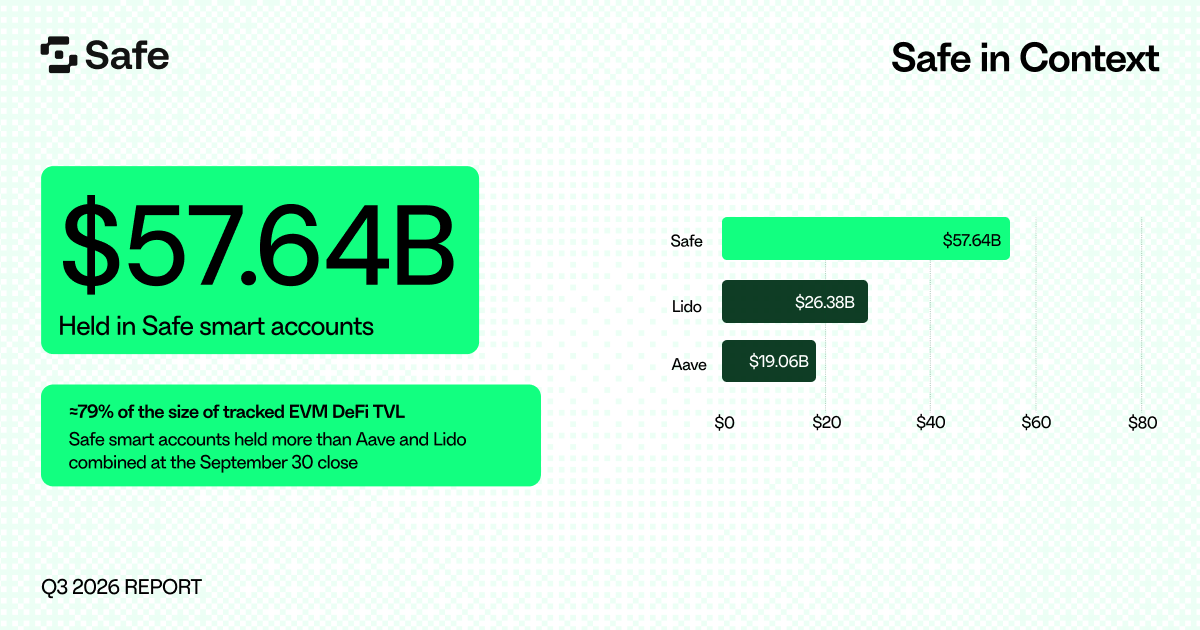
Safe smart accounts held $57.64B at the 30 September close.
More than Aave ($19.06B) and Lido ($26.38B) combined.
And $1 in every $42 of global stablecoin supply.
https://t.co/QcMRd508s1
One of crypto's largest KOLs has been secretly extracting millions from his audience
We’ll expose him soon
Unfortunately, he’s just a symptom of a much bigger problem
Social trading has brought out the worst in KOLs. It was designed to keep them honest by making every trade public. In reality, the opposite happened
In just a few weeks, we exposed a number of "top social traders" using the same tricks:
• Public wallets to attract copy traders
• Side wallets to dump
• Callouts to farm rewards
• Bundled tokens to hide supply
And there are plenty more doing the exact same thing
Why? Because our industry incentivizes it
1) Launchpads allow it
Most launchpads today are obsessed with one thing: volume. Millions in callout rewards, affiliate links, and top leaderboards. Almost nothing on detecting bundles, side wallets, or shady traders. Scams drive volume. Launchpads have no reason to stop it (other than actually caring about their users)
2) Social trading incentivizes it
Side wallets have become a business model. Before social trading, only big KOLs could do it. Now, anyone who lands on a leaderboard can monetize by dumping on their copy-traders. The temptation is real
3) CT normalizes bundle culture
“Everyone bundles. It's how it's done" - an excuse we hear every time we expose a KOL. Supply control isn't the problem. Hiding it is. If it's so bullish, why hide it? Spoiler: because you're planning to sell
***
Launchpads are paying millions to dishonest KOLs. It's time they start taking it seriously
Audit the top traders. Expose their side wallets. Ban repeat offenders
We have the tools. What's missing is the willingness to use them
No one's coming to save us
AI can’t be good enough without enough data.
But not all data can be shared to train AI, even within the same company.
FLock flips it. The model goes to where the data lives, not the other way around. And we’re doing it in production with enterprises, not just in research papers.
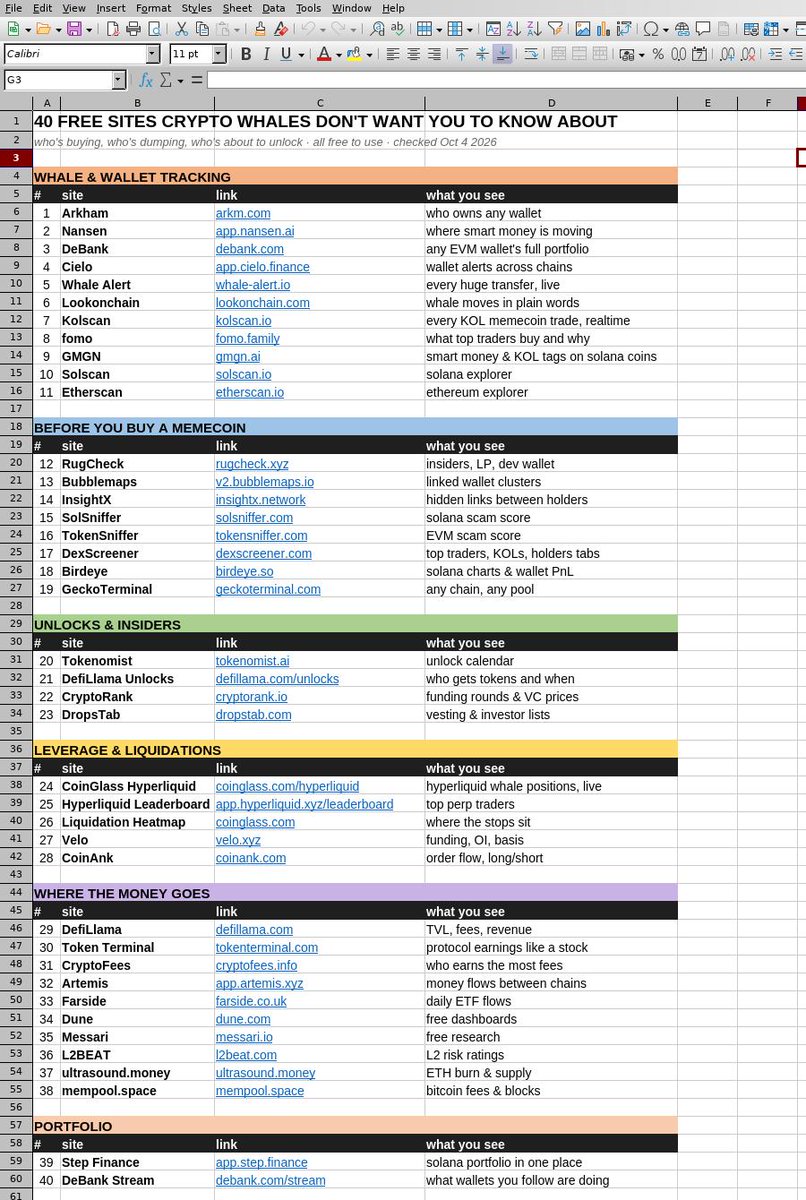
40 free sites crypto whales don't want you to know about
who's buying, who's dumping, who's about to unlock. all free
whale & wallet tracking
1.) https://t.co/w2M4J1tscG → see who owns any wallet
2.) https://t.co/7vGbfpW4f3 → where smart money is moving
3.) https://t.co/jDyC6z6Zm5 → any EVM wallet's full portfolio
4.) https://t.co/3mlDuUkStM → wallet alerts across chains
5.) https://t.co/FN6G4GnHdI → every huge transfer, live
6.) https://t.co/5IOmh9ZtX7 → whale moves explained in plain words
7.) https://t.co/mx4LekOYn1 → every KOL memecoin trade, realtime
8.) https://t.co/dDHvhx7Yaa → what top traders buy and why
9.) https://t.co/8lv740KchL → smart money and KOL tags on any solana coin
10.) https://t.co/wqEA2Vvnnp → solana explorer
11.) https://t.co/IkglL9ltOi → ethereum explorer
before you buy a memecoin
12.) https://t.co/1Tx1tKDU3b → insiders, LP and dev wallet on one page
13.) https://t.co/M309AiKyKk → linked wallet clusters
14.) https://t.co/Fme3565t3j → hidden connections between holders
15.) https://t.co/hGmY58uvQM → solana scam score
16.) https://t.co/1wrkYNTU6p → EVM scam score
17.) https://t.co/Qx3OAzFw2I → top traders, KOLs and holders tabs
18.) https://t.co/G85C1snXRr → solana charts and wallet PnL
19.) https://t.co/sG4YUMnIdF → any chain, any pool
unlocks & insiders
20.) https://t.co/XdpH9Pv6WN → unlock calendar
21.) https://t.co/MexjSNObZb → who gets tokens and when
22.) https://t.co/cmdISuBNah → funding rounds and VC buy prices
23.) https://t.co/zWK6Filwz4 → vesting and investor lists
leverage & liquidations
24.) https://t.co/OCo4Ffn5YJ → hyperliquid whale positions, live
25.) https://t.co/ljWIndF0Og → top perp traders
26.) https://t.co/KiqWOelES5 liquidation heatmap → where the stops sit
27.) https://t.co/MCA0X1EDfA → funding, open interest, basis
28.) https://t.co/xkUL69yCn8 → order flow and long/short ratio
where the money actually goes
29.) https://t.co/A45y65WVBr → TVL, fees, revenue
30.) https://t.co/T40UuGF2MW → protocol earnings like a stock
31.) https://t.co/tojTH4I9J7 → who earns the most fees today
32.) https://t.co/eaWzhlerGK → money flows between chains
33.) https://t.co/orziuqxM4H → daily ETF flows
34.) https://t.co/w8sQcQUene → thousands of free dashboards
35.) https://t.co/UWTLoyFkTR → free research
36.) https://t.co/HY65fLAf7j → L2 risk ratings
37.) https://t.co/c321outhUB → ETH burn and supply
38.) https://t.co/2sBcEzOZYG → bitcoin fees and blocks
portfolio
39.) https://t.co/kwOxVIMzEg → solana portfolio in one place
40.) https://t.co/jl8Rv2lZF3 → what wallets you follow are doing
bookmark this. you'll need it next time you're about to ape
🧵 Why I'm paying much more attention to $FLOCK
The more I research FLock, the more I think people are looking at it through the wrong lens.
This isn't simply another “AI crypto.”
FLock is building infrastructure around one of the biggest problems in AI:
**How do you train and deploy useful AI without giving up control of your data?**
Let me explain. 👇
1/ 🧵
@ClearpoolFin It’s an interesting trick to use when you’re out of ideas and money: latch onto a major project to boost your coin count. Why invest when you can just do that again? It will ruin the project.
Together with @Ripple and @cicadacredit, Clearpool is building the flagship institutional credit platform on the XRP Ledger.
The credit layer we've spent years building is finally reaching a network built to move value at scale. Ready for our next chapter 💪🏻
Read more 👉🏻
https://t.co/VhMPdPej0a
$CPOOL $XRP @RippleXDev
@apecoin@ApeChainHUB@OthersideMeta@BoredApeYC Make a movie or a cartoon with your gorillas and add elements of cryptocurrency - it will be a resounding success if the script is right.
🚨 Hoy ha pasado algo que casi nadie está explicando bien, y conviene que lo entiendas porque dice mucho de hacia dónde va esto.
Se ha lanzado Open USD (OUSD), una nueva stablecoin. Pero lo importante no es "otra stablecoin más"... es QUIÉN está detrás.
Más de 140 empresas que normalmente se pelean a muerte entre sí, juntas en el mismo proyecto: Visa, Mastercard, American Express, BlackRock, Google, Samsung, Stripe, Coinbase... y sí, Ripple también.
¿Y por qué se juntan todos? Aquí está la jugada, y es brillante.
Hasta ahora el negocio de las stablecoins funcionaba así: tú le das tu dinero a Circle (los de USDC), ellos emiten el token, y con TU dinero compran deuda de EEUU y se quedan ellos casi todo el rendimiento. Dinero gratis para el emisor.
OUSD le da la vuelta a la tortilla: el rendimiento se reparte entre las empresas que participan. La stablecoin deja de ser el negocio y pasa a ser solo la tubería. Un estándar compartido en vez de un emisor que se lo queda todo.
¿Y a quién le sienta esto como una patada? A Circle.
Hoy mismo sus acciones cayeron casi un 16%.
Ni Circle, ni Tether, ni PayPal están invitados a la fiesta. Normal.
Y ahora fíjate en quién dirige esto, porque lo explica TODO. El CEO de Open Standard (la empresa detrás de OUSD) es Zach Abrams, cofundador de Bridge. ¿Y qué es Bridge? La infraestructura de stablecoins que Stripe compró por 1.100 millones de dólares en 2024.
O sea: esto es, en el fondo, una jugada del ecosistema Stripe.
Por eso de entrada OUSD NO sale en todas partes. Sale nativo en Solana desde el día uno (donde Bridge ya tiene toda la fontanería montada y rodada) y en Tempo, que es la propia blockchain de pagos de Stripe.
No es casualidad ni ideología: lanzan donde el equipo fundador ya tiene la infraestructura funcionando.
¿Y las demás cadenas? Aquí te aviso, porque he visto a medios soltar alegremente "sale en Solana, Stellar, Base y Polygon".
Cuidado: eso NO lo ha confirmado Open Standard. Lo único sólido es Solana + Tempo el día uno. El resto es especulación de periodistas mirando qué cadenas están entre los socios.
No te lo creas hasta que salga la documentación técnica.
Y la cosa no estará del todo operativa hasta más adelante en 2026 — no hay fecha firme todavía.
Ahora, la pregunta que de verdad importa para nosotros: ¿qué pinta Ripple ahí?
Y aquí te voy a ser sincero, sin venderte humo: Ripple está en la lista de socios, pero eso NO significa que OUSD vaya a funcionar sobre la XRP Ledger.
La XRPL es, como mucho, un riel más entre varios posibles.
Y el centro técnico de todo esto no es la XRPL... es Bridge + Tempo, o sea, Stripe. Ripple está en la periferia estratégica, no en el núcleo.
Ripple está jugando a estar sentada en TODAS las mesas que importan.
Es estrategia de cobertura: "yo me pongo en todos los raíles posibles y ya veremos cuáles ganan". Inteligente, pero hay que llamarlo por su nombre.
Y ojo al detalle que nadie te va a decir, porque no vende: aunque OUSD acabara corriendo sobre la XRPL, las transacciones ahí cuestan fracciones de céntimo. Eso quemaría un goteo ridículo de XRP.
Que la red se use NO significa automáticamente que el token suba.
Lo llevo diciendo tiempo: una cosa es la utilidad de la red, otra muy distinta que ese valor llegue al token.
Resumen para que te lo lleves claro:
✅ Bueno para Ripple como empresa/infraestructura (está en la mesa de los grandes).
⚠️ Neutro para el precio de XRP a corto (el mecanismo que conecta uso → precio sigue siendo flojo).
💥 Muy malo para Circle (le acaban de montar una coalición en contra).
🏗️ Y en el fondo, esto huele a Stripe: su CEO viene de Bridge, sale en su cadena Tempo, y el núcleo técnico es suyo.
Esto va de raíles, no de tokens. Y el que entienda esa diferencia, va a leer este mercado mucho mejor que el que solo mira el precio.
¿Qué opináis? ¿Ripple cubriéndose las espaldas o tiene una carta que aún no enseña? 👇