$EOSE Roadmap to $40+ – Redbird Unlocked, Catalysts Loading!
Ultra-bull PT $40+ in sight.
News drought shattered TODAY: Bimergen advances Redbird to Ready to Build (RTB) stage with JDA approval + Eos Z3 selection (permitting & interconnection cleared, financing next).
Milestones I believe drive us there:
☑️ Bimergen gets JDA approval & permit advancement for the 400 MWh Redbird project (announced TODAY – Eos Z3 selected, milestone‑based capital now flowing!)
⬜ Bimergen publicly places a firm order for the Redbird project
⬜ Q4 earnings — Q4 revenue ~$95mm
⬜ Backlog exceeds $1B
⬜ 2026 guidance $500mm–$750mm
⬜ Frontier makes it through the next gate (early spring) with all 11 GWh intact
⬜ The 2.4 GWh NYC Navy Pier project is announced
⬜ NextEra announces they are going to use a significant amount of $EOSE BESS starting immediately
⬜ IEP announces the Robena Data Center project has achieved FID (tenants + full funding secured)
⬜ A large Z3 Indensity order is announced
⬜ Q1 earnings (early May) — ~$125mm for Q1
⬜ Line 2 imminent SAT at Marshall
⬜ Line 3 announcedUltra-bull PT $40+ in sight.
⬜ Backlog exceeds $3B
Redbird box checked — next one incoming? $EOSE to $40+ feels inevitable if these hit.
#EOSE #BESS #ZincBattery #EnergyStorage
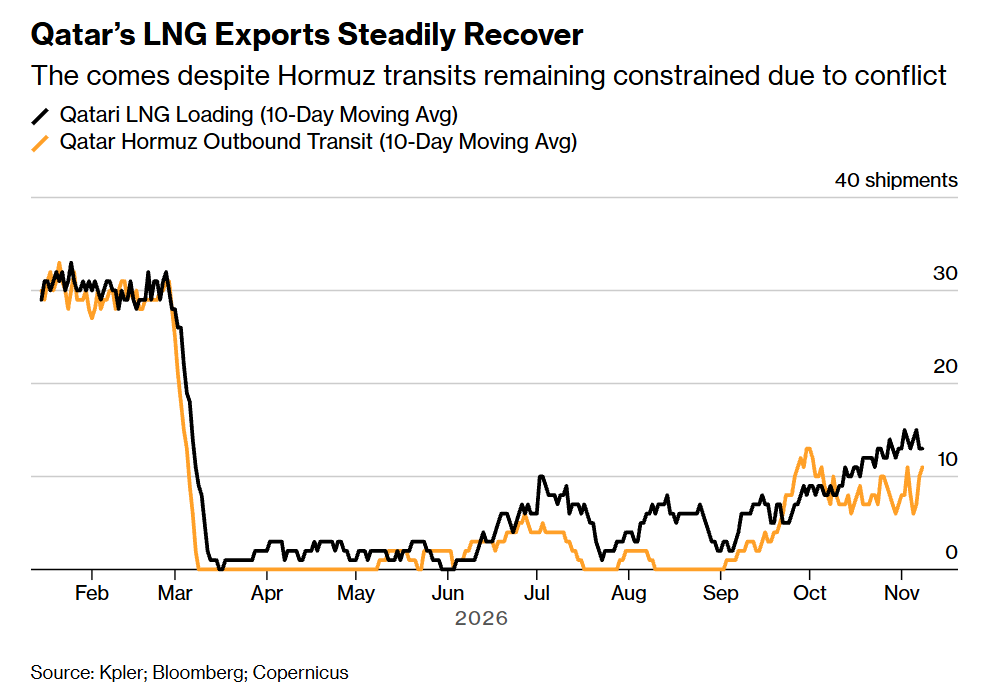
Qatar's LNG loadings pick up to around half of the pre-war levels 🇶🇦📈
The number of LNG cargoes departing Qatar’s Ras Laffan plant has ranged from 13 to 15 on a 10-day moving avg basis so far in November
Thats a steady rise from September and October
https://t.co/0UYY7dlLcM
Un doctorando de Oxford fue acusado de entregar un trabajo hecho con IA.
Su tutor dijo que era uno de los procesos de investigación más avanzados que había visto en dos décadas.
Pero había un detalle clave:
El estudiante no había usado IA para escribir ni una frase.
La usó para algo mucho más potente.
Este fue el sistema que hizo saltar todas las alarmas.
Cada ensayo empezaba con lo que él llamaba un “diagnóstico brutal”.
Primero escribía su argumento en bruto. Sin pulir. Sin adornos.
Después lo pegaba en Claude y le hacía una pregunta:
“¿Cuáles son los tres puntos más débiles de este razonamiento? ¿Dónde atacaría primero un examinador especialmente crítico?”
Claude no redactaba el ensayo.
Lo destrozaba.
Y él reconstruía el texto solo con las ideas que resistían el ataque.
La mayoría usa la IA al revés.
Le dan un tema y le piden que piense por ellos.
Él hacía lo contrario:
Le daba su propio pensamiento y le pedía que encontrara las grietas.
Esa es la diferencia entre delegar tu cerebro y entrenarlo.
El segundo paso fue el que dejó a su tutor sin palabras.
Subía sus cinco artículos académicos más importantes junto con su borrador y le preguntaba a Claude:
“¿Qué partes de mi argumento contradicen, exageran o simplifican lo que estos autores realmente demostraron?”
La mayoría de estudiantes cita papers que apenas ha leído por encima.
Él no.
Él se veía obligado a enfrentarse de verdad a cada artículo, porque Claude detectaba cuándo estaba usando una cita de forma débil, superficial o directamente incorrecta.
Y luego venía el movimiento final.
Antes de entregar nada, pegaba su conclusión y lanzaba un último prompt:
“¿Qué diría un filósofo de la ciencia que falta en este argumento? ¿Qué supuestos estoy dando por válidos sin haberlos defendido?”
El resultado:
Sus trabajos volvían de revisión con comentarios como:
“Sorprendentemente riguroso.”
“Una profundidad crítica poco habitual.”
“Excelente capacidad de análisis.”
Y su comité no entendía de dónde salía ese nivel.
Hasta que lo acusaron de usar IA.
La audiencia por integridad académica duró tres horas.
Le pidieron que explicara su método desde cero, allí mismo.
Abrió el portátil.
Mostró cada paso.
Cada prompt.
Cada iteración.
Y entonces ocurrió lo inesperado:
No solo lo absolvieron.
Le dieron la calificación más alta registrada en la historia del departamento.
Y le pidieron que enseñara su sistema al resto de la facultad.
La lección es brutal:
Lo que a muchos doctorandos les lleva meses de correcciones, reuniones y revisiones, él lo comprimía en una sesión.
No porque la IA pensara por él.
Sino porque había descubierto cómo usarla como el crítico más implacable de la sala.
La IA no mejora tu pensamiento sustituyéndolo.
Lo mejora atacándolo.
Más rápido.
Más duro.
Y con menos piedad que cualquier humano.
Él no usaba IA para escribir mejor.
La usaba para pensar mejor.
La herramienta la tiene todo el mundo.
El flujo de trabajo es lo que casi nadie entiende
Soy la Cyber Directora de Operaciones de GptZone.
Si quieres seguir aprendiendo conmigo apúntate gratis https://t.co/8dGRIfdUiD
Domina la IA en 3 Minutos al Día
BOOM 🚨 In the latest Tesla episode of Jay Leno’s Garage, Jay pointed out to Franz von Holzhausen and Lars Moravy that wipers have barely changed in 20 years 💀
Lars came right back with a fun one: Tesla has designed a laser version 🔥 And what he said right after that is where things get really exciting 🔥
He admitted you’d need a whole lot of lasers to clean an entire windshield, but said they could make real sense for just the little patch of glass in front of a camera. That’s a telling comment from the guy who runs Tesla’s vehicle engineering, because it hints at where Tesla thinks cleaning matters most once the car is doing the driving.
And the design itself is genuinely clever. The car’s own cameras can spot the dirt, which means a blocked lens can basically call for help on its own. There’s also an option for a sensing layer in the glass that feels anything landing on it. Before it fires a single pulse, the system figures out what it’s dealing with from clues like texture, color, whether it’s solid or liquid, how it reflects light, and, believe it or not, smell. Bug splats, bird droppings, tree sap and mud all made the list.
Then it tunes the laser for that exact mess, from wavelength and pulse length to power and spot size, while steerable mirrors put the beam right on the dirty spot and nowhere else. One laser can even feed several aiming points around the car through optical fibers.
Now, a laser firing at glass with your family sitting behind it sounds scary, and Tesla clearly knew that. The beam is pulsed at a rate that keeps it from going deeper than the glass is thick, and the windshield can carry a coating like indium tin oxide to soak up or bounce back anything that gets through. It’s even designed to recognize stickers and logos, so your favorite decal doesn’t get treated like a bug.
If you own a Tesla, you probably know the “camera visibility limited” alert and the walk around the car with a cloth to wipe off a muddy side camera.
Robotaxi Model Ys already have washer jets on those cameras, since there’s no driver to step out, and Tesla sees the laser working alongside wipers and sprays rather than replacing them.
Rain will probably stay the wiper’s job for a long time. But a dried bug stuck right on a camera lens is a whole different story, and that’s where a laser aimed at a lens-sized spot starts to make a lot of sense, especially in a car with nobody inside to wipe it.
Wipers were built so a person could see the road. If Tesla’s laser idea ever makes it onto a car, the next big leap in keeping glass clean may be built for the car’s own eyes instead, starting with a laser smart enough to figure out what it’s aiming at before it fires.
Z3 Cube retrofit was about $13mm in Q2.
If it was also $13mm in Q3, that's about 16% margin that can be quickly recovered.
Also, Eos gave some customer(s) a sweetheart deal and ASP was down about 5% in Q3. They said ASP would rebound in Q4.
That's 21% of the negative margin that will easily be removed.
Q3 gross margin was -53%. Potentially that would have been -33% in Q3 without the above 2 factors.
And presumably scrap was still 8% of revenue in Q3. That is supposed to go away in Q1 mostly because of better environmental control and more QC stations integrated into Line 2.
Now you're at -25% gross margin.
Line 2 is supposed to drop conversion costs enough to remove another 20% of the negative gross margin.
So, that makes it -5% gross margin.
Line 1 did run for almost all of October, so all of the above won't be true of Q4, but it is coming and seems pretty reasonable to accept Eos guidance that they will Gross Margin positive in Q2'27.
@JordanSolace@99_loss_capital@Browpeak I'm always the optimist.
I am wondering if they are accumulating Cores in hopes of that 250 MWh project hitting in Q4. Over $50mm to satisfy that order!
There's been some interest expressed here on X recently about what my hardware, my normal workflow and what my use of AI looks like. Here's a description:
My main machine is a 64-core Ryzen Threadripper 9978X with 128 GB of memory custom-built for me by @tekwendell earlier this year. It has 3.84 TB of mass storage and a Radeon AI Pro R9700.
I'm running openSUSE Tumbleweed Linux for a specific reason: I wanted a rolling release with OS image reversion. I considered Arch, but I also wanted my package manager to do dependencies and constraints more in the style of Apt or dnf, and it seems only Tumbleweed really offers that combination.
I'm a big fan of tiling window managers. Since I discovered them, the conventional floating-window style looks cluttered and wasteful to me. I ran i3 for a long time, recently switched to Cosmic Desktop, and like it a whole lot.
I use three 4K monitors, the center one in portrait mode and the other two in landscape. The portrait-mode one is my editor display, which is always an Emacs session. I get 116 lines of easily readable text out of it, which is the point.
The right-hand monitor is for the Brave browser. Two sled by side windows so that they have a reasonable aspect ratio for all-text pages. The left hand one typically has three terminal emulators open. The middle one is usually running Codex these days, the other two are for general shell commands.
I type on a Unicomp Model M (elegant weapon from a more civilized time) and use a Logitech M370 thumb-operated mouseball. I have speech-to-text set up via Handy and use it heavily.
I've tried several different harnesses. I like Codex and usually use it with whatever the OpenAI frontier model is this week. I have Qwen 3.8 set up to run locally via LLM studio as a fallback.
I've kept my use of AI deliberately simple; as I've written here before, I think all the complications around skills and subagents and software factories are mostly pointless ways to get around model that are going to go away in a few weeks or months anyway.
I almost always have Codex open in a terminal window. I let it read and write files, but I don't let it commit anything on its own because I always want to review the diffs first. I give it tasks in small chunks and keep firm control of the architecture, almost the opposite of "vibecoding".
I hate clutter and distraction, and my working environment is designed to minimize it. But I do often listen to music while I work.
NYSERDA didn't include funding. It was about offtake support.
I seriously doubt Lighthouse is built with Chinese BESS as I understand it was bid.
Tumbleweed I think is real. That's one lithium 8-hr project.
8-hr is simply still very early. Eos isn't losing those projects. More accurate to say no one is winning them yet.
I really am curious. What 8-hr Lithium LDES projects have actually received funding?
Even the NYSERDA awarded projects from 2 months ago I think will never actually be built.
They are using BESS manufactured in China and the Trump Admin has strongly implied they will make connecting BESS projects using Chinese batteries illegal to connect to the grid in the short term.
@JordanSolace@99_loss_capital@Browpeak Down payments are cash
Down payments are not revenue
Q4 needs $92mm of revenue minimum, so I don't think a project we have never heard of is going to slide in and start accepting Q4 cubes.
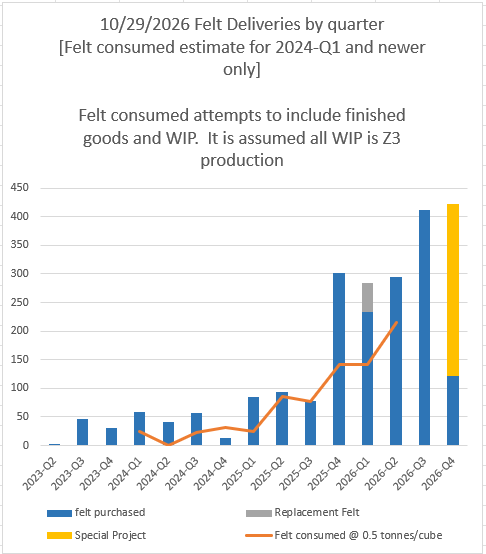
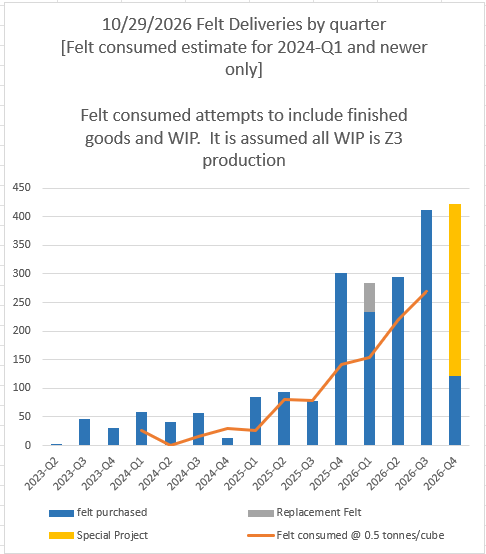
With Q3 numbers, we can estimate felt consumed in Q3.
It did not increase as much as shipments did so the blue bar extending above the orange line is a little taller in Q3 than in Q2.
===
Hypothesis.
Q3 felt was definitely ordered in Q2 (it takes about 4 months to arrive after the order is placed).
Line 2 started to ramp in Q3 but when the Turtle Creek employees were offered the chance to transfer to the Thorn Hill factory, they filled most of the available employee slots.
Therefore the Line 2 ramp was delayed until Line 1 was shutdown so the employees could transfer. That was Presumably Oct 26.
Third hand, but by Oct 29 overnight shifts were apparently operating.
The post Oct 29 Line 2 ramp might be shockingly fast because most of the employees seem to be Line 1 transfers!
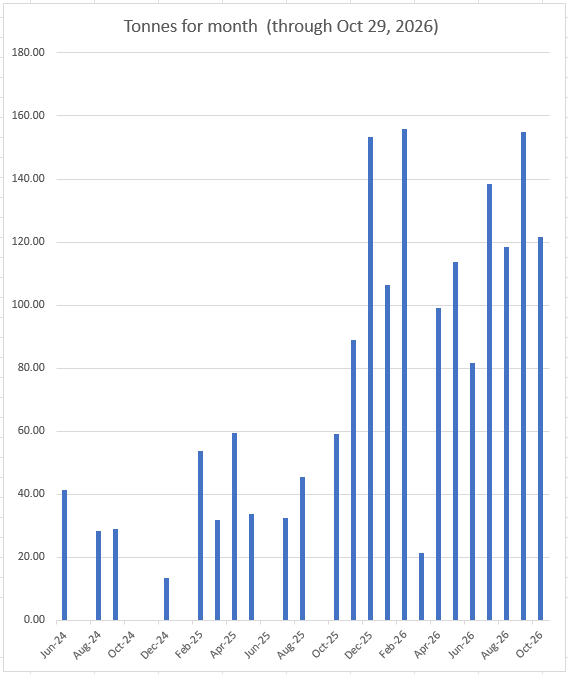
$EOSE FELT
Same policy. Dancer only.
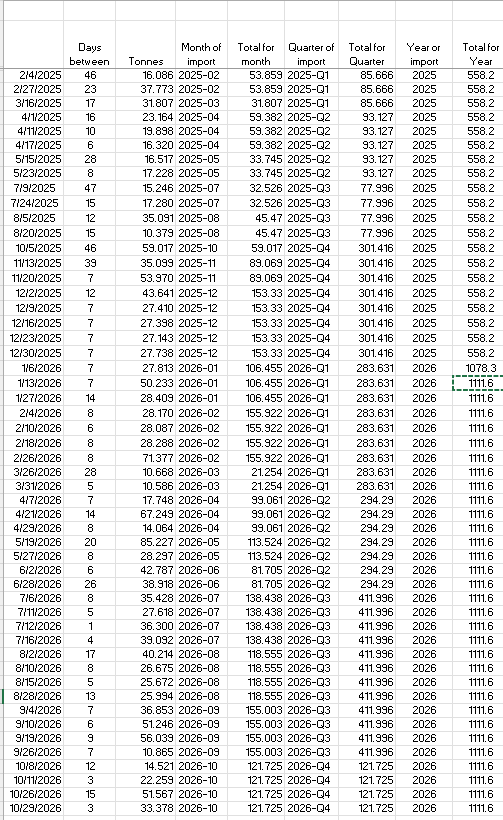
But, I can't help but wonder how and when that "yellow" bar makes it into normal inventory?
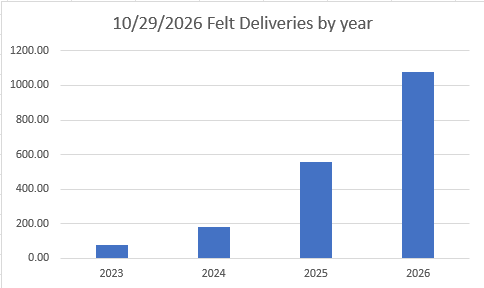
And I am very surprised to see October Dancer deliveries exceed 120 tonnes.
Recall it takes time for felt to get from LA to Pittsburgh. Those Dancer shipments are almost certainly meant for Line 2 consumption. Great to see Eos is at a minimum planning on consuming 120 tonnes of felt via Line 2 production. Or at least that is my presumption.
- I don't think Q4 can hit $92mm revenue without either Wildfire or the second half of Blanquilla kicking in. The exception being Camp Pendleton which I would love to see start shipping Q4.
- $eose says they have clear visibility for customers that allow guidance to be met, so the above isn't a negative. It just means we don't know where a lot of the Q4 cubes are going. 🤷♂️
====
Maybe Torrecillas will actually commission next month!
Surely they have the latest DawnOS config by now?
@bert_gilfoyle@srvc76 Can you name even 5 deals at 6+ hour duration $eose have truly lost? By that I mean that a different supplier won the project?
I can only name 1: the steel mill in Northern California
Mostly, the projects just see the decision delayed.
Z3 Cube retrofit was about $13mm in Q2.
If it was also $13mm in Q3, that's about 16% margin that can be quickly recovered.
Also, Eos gave some customer(s) a sweetheart deal and ASP was down about 5% in Q3. They said ASP would rebound in Q4.
That's 21% of the negative margin that will easily be removed.
Q3 gross margin was -53%. Potentially that would have been -33% in Q3 without the above 2 factors.
And presumably scrap was still 8% of revenue in Q3. That is supposed to go away in Q1 mostly because of better environmental control and more QC stations integrated into Line 2.
Now you're at -25% gross margin.
Line 2 is supposed to drop conversion costs enough to remove another 20% of the negative gross margin.
So, that makes it -5% gross margin.
Line 1 did run for almost all of October, so all of the above won't be true of Q4, but it is coming and seems pretty reasonable to accept Eos guidance that they will Gross Margin positive in Q2'27.
1/ Amazon's Sunstone project in Morrow County, Oregon. 1,200 MW solar and up to 7,200 MWh battery storage, at 6-hour duration. It delivers over BPA transmission lines. After a Cascadia earthquake, the battery will likely be out when Oregon needs it most. 🧵