What are users thinking during their interactions with LLMs?
We introduce ThoughtTrace — the first large-scale dataset that captures what users think during real-world human–AI conversations, not just what they type.
→ 10,174 thought annotations
→ 2,155 multi-turn conversations, 17,058 turns
→ 1,058 users
→ 20 LLMs
These thoughts improve user behavior prediction (+41.7%) and model alignment (+25.6%).
This opens a new paradigm of user-centric LLM research. Full information in the thread 🧶
Read our paper: https://t.co/lRYJvGJ7bb
Check our project website: https://t.co/AupCn1YQOk
🤖 We often talk about “context rot”: LLMs get worse as context grows.
But once distracting information enters, is it just “a bit more noise → a bit worse performance”?
Our #ICML2026 paper finds: no! 🤯 Instead, we reveal a striking "First Drop of Ink" effect: the first very few hard distractors do almost all of the damage, exactly like how one drop of ink clouding clear water.
Paper link: https://t.co/s3zg49imUr
New Anthropic research: Natural Language Autoencoders.
Models like Claude talk in words but think in numbers. The numbers—called activations—encode Claude’s thoughts, but not in a language we can read.
Here, we train Claude to translate its activations into human-readable text.
While AI has the potential to automate semi-structured interviews, it falls short in perceiving nonverbal cues, building rapport, and strategically steering long-horizon conversations. At the same time, qualitative researchers often want to conduct interviews themselves, as doing so helps them better understand participants and may lead to deeper insights.
Instead of asking whether AI should replace interviewers, we asked: 𝗛𝗼𝘄 𝗰𝗮𝗻 𝗔𝗜 𝘀𝘂𝗽𝗽𝗼𝗿𝘁 𝗶𝗻𝘁𝗲𝗿𝘃𝗶𝗲𝘄𝗲𝗿𝘀 𝘄𝗶𝘁𝗵𝗼𝘂𝘁 𝗴𝗲𝘁𝘁𝗶𝗻𝗴 𝗶𝗻 𝘁𝗵𝗲 𝘄𝗮𝘆?
In our #CHI2026 paper, we introduce InterFlow, an unobtrusive form of AI assistance that supports interviewers in managing interview flow and facilitates real-time data sensemaking. InterFlow features ambient visualizations, mixed-initiative information capture, and process-oriented AI suggestions grounded in empirical knowledge of semi-structured interviewing.
Our user evaluation showed that InterFlow reduced cognitive load and helped interviewers keep track of both the big picture and important emerging details during interviews.
Huge thanks to my collaborators Yu Zhang, Sriram Suresh, and to my advisors @luzc08 , @canlhci , and @Iriskie_Xia!
Full paper: https://t.co/7fbCtMihIP
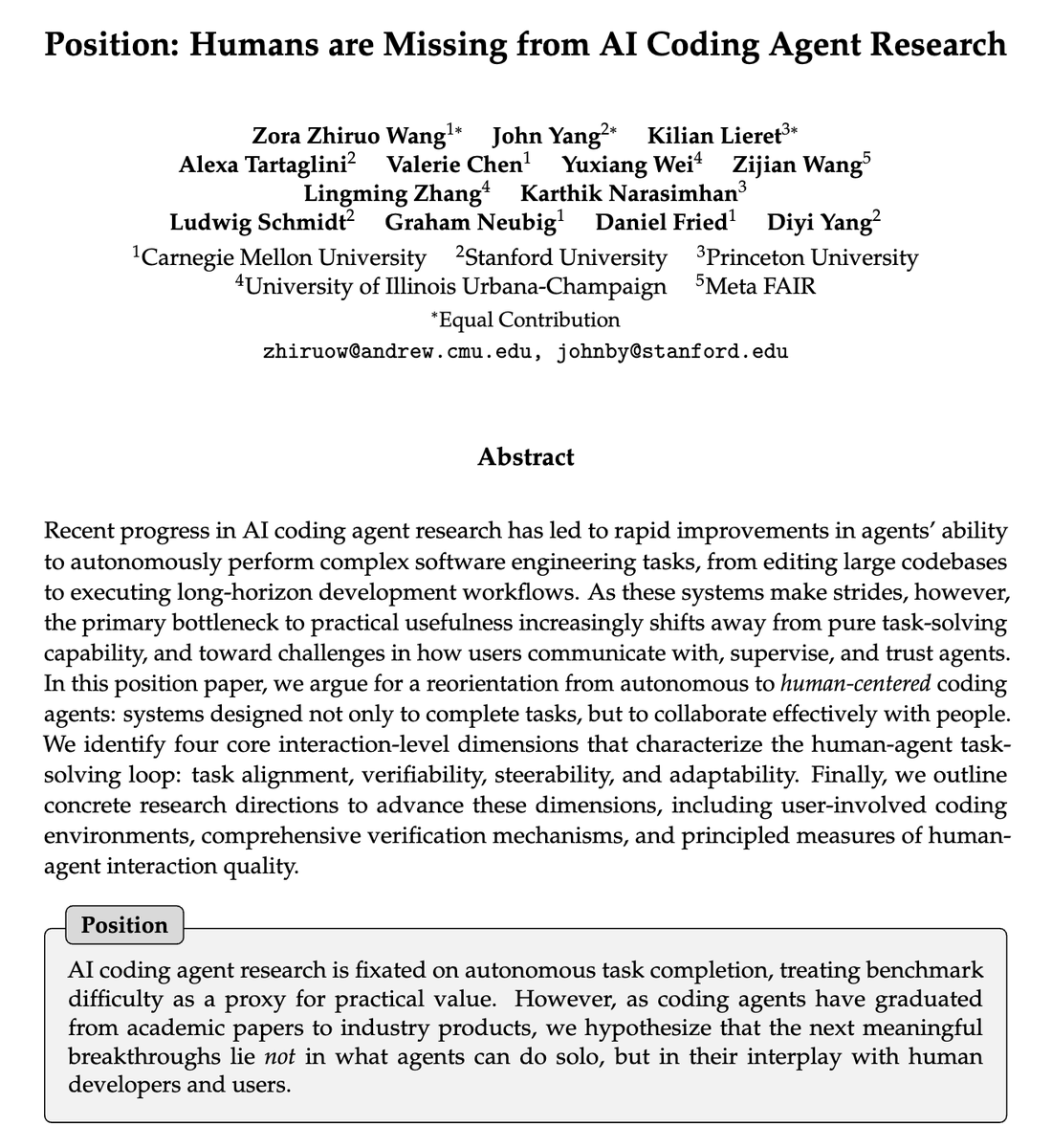
‼️Position: AI coding agent research needs recalibration.
We've heavily optimized for solo autonomy, and far less for designing agents that empower the humans using them.
It’s time to build human-centered coding agents. 🧵
Hello, we are a research team at Northeastern University conducting a paid remote study on human–AI collaboration in coding workflows. We are currently looking for developers to participate in testing these workflows.
Eligibility:
Software engineering experience in software or website development
Familiar with AI-assisted coding tools (e.g., GitHub Copilot, Cursor)
Proficient with GitHub/GitLab, VS Code, and code review workflows
Study Details:
Collaborate with an AI agent to develop and review code (~4 hours in total)
Compensation ($25/hr) via digital gift cards
Participation is entirely voluntary.
Interested? Sign up here: https://t.co/a5BeeXs3Ps
Contact me if you have any questions!
🎓 PhD Recruitment | Texas A&M CS
I am seeking 1–2 PhD students for Fall 2026 in Human–AI Interaction, with a focus on AI for education.
✅ Motivated and responsible
✅ CS background
✅ Full-stack development or LLM fine-tuning experience is a plus
📅 Deadline: Dec 15, 2025
I rushed to move to the US on Saturday, so it is a pity that I cannot attend either UIST or Ubicomp this year. Hope to meet HCI people in some future conferences!
Feel free to help me spread the word that I am looking for new PhD students to start my lab at Utah! #UIST#Ubicomp