Don't overcomplicate it, ETH is just a better BTC.
If BTC managed to reach $2T with no privacy, no quantum resistance, no plan for long term security budget, no smart contracts, no Defi, high fees, low decentralization
Then ETH can easily target $4T
Don't overcomplicate it, ETH is just a better BTC.
If BTC managed to reach $2T with no privacy, no quantum resistance, no plan for long term security budget, no smart contracts, no Defi, high fees, low decentralization
Then ETH can easily target $4T
@koolkrypto223 The main problem with HYPE is that it's not a certainty that they will survive long term, whereas for ETH it's much more certain.
At the end of the day Hyperliquid is just an app. Apps come and go whereas infrastrusture is here to stay.
https://t.co/etcHdAIIm1
Bear case for Hyperliquid (and HYPE):
Someone manages to unify all perp liquidity on Ethereum L1 + L2s in the same way that the @etheconomiczone managed to unify all DEX liquidity across L1 + L2s.
Thanks to the EEZ, a DEX on a random L2 with zero liquidity can tap into all the liquidity from Uniswap on L1, effectively killing liquidity as a moat for L2s.
Hyperliquid moat is its liquidity because it is seen as something very hard to get. But what if perp liquidity could be shared across protocols inside the Ethereum ecosystem?
Who is building this? @koeppelmann can you build this?
Compute markets are finally here.
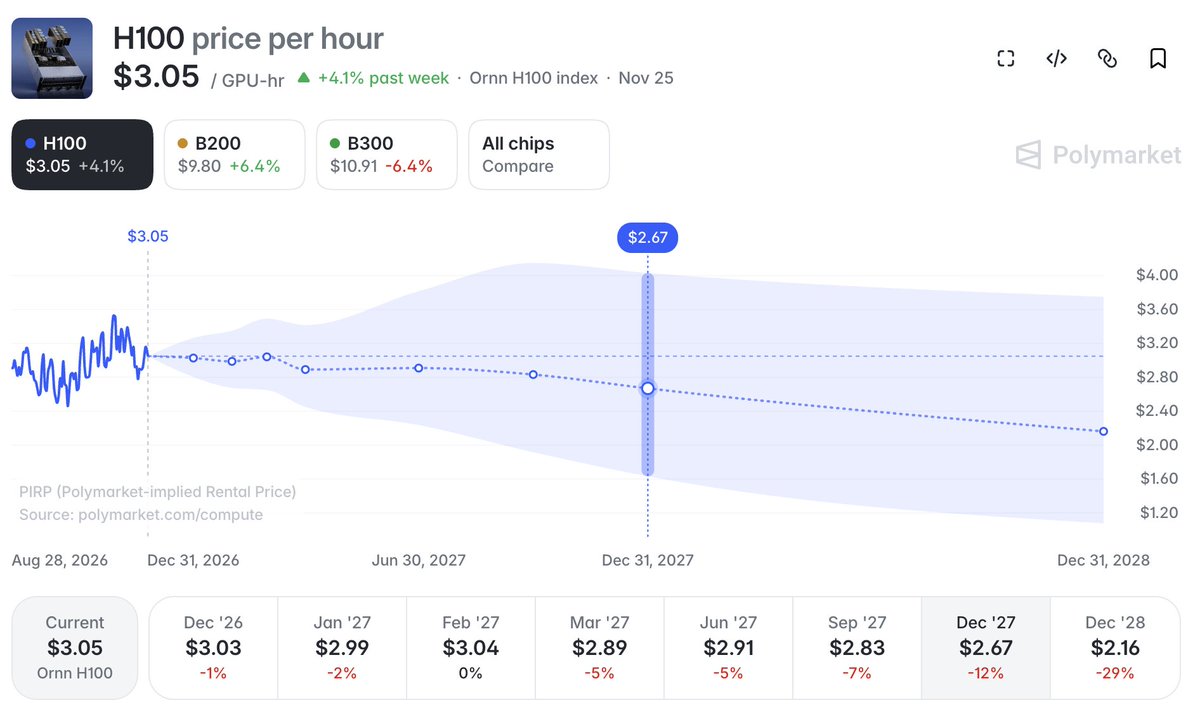
@Polymarket now prices on-demand compute for @nvidia H100s, B200s, and B300s, out to 2028. More chips and terms soon. https://t.co/JAJHRcAk8N
Think of it as a yield curve for the cost of compute: the forecasted $/hour price of each chip at every expiry, and whether it's trending up or down. The whole AI economy rides on these prices, and until today there was no public market for where they're going. Which is nuts. So Polymarket built it.
This will change how compute gets bought and financed. Every contract negotiation and every GPU loan will have a market price to check against.
Hundreds of billions of dollars are being committed to compute years in advance. Many of those deals are essentially a levered bet on what GPUs will rent for in the future (what could go wrong lol)
As AI financing sobers up, the labs buying compute, the providers selling it, and the lenders financing it will all need to hedge that risk.
We think compute could become one of the largest financial markets in the world. This launch is Polymarket's first step toward building it.
If you’re buying, selling, or financing compute, DM us with what markets you'd like to see.
@brivael Les gens normaux n’inventent pas le cinéma, ni la radioactivité, ni le courant alternatif, ni la pile, ni le prisme, ni l’ampoule electrique, ni l’IRM, ni les centrales nucléaires, ni l’avion ni la fusée.
Il faut des gens bizarres pour ça.
Restez bizarres.
@Paul_Glavin If you hard coded gas values in your contracts you are at fault and it's not the EF job to rescue developers whose smart contracts are buggy.
I just realized that the 20th century was perhaps an anomaly in how much it rewarded being book smart over street smart. For 80 years, the recipe for success was to study hard, get a degree, specialize and follow the rules. AI is about to commoditize much of what made that recipe work.
I think we’re entering an era that will disproportionately reward the curious, the resourceful, the self-taught and those who thrive in uncertainty. When intelligence becomes abundant, agency becomes scarce. That’s probably the most important thing we can cultivate in our kids now.
Every wrapped Bitcoin has somebody who holds the real one. A new paper shows how to remove this somebody.
It is witness encryption. You encrypt a secret not to a key but to a statement, for example "a valid proof exists that the loan was repaid". Whoever holds this proof can decrypt. There is no custodian, no committee and no operator who has to stay online.
So the BTC stays sealed on Bitcoin, and the key to it opens only for a correct proof from another chain. This is native Bitcoin as DeFi collateral, and the same idea works for Zcash.
The idea is from 2013, and until now it lived only on paper. Earlier estimates gave ciphertexts of hundreds of terabytes. The new scheme needs about 8 GB and seconds to encrypt and decrypt.
Its proofs are checked in Lean, the same tool that checked the Riemann proof last week.
The extreme version of AI-assisted research is pretty uncomfortable:
None of us can have a clue as to how the solution works. All I know is that my AI produced a solution, and all you know is that an AI verified it.
Update: I've asked Claude and got the answer I was looking for.
Basically, we know the proof is correct because it proves Mathlib's existing specs which we know are true, whereas if the specs were written by Claude researcher Levent Alpöge he could have made mistakes in the specs and therefore the proof wouldn't hold.
I can't find the answer anywhere on X so I'm gonna ask it here:
Yes, the Lean proof of the Riemann Hypothesis has been proven, but that doesn't mean that the Riemann Hypothesis is proven, it just means that the Lean proof respects the Lean specs of the Riemann Hypothesis, but if the specs are wrong, then the Riemann Hypothesis is still not proven.
Has anyone checked the Lean specs instead of the Lean proof?
The Lean FRO and Mathlib Initiative have released a joint statement on the Lean verification of the Riemann Hypothesis.
On November 20, Levent Alpöge released a proof of the Riemann Hypothesis as a Lean library of 17 million lines of code. Over the past day, the Lean and Mathlib communities worked together to verify it. The statement certifies the proof as correct and describes how it meets all necessary verification criteria.
Congratulations to Levent on this achievement, and thank you to everyone in the community who contributed to the verification.
Full statement: https://t.co/edxEbkodw7
Just 5 examples of cool Defi projects I've discovered in the last few weeks. I'm sure there are many more.
Phylax Systems: https://t.co/M1qPuD1vMG
Coffer: https://t.co/Kmd5ZLb82Z
Derive: https://t.co/eNfgFAu98B
RyskFinance: https://t.co/7B4SvpEFOp
Metric: https://t.co/mLV5pGRva8
Interesting strategy I've discovered recently for token accumulation.
Let's say there is a token you really believe in like ETH or HYPE. You want to hold it on spot and ideally accumulate more. What's the best way to do it?
The risky way would be to long the token on perps or buy call options. Perps have liquidations and options may not pay off. So you can potentially lose part, if not all, of your money. What you want is a reliable way to accumulate no matter where the market is going.
A better approach is to sell call options backed by your token, so you collect a premium while holding the token on spot. This is called a covered call and it is the business of @ryskfinance, although you can also buy covered calls on @DeriveXYZ with much better rates at the price of a slightly more complicated UX.
Covered calls are great but they mainly enable accumulation during downside trends. When the market is going up you are giving away the upside of your token so it is harder to accumulate. It's not good enough.
Which brings us to an even better way to accumulate... 🥁
Covered calls where the call option and its collateral are 2 different tokens 🤯
For example a BTC covered call collateralized by ETH. As far as I know, only @DeriveXYZ enables you to do this.
Why is it such a good way to hold and accumulate ETH?
Well, it has to do with the token you choose for the covered call (in this case BTC but it can be something else). If you choose a token that you believe is greatly overvalued compared to the token you are holding (ETH in this case), then your covered call is more likely to expire with more money earned on the collateral than the money lost on the option.
Basically, when BTC goes up, ETH usually goes up even more so your earnings compensate your loss. And even if that's not the case, the premium you got for selling the call option compensate your loss too.
Use your earnings to buy more ETH and repeat indefinitely until you think that BTC is no longer overvalued compared to ETH.
It isn't proven math and it really depends on your ability to accurately predict that one token is overvalued compared to another, but if you are right, then it's a great and consistent accumulation strategy.
What is particularly good with this strategy is that it's an asymmetric bet. You can potentially earn big in the long term while the downside should be quite limited, because as we've seen, the premiums earned compensate potential losses.
What do you guys think about it?
Derive king @koolkrypto223, any thoughts on this?
> "the BTC-overvalued view really is the whole trade"
That's right.
> "If BTC outruns ETH, the call loss comes out of your ETH collateral"
Yes but you are missing 3 things:
- Historically in last 10 years, when daily BTC went up, daily ETH went up even more, this was true 90% of the time
- You sold a call option so you get a premium that partially compensate your loss
- When selling the call option, your strike is usually at least +0.5% away from the current BTC price (for example when BTC is $64,500 you will sell the $65,000 call) so you only start losing everything that is above $65,000. Your ETH collateral profits from the whole BTC rise from $64,500 to $65,000 while you're not losing anything on the call. This also partially compensate your loss.