Just 5 examples of cool Defi projects I've discovered in the last few weeks. I'm sure there are many more.
Phylax Systems: https://t.co/M1qPuD1vMG
Coffer: https://t.co/Kmd5ZLb82Z
Derive: https://t.co/eNfgFAu98B
RyskFinance: https://t.co/7B4SvpEFOp
Metric: https://t.co/mLV5pGRva8
Interesting strategy I've discovered recently for token accumulation.
Let's say there is a token you really believe in like ETH or HYPE. You want to hold it on spot and ideally accumulate more. What's the best way to do it?
The risky way would be to long the token on perps or buy call options. Perps have liquidations and options may not pay off. So you can potentially lose part, if not all, of your money. What you want is a reliable way to accumulate no matter where the market is going.
A better approach is to sell call options backed by your token, so you collect a premium while holding the token on spot. This is called a covered call and it is the business of @ryskfinance, although you can also buy covered calls on @DeriveXYZ with much better rates at the price of a slightly more complicated UX.
Covered calls are great but they mainly enable accumulation during downside trends. When the market is going up you are giving away the upside of your token so it is harder to accumulate. It's not good enough.
Which brings us to an even better way to accumulate... 🥁
Covered calls where the call option and its collateral are 2 different tokens 🤯
For example a BTC covered call collateralized by ETH. As far as I know, only @DeriveXYZ enables you to do this.
Why is it such a good way to hold and accumulate ETH?
Well, it has to do with the token you choose for the covered call (in this case BTC but it can be something else). If you choose a token that you believe is greatly overvalued compared to the token you are holding (ETH in this case), then your covered call is more likely to expire with more money earned on the collateral than the money lost on the option.
Basically, when BTC goes up, ETH usually goes up even more so your earnings compensate your loss. And even if that's not the case, the premium you got for selling the call option compensate your loss too.
Use your earnings to buy more ETH and repeat indefinitely until you think that BTC is no longer overvalued compared to ETH.
It isn't proven math and it really depends on your ability to accurately predict that one token is overvalued compared to another, but if you are right, then it's a great and consistent accumulation strategy.
What is particularly good with this strategy is that it's an asymmetric bet. You can potentially earn big in the long term while the downside should be quite limited, because as we've seen, the premiums earned compensate potential losses.
What do you guys think about it?
Derive king @koolkrypto223, any thoughts on this?
> "the BTC-overvalued view really is the whole trade"
That's right.
> "If BTC outruns ETH, the call loss comes out of your ETH collateral"
Yes but you are missing 3 things:
- Historically in last 10 years, when daily BTC went up, daily ETH went up even more, this was true 90% of the time
- You sold a call option so you get a premium that partially compensate your loss
- When selling the call option, your strike is usually at least +0.5% away from the current BTC price (for example when BTC is $64,500 you will sell the $65,000 call) so you only start losing everything that is above $65,000. Your ETH collateral profits from the whole BTC rise from $64,500 to $65,000 while you're not losing anything on the call. This also partially compensate your loss.
Don't overcomplicate it, ETH is just a better BTC.
If BTC managed to reach $2T with no privacy, no quantum resistance, no plan for long term security budget, no smart contracts, no Defi, high fees, low decentralization
Then ETH can easily target $4T
Personal update: I’ll be leaving @ledger at the end of 2026. After nine years, those words are strange to type.
I joined as CSO in December 2017. No desks, no team, just a blank page. I built the @DonjonLedger, our attack lab. Since then it has broken smartphone secure-boot chains, responsibly disclosed vulnerabilities in hardware, software, infrastructure across the industry, pushed research into post-quantum cryptography and AI-driven security...
Later, as CTO, I helped grow Ledger from a small startup into a unicorn. Ledger has now sold more than 8 million signers in 180 countries, and they protect roughly 20% of the world’s crypto assets. We built a full line of signers (Ledger Nano, Stax, Flex, Gen5 and Atom), the Ledger Wallet app, and Ledger Enterprise, which now serves 100+ financial institutions and brands. I’m proud of all of it.
I learned a lot along the way. In nine years, crypto went from a niche to infrastructure for modern finance, and cryptography made fifty years of progress in ten. Bitcoin is still permissionless money, and we still need it.
The threat landscape changed too. AI is making attacks cheaper, faster and easier to scale; The Donjon now uses AI to hunt bugs, and attackers do the same. The question we spent a decade answering for crypto (how do you protect what matters when any device can be compromised?) is now a question for every company, every AI agent and every government.
Thank you to @_pgauthier and the early team for trusting me with that blank page. To all the teams: you are exceptional, and it has been an honor to build with you.
We’ve been preparing this transition for many months, so Ledger’s teams, partners and roadmaps are ready. I’m bullish on Ledger’s future.
As for me, I’m building something new. I’m gonna dedicate my time to solving this security mess. More very soon.
Stay safe. Stay honest about your trust assumptions.
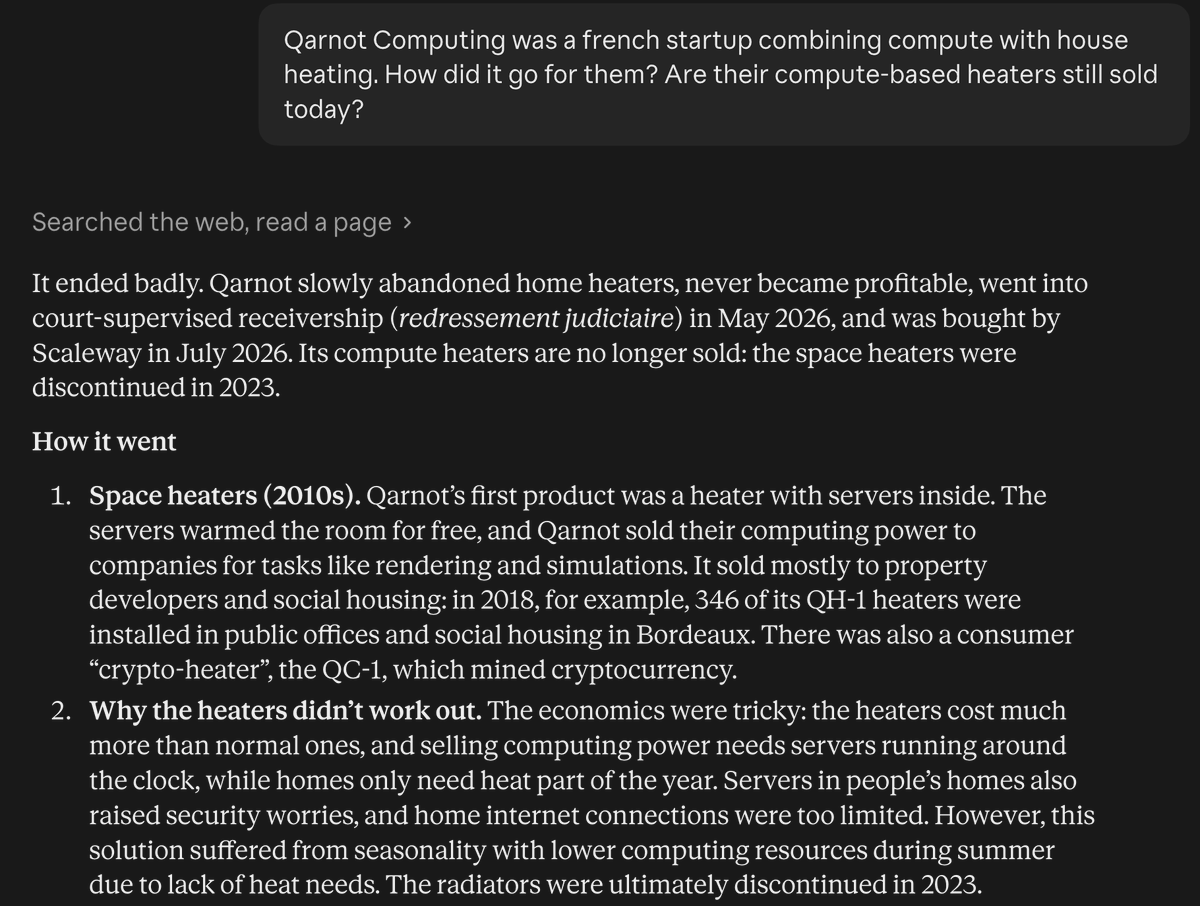
pearl-2:native reminds me of Qarnot Computing, a French startup selling home heaters powered by 3D computations. Didn't end well for them.
Just use a computer for 3D simulations and a regular heater for the house. Overengineering things usually doesn't end well.
pearl-2:native reminds me of Qarnot Computing, a French startup selling home heaters powered by 3D computations. Didn't end well for them.
Just use a computer for 3D simulations and a regular heater for the house. Overengineering things usually doesn't end well.
Pearl is trying to combine AI training with Proof of Work.
Sounds great on paper, until you realize that both of these things can be much better accomplished by specialized systems.
**AI training** can be better achieved with optimized hardware and software.
**Proof of Work** can be substantially improved by switching to Proof of Stake like Ethereum did.
Are you using toilet paper to clean both your butt and your hands? No, you use toilet paper for your butt, and a towel to dry your hands. In theory you could also use toilet paper to dry your hands, but nobody does that because it's less efficient and not a pleasant feeling.
Are you using a fork as the only tool to eat? No, you use a fork to grab food, a knife to cut food, and a spoon to catch liquid.
Are you using your sofa to chill and sleep? No, you use your sofa to chill, and your bed to sleep.
We can go on indefinitely. Everything you use in life is optimized for a particular purpose. AI training and Proof of Work are no different, they both require specialized systems to work optimally.
By trying to do 2 things at the same time, Pearl will be good at none.
Pearl to zero. Bookmark this.
If our network does not go down over the next 6 months despite holding $550B, then people and institutions will race to deposit their livelihoods onto the future-proof + post-AI sanctuary that we call Ethereum: a place where you can be safe without giving someone else your keys.
Very interesting project.
It seems to be like Lido (give away ETH to validators => get yield on that ETH) but in a more decentralized way because you can actually choose a specific validator you trust to manage your ETH, contrary to the "one big pool" model from Lido.
I’ve been in this space since 2015 and these times feel hard again. But this time I feel great, because today @cofferproject goes live on Ethereum mainnet.
For years I listened to podcasts where Ethereum builders talked about their work. In TradFi, most of the economy grows on bonds. Companies borrow at a fixed rate, invest, and pay it back over time.
Validators are the most important part of Ethereum, but they’re mostly passive. They lock their ETH, earn the base yield and that’s it. I believe they can do a lot more with that capital and become the most capital efficient players in the network.
Ethereum has the main pillar every bond needs - a steady income. Validators earn yield every few minutes (every epoch), and that income can back much more than it does today. Why couldn’t a validator issue a bond against its stake and use it to grow its business? For a long time it couldn’t be done. The execution layer and the consensus layer didn’t talk to each other in a way a contract could enforce. A validator could promise to repay, but nothing could force it. Then Pectra shipped EIP-7002 and a contract could trigger a validator’s exit. Now you only need to trust the contract. So we started building.
Every bond is an onchain asset. Apps, bots, marketplaces, exchanges, anyone can list it, trade it or build on it. No permission needed. Today it’s a bond NFT, and it will keep evolving.
I see validators becoming the backbone of the Ethereum economy, creating more value for themselves, the network and everyone in it. This is where we start.
Believe in somETHing. Let’s go!
https://t.co/sREwvxjHgn
@ivglavas@cofferproject Interesting project.
It seems to be like Lido (give away ETH to validators => get yield on that ETH) but in a more decentralized way because you can actually choose a specific validator you trust to manage your ETH, contrary to the "one big pool" model from Lido.
Correct?
This guy is right in the short term, but I wouldn't bet against Polymarket in the long term.
Polymarket crypto native roots enable them to have deeper integrations and permissionless innovation on top of their infrastructure which is something that Kalshi will probably never have.
Kalshi chose the standard playbook of Silicon Valley startups which often leads to enshittification a few years down the line.
Just in the last few days, Polymarket:
- decreased their fees up to 80%
- partnered with PumpFun (this is actually bullish contrary to what you think)
- released their new infra based on Rust with 100x latency improvements
There are probably 100+ teams building products on top of Polymarket (I am one of them). I cannot name a single team who is building on Kalshi, and it's normal because you cannot build on Kalshi, it's centralized by design.
Yes Kalshi has more volume today, but is it what really matters? It reminds me of the debate Solana vs Ethereum. Although Solana is faster and cheaper, and has maybe more transactions per second, this is not what matters, they are playing 2 different games. Ethereum doesn't really care about being fast today, they chose to go all-in on CROPS, and it will probably pay off long term.
So long story short, I really think Polymarket can surprise a lot of us. This is only the beginning.
We defended Polymarket for years.
Through the CFTC fine. Through the FBI raid. Through "new phone, who dis."
Now its markets are live inside https://t.co/MqP2N2Tooz.
Meanwhile Kalshi is in talks to raise at $65B, and Polymarket still hasn't announced its $21B round.
Both started with the same idea: let people trade on what happens next.
Kalshi sued its own regulator and won. Then it kept shipping:
- Single-stock perps on 50+ companies this month,
- Indices
- AI compute futures.
Meanwhile Polymarket sits in the "Predict" tab, next to memecoins and perps, inside the app that destroyed crypto !
One is building an exchange. The other is becoming a feature in a memecoin app.
What hurts is how badly we wanted to believe.
A 22-year-old building alone in a Lower East Side apartment in the middle of a pandemic. The misfit who actually made crypto useful.
"Shayne is one of us."
We put that story in every thread. We sent it to every friend who said crypto was a scam.
Then it started to derail:
→ "Keep growing and pay a fine." What he reportedly told staff during a $10M stolen-card fraud wave (WSJ)
→ Creators paid to show fake winning trades on cloned versions of the site (WSJ)
→ The compliance chief who flagged the fraud resigned. The US CEO got fired.
Misfits don't run that playbook.
If you still think "Shayne is one of us", I have a bridge to sell you.
Feelings aside, this is a once-in-a-lifetime case study. Two frontier companies, this close, this different and so comparable:
→ Founders: two MIT math folks vs a NYU artsy Adam Newman type
→ Culture: Alfred Lin's Sequoia vs Dragonfly, Blockchaincap, 1Confirmation
→ Habits: grinding in the office vs company-paid private jets for basketball games
Result = $5B+ vs $1.8B+ revenues
Kalshi isn't a saint. Most of its volume is still sports
But you have to look at where it's going. Prediction markets either become a real asset class or the next casino.
Kalshi is building toward the first. Polymarket chose the second.
When we talk about Kalshi, we will talk about CME, Nasdaq, Interactive Brokers.
When we talk about Polymarket, we will talk about https://t.co/MqP2N2Tooz.
You are right in the short term, but I wouldn't bet against Polymarket in the long term.
Polymarket crypto native roots enable them to have deeper integrations and permissionless innovation on top of their infrastructure which is something that Kalshi will probably never have.
Kalshi chose the standard playbook of Silicon Valley startups which often leads to enshittification a few years down the line.
Just in the last few days, Polymarket:
- decreased their fees up to 80%
- partnered with PumpFun (this is actually bullish contrary to what you think)
- released their new infra based on Rust with 100x latency improvements
There are probably 100+ teams building products on top of Polymarket (I am one of them). I cannot name a single team who is building on Kalshi, and it's normal because you cannot build on Kalshi, it's centralized by design.
Yes Kalshi has more volume today, but is it what really matters? It reminds me of the debate Solana vs Ethereum. Although Solana is faster and cheaper, and has maybe more transactions per second, this is not what matters, they are playing 2 different games. Ethereum doesn't really care about being fast today, they chose to go all-in on CROPS, and it will probably pay off long term.
So long story short, I really think Polymarket can surprise a lot of us. This is only the beginning.
"who pays to make markets on questions that are useful but not particularly exciting to traders?"
That's actually the elephant in the room. Maybe Polymarket tried early on to create weird markets about interesting things to know but that are not exciting for traders to bet on, and the liquidity didn't show up so they stopped. To be honest, I kind of understand why Polymarket became "gambling maxi" as it is not a proven fact that traders will show up on any market you create.
A solution I see is to make market creation permissionless so that people can propose new markets that are interesting for both traders and information seekers.
It's very hard for a single company to come up with interesting markets to create so it makes sense to make this particular feature permissionless.
@BautiDeFi@TheFatMbappe probably but who knows, if a former employee with a shit ton of UMA wants to get a quick buck he can be the ideal prey for an attacker