We are not suicidal. If anything happens to a member of our team, you can be sure Israel is behind it.
Shadow banning on twitter is on the rise; help us combat it by following our backup @ZionismExposedx & joining telegram (in bio).
https://t.co/JvgvyJ0naK
Why couldn't the most powerful military on earth just win in Vietnam?
It is the question that hangs over everything. The United States had the bombers, the helicopters, the artillery and the firepower, and across ten years it won nearly every major battle it fought. It still lost the war. The reason is not one thing. It is a stack of them, and they fed each other.
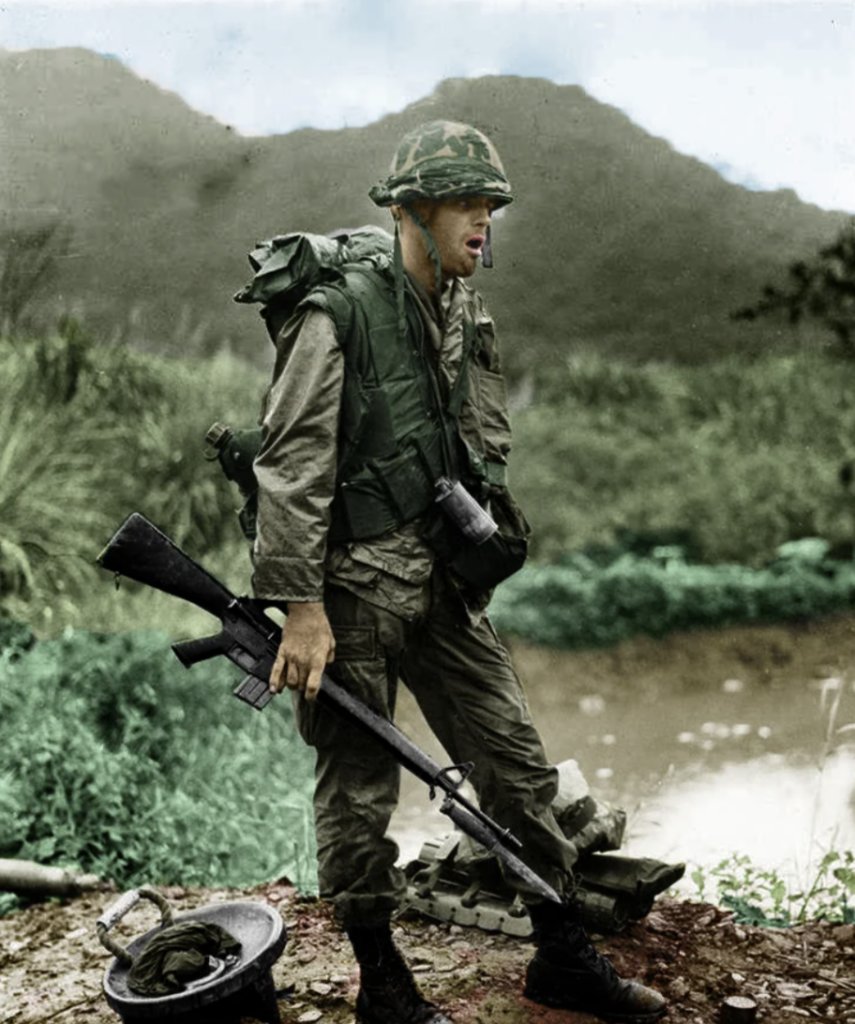
Start with the kind of war it was. For much of it there were no front lines. The enemy was both a guerrilla who farmed rice by day and laid mines by night, and a regular army that came across the border to stand and fight when it chose. You could sweep a valley, win the firefight, count the enemy dead, and fly out, and the same ground would be enemy ground again a week later. That is a lot of what this whole series has shown, the same hills and the same treelines fought over again and again. Firepower is great at destroying an enemy you can find and pin down. It is nearly useless against one who decides when and where to be found.
Then there was the sanctuary problem. North Vietnam kept its supply lines, the Ho Chi Minh Trail, running through Laos and Cambodia, officially neutral countries the US mostly would not openly invade. The enemy could fight, then step across a border to rest, rearm and heal in a safe rear area the Americans were not allowed to follow into. You cannot destroy an army you are not permitted to chase home.
That points to the biggest thing of all. The United States was fighting a limited war, and the North was fighting a total one. Washington's goal was never to conquer North Vietnam. The nightmare was Korea all over again, that pushing too hard would drag China or the Soviet Union directly into the fight, maybe into a nuclear one, so the North was largely off limits to invasion. Meanwhile Hanoi was fighting for the one thing it cared about above all else, a single unified Vietnam, and it was willing to lose staggering numbers of men and keep coming for as long as it took. When one side will pay any price and the other has deliberately capped what it is willing to risk, the willing side has an enormous advantage.
The South Vietnamese government the US was propping up was also a large part of the problem. It was often corrupt, unstable, and short on the loyalty of its own people, which meant America was trying to win a war on behalf of an ally that could not stand on its own. You can protect a government with troops. You cannot hand it legitimacy.
And the North understood something the American command was slow to admit. The real target was not any hill or any body count. It was the patience of the American public. The US measured success in enemy dead and battles won, but the enemy measured it in years, betting that a democracy fighting a costly, confusing, faraway war it did not clearly understand would eventually get tired and go home. Every night the war was on television. Support drained away, and the North simply waited it out.
So the honest answer is that the United States did not lose because its soldiers were beaten in the field. They mostly were not. It lost because it was fighting a limited war for a shaky ally against an enemy who treated the war as survival, who could never be fully cornered, and who had correctly guessed that America's breaking point would come before his did. Overwhelming firepower can win you every battle and still not win you a war, if the war is about will and time rather than ground. Vietnam was.
Travel clean.
Bring a burner phone or a freshly wiped device with only what you need for the trip. download what you need after you arrive. This is now the standard advice from digital security experts, including Runa Sandvik, who told TechCrunch: "It's better to not have that data on you when you cross certain borders."
What CBP can legally do:
— demand your phone without a warrant
— copy its entire contents into a central federal database
— do this on suspicion alone
— before you're formally admitted to the country
This applies to US citizens returning home. not just foreign nationals.
What the Tunick case means for your device:
— a duress PIN is now legally risky at a US border. agents may interpret triggering it as destruction of evidence.
— having GrapheneOS installed could be framed as evidence of intent by prosecutors.
— refusing to provide a passcode is legally different; you can invoke your Fifth Amendment right to remain silent, but CBP may detain you longer.
Practical steps before any international travel:
1. back up your phone to an encrypted drive at home.
2. factory reset your travel device.
3. only reinstall apps you actually need for the trip.
4. log out of everything sensitive before landing.
5. if questioned: you can decline to provide a passcode. Say "I am invoking my Fifth Amendment right." They can still seize the device. They cannot currently compel the password itself.
If you're stopped:
contact the EFF's border search resources at https://t.co/dUfHtuIBvQ before you travel so you know your rights before you need them.
The border is not where you want to learn what your rights are.
They want the votes. If they police the grocery store, they will lose the votes. So they tax those who don’t vote for them to provide food for those who do vote for them.
After years of doing video interviews with other outlets, but rarely my own, we have decided to re-launch the Unlimited Hangout podcast as a video show. Our first episode is now live and features a discussion between myself and @markgoodw_in focusing on the first installment of our investigation into Polymarket and its origins and future ambitions.
Watch our pilot episode here:
https://t.co/TIhKmb2awz
We ultimately decided to publish on YouTube in part to try and fight against all of the channels impersonating me, with and without AI (though most seem to use it). Previously, YouTube would not let us report impersonators without having our own channel.
This channel is the only presence of Unlimited Hangout (and me!) on YouTube and I would really appreciate it if you all could help report these really annoying impostors who have been trying to cheapen and degrade my work and research for years now for their monetized clickbait garbage.
Note: Unlimited Hangout members get early access, not only to this episode and all future episodes, but also to our two demo episodes, which discuss data centers and the upcoming launch of X Money. If you'd like to join to support our journalism, the new show and obtain these perks (and more!) click the link in the tweet below this one.
This post will be re-quoted daily.
The Genocide of the Palestinian People must never be allowed to ever disappear from humanity’s sight.
Long Live Palestine 🇵🇸
This is WILD
American went to a parking garage in Detroit with a friend. They leave the parking garage and the friend who drove didn’t pay
That parking garage somehow automatically identified her by her phone, charged her card and texted her a receipt with the make, model and license plate of her friends vehicle
Again she didn’t drive, she didn’t interact with any machines, the parking garage was able to just identify her and charge her because she had her cell phone with her
This is real
The building was the Fisher Building garage in Detroit. It’s a shopping area
It’s a modern automated parking management system on Metropolis Parking’s platform that has License Plate Recognition cameras combined with phone-linked accounts and stored payment details
Because this woman had been there before and paid, the system saved her data, recognized her by her phones signal and automatically charged her with a previous payment method
Technology is going way too far