Day 5 of the lab series. Added BFD to the topology.
Without BFD, OSPF takes up to 40 seconds to detect a dead neighbor. BGP takes up to 3 minutes.
With BFD enabled, both drop to under 5 seconds on virtualized hardware. On bare metal the numbers get even tighter.
The config is straightforward in RouterOS v7. Three steps: allow BFD sessions on the relevant subnets, enable use-bfd on OSPF interface templates and BGP connections, done.
One thing worth knowing: if use-bfd=yes is set on a BGP connection but the BFD session fails to establish, BGP will not come up at all. Enable it only when both sides support it.
5 routers running BFD across OSPF and BGP simultaneously, all sessions up.
#BFD #OSPF #BGP #networking #MikroTik #homelab
Day 4 of the lab series. eBGP and iBGP, plus the two attributes that control traffic flow across AS boundaries.
eBGP runs between different autonomous systems. iBGP runs inside the same one, keeping every router in sync about the outside world.
Local Preference is an internal decision. It tells routers inside your AS which exit to prefer when sending traffic out. Higher wins. Never leaves the AS.
First screenshot: same prefix, two paths. The one through CHR4 wins with local-pref 200 over the direct path at 100.
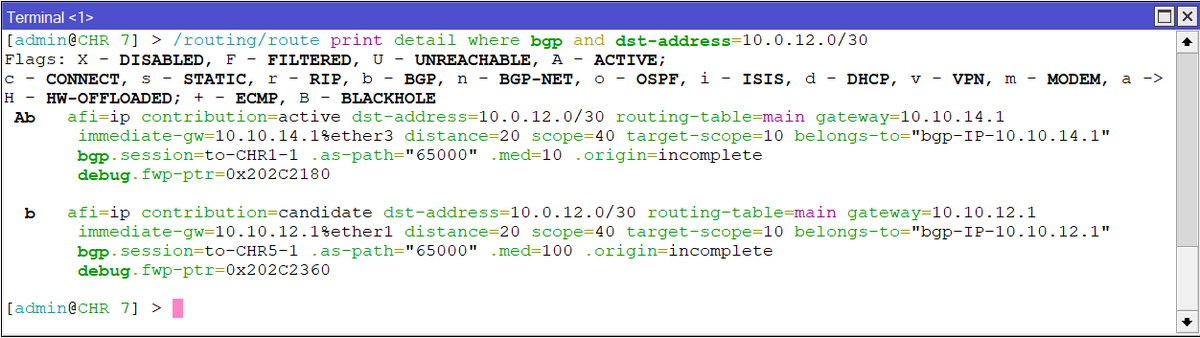
MED works the other way. It's a signal sent to a neighboring AS, telling them which entrance to use when sending traffic in. Lower wins, and it's only compared when both paths come from the same neighbor.
Second screenshot: same idea, reversed direction. Path through CHR1 wins with MED 10 over CHR5 at 100.
Outbound decided internally. Inbound suggested externally. Same goal, opposite ends of the conversation.
7 routers, 3 AS, both verified end to end.
#BGP #networking #MikroTik #homelab
Day 3 of the lab series. Testing OSPF stub and NSSA on MikroTik RouterOS v7.23.
Stub area never injected a default route into the area. Tried everything: type=stub, default-cost, originate-default=always, static blackhole. Nothing worked.
Switched to NSSA as a workaround.
NSSA was partially working. Type 7 LSAs generated correctly by the ASBR inside the area. Default route injection worked after setting default-cost.
But the ABR never translated Type 7 to Type 5. That translation is the entire point of NSSA, and MikroTik documents it themselves.
Both bugs reported on the MikroTik forum since v7.13. Neither fixed in v7.23.
#OSPF #MikroTik #networking #homelab
Day 2 of the lab series. Killed an Area Border Router mid-test to watch what happens to the isolated area.
Complete blackout. No neighbors, no routes, no reachability. Single ABR per area means single point of failure.
Brought it back up, full convergence in under a minute.
Next experiment is a second ABR for redundancy.
#OSPF #networking #MikroTik #homelab
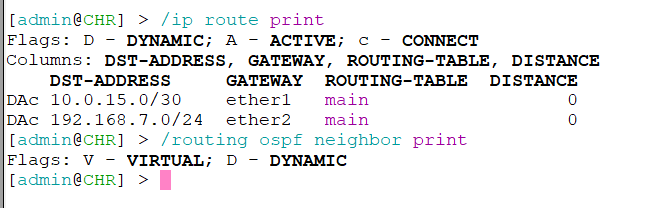
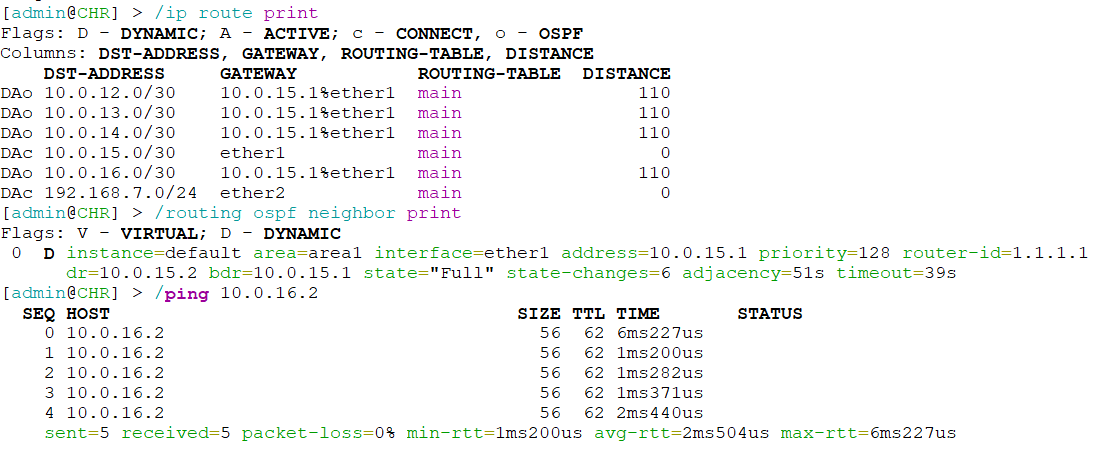
Day 1 of a small networking lab series. Spun up three virtual routers in a triangle topology on a small cloud VM (2vCPU/8GB), wired them with OSPF, then killed one link mid-test to watch convergence and ECMP kick back in.
More coming.
#OSPF#networking#homelab#MikroTik
1.6M readings from my ETH/IDR oracle. Average drift from the live market: 0.08%. Two rows out of 1.6 million crossed 1%.
When it's alive, it's accurate. The hard part was never precision. It was staying up on household electricity.
What 113 days of real oracle data taught me:
https://t.co/nZgtFBx6gZ
Three devices, three different Cloudflare WARP modes. Same tool, different reasoning for each.
Servers use DNS over HTTPS only. The ARM STB runs oracle feeders that pull price data from Binance. Some ISPs in Indonesia throttle or block crypto exchange traffic. Encrypted DNS resolves that without routing all traffic through Cloudflare.
Laptop uses full WARP, but only on public WiFi. Campus networks, coffee shops, anywhere the network itself is not trusted. On stable home network, WARP is off.
Phone uses WARP selectively when accessing Binance. Same reasoning as the STB, consistent access without depending on ISP behavior.
Not a blanket policy. Each device has a specific reason.
That's how security configs should work. Not maximum protection everywhere, but the right protection for each context and threat model.
@Cloudflare #Networking #Security #BuildInPublic
Been quiet for a week. Final exams.
Came back to servers still running, oracles still pushing, bridge still syncing.
That's the goal. Infrastructure that doesn't need you to babysit it.
Back to building.
Hi @AnthropicAI, could you consider regional pricing for Indonesia? The USD exchange rate makes both the $20 Pro and $100 Max plans quite expensive for many users here. cc @DarioAmodei@jackclarkSF