When I was a young MD student, I had mixed feelings about this passage in Hutchison s. It felt like a rich man claiming money doesn't bring happiness. Or a beautiful girl claiming beauty is in the eyes of the beholder.
As I grew older, I realized Hutchison was simply stating a fact - that success is not just about talent or hardwork. Call it randomness, luck or divine will - there are things beyond our control which determine our success. Hutchison didn't advocate for mediocrity, but for contentment. He didn't ask us to disregard the destination, but to enjoy the journey. Perhaps he didn't mean success isn't for most of us - he meant we are enough, with or without worldly success.
The older I get, the more I understand his words ♥️
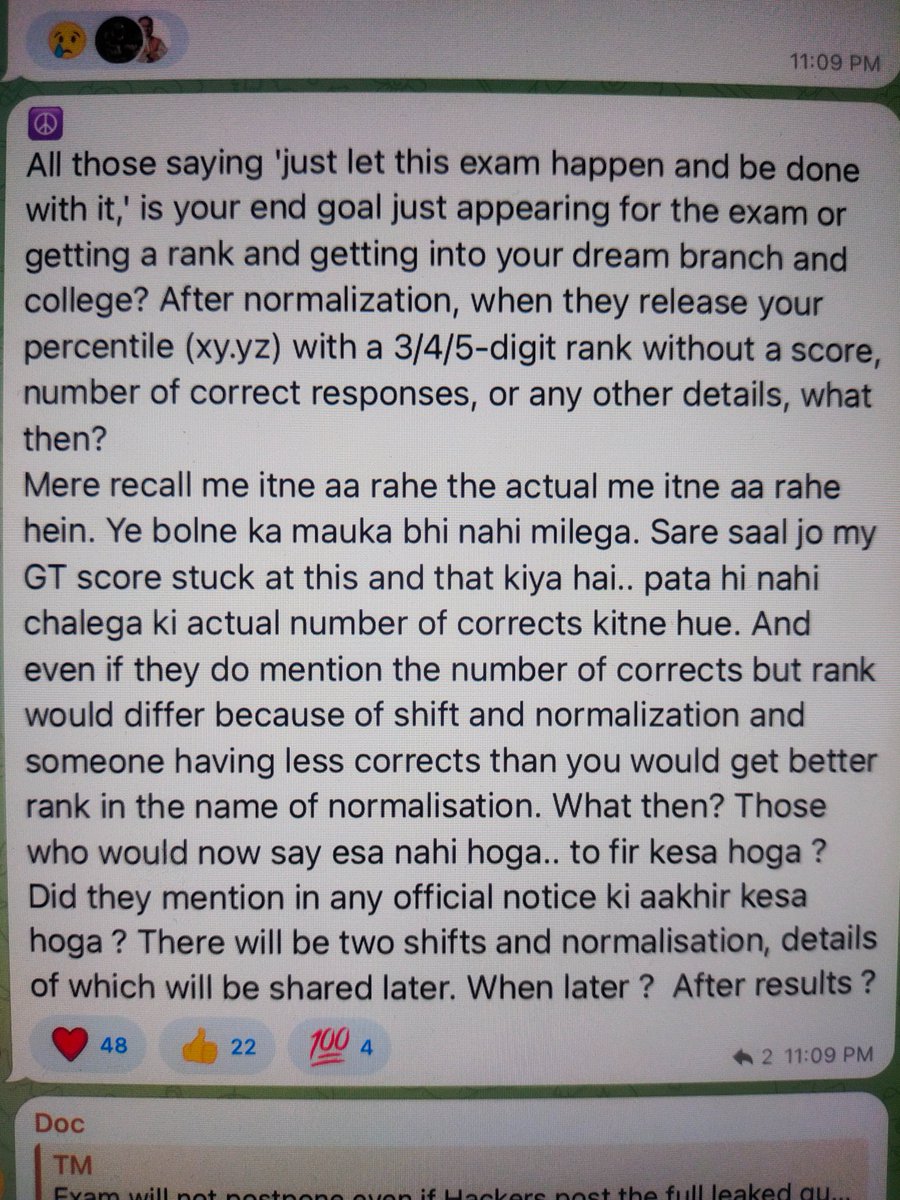
LONG POST ALERT! Here is my take on Normalization in MD/MS exams, in a country like India.
1. Loss of Individual Performance Insight: Obscures detailed individual performance, making it harder to distinguish between high and low performers accurately.
2. Potential for Misrepresentation: Scores can be misrepresented due to over-reliance on statistical adjustments, potentially leading to unfair outcomes.
3. Complexity and Lack of Transparency: The process is often complex and difficult for students to understand, leading to perceptions of unfairness.
4. Overemphasis on Statistical Parity: Can ignore differences in exam difficulty, disadvantaging students who took a harder or easier version.
5. Introduction of Bias: If not done correctly, normalization can introduce biases, especially if all relevant factors are not considered.
6. Reduced Motivation: Students may feel demotivated if they perceive their raw scores are significantly altered, reducing the perceived value of their effort.
7. Data Dependency: Relies heavily on the quality and quantity of data available. Poor-quality data can lead to incorrect adjustments and unfair results.
8. Diverse Exam Content: MD/MS exams cover fundamentally different content areas and competencies. Normalization assumes comparability of scores across different subjects, which is not applicable given the varied nature of the exams.
9. Potential for Over-correction: Excessive normalization may over-correct scores, diminishing the accuracy of performance assessment.
10. Loss of Original Score Integrity: Original scores may lose their integrity and meaning after normalization, affecting their reliability as a measure of performance.
Finally - Even if the paper is leaked and a candidate scores 200/200, normalization will make sure no one knows it.
Last but not least, has the statistical method been tested already in a group of the population and agreed to be unbiased? If not, how can it be applied in an exam to a large population, especially in an exam that means life or death to the students?
#NEETPG2024 #needfairassessment
@autopsy_surgeon Both men and women equal. Nobody should be forced according to societal norms. Choice to be given. Woman wants to work , she should. Woman wants to be housewife, she should and vice versa. Mutual respect 🙏🏼🫡
Indians are gonna freak out if they realize the potential side effects of Dolo and pain killers their medicine shop guy gives them without prescription
60cr people vaccinated. 500 had side effects. Do the maths.
The chances of a girl developing blood clots and ending up in hospital from birth control pills is probably higher.
@autopsy_surgeon Sir actually it also depends on the choice and reputation of college. I know someone who had all that … 6 students per cadaver dissection table , clinical classes , hospital rotations in China
It depends on the quality of college