“We tried to get Claude to write it, but it did a poor, sloppy job and we had to spend a lot more time editing than we expected (don’t tell him we said that, just in case…). Perhaps there’s a lesson to be learned there. Claude also didn’t like our references to specific companies – one in particular. He preferred “standalone model developer”. So, our legal team would like us to point out that any reference to companies, products or individuals is illustrative and does not describe or imply their actual conduct, financial condition or intentions. It is a work of fiction, and any remaining errors are the fault of AI. As we know, AI “just does stuff sometimes” and no human should ever be held accountable for its actions. AI moves in mysterious ways.”
A recurring theme at #Gastech: is the world becoming too dependent on U.S. LNG?
One point I’ll make later today: the U.S. isn’t a monolithic supplier. Thousands of producers, hundreds of midstream systems, multiple LNG facilities.
No single owner controls the molecule’s path to water.
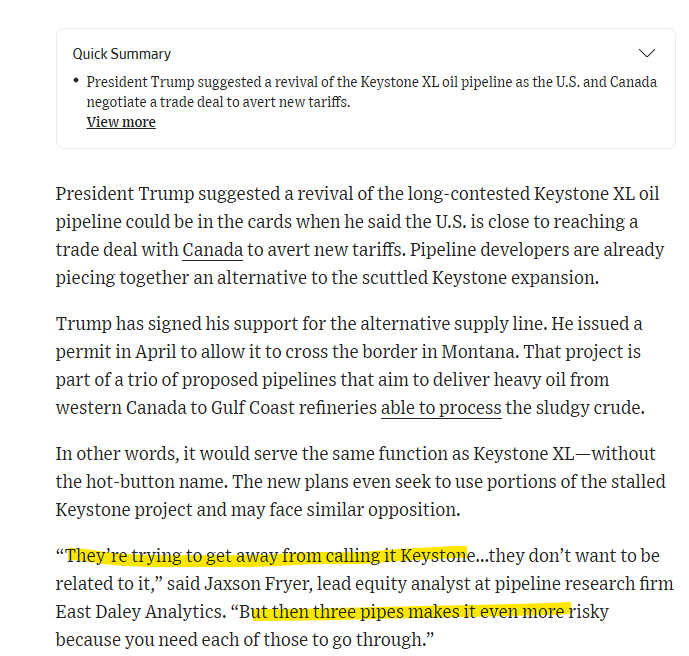
Trump Wants to Revive Keystone XL. The Industry Has a Different Plan.
Shout out to @FryerJaxson for his contribution to the @WSJenergy article.
https://t.co/Yf5wUHorlN
$5.5B Momentum Deal Gives Williams More Leverage in the Haynesville
$WMB’s acquisition of Momentum Midstream does more than expand its gathering footprint. It gives Williams greater access to the emerging Western Haynesville and more control over gas flowing into the Gillis hub — a critical supply point for Gulf Coast LNG.
Momentum brings 4,000 miles of pipe, 6 Bcf/d of gathering capacity and a 65% stake in the 1.75 Bcf/d NG3 pipeline. East Daley estimates the platform could generate $564MM of EBITDA in 2027.
The strategic value is the connection to Gillis.
Williams is already expanding Louisiana Energy Gateway and Transco along the same corridor, including the 2.25 Bcf/d Delta Access project. Combined with Momentum, those investments position $WMB as one of the largest gatherers supplying Transco and Gulf Coast LNG projects.
That matters as LNG demand accelerates. East Daley forecasts Gulf Coast feedgas demand rising from 19.1 Bcf/d today to 36.5 Bcf/d by 2030.
Williams also has downstream exposure through its 10% stake in Woodside’s Louisiana LNG project and an 80% interest in Driftwood Pipeline Line 200, which terminates at Gillis.
The takeaway: Williams is consolidating the Haynesville-to-Gillis corridor from wellhead to LNG export. Momentum adds supply, infrastructure and optionality at the exact point where competition for molecules is likely to intensify.
Behind-the-meter demand doesn’t just find a home for stranded gas. It resets the price of every molecule it burns.
At scale, it tightens Waha basis and changes the math on the next takeaway buildout.
We called it in January. The question now is how many basins get one.
The Chevron-Microsoft deal reads as Big Oil moving into AI power.
From the midstream seat, that misses it. This is a gas repricing story.
Permian gas outruns takeaway. Operators flare it or sell at Waha for next to nothing. Chevron cited that dynamic as Kilby’s cost advantage.
Prairie Connector just cleared an important commercial hurdle.
South Bow secured 20-year binding commitments for its proposed crude pipeline from Hardisty, Alberta to U.S. delivery points.
That gives the market more visibility on a potential new Canadian crude egress path - but the hardest part may still be ahead.
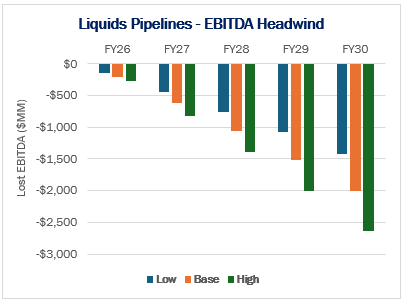
FERC’s latest oil pipeline rate reset looks small on paper - but the impact is not.
East Daley estimates the shift from PPI-FG +0.78% to PPI-FG -0.55% could remove $1B+ of annual EBITDA upside from liquids pipelines by 2028.
The 2027 WTI forward curve is pricing a world that has already healed. Inventories are drawn, the SPR is depleted, and $80 deferred does not clear a Permian ramp. Rebalancing is not the destination. Restocking is. The curve has not priced that yet.
Kinetik’s margins track the Waha spread. Almost 1:1.
That relationship has been a tailwind since 2022.
Now it’s at risk.
New Permian egress compresses the spread → margins follow.
Same assets. Different outcome.
Watch Full Webinar https://t.co/VSrtY3Ecdi
#natgas#Permian#LNG #midstream #oilandgas #energy
From our experts @FryerJaxson
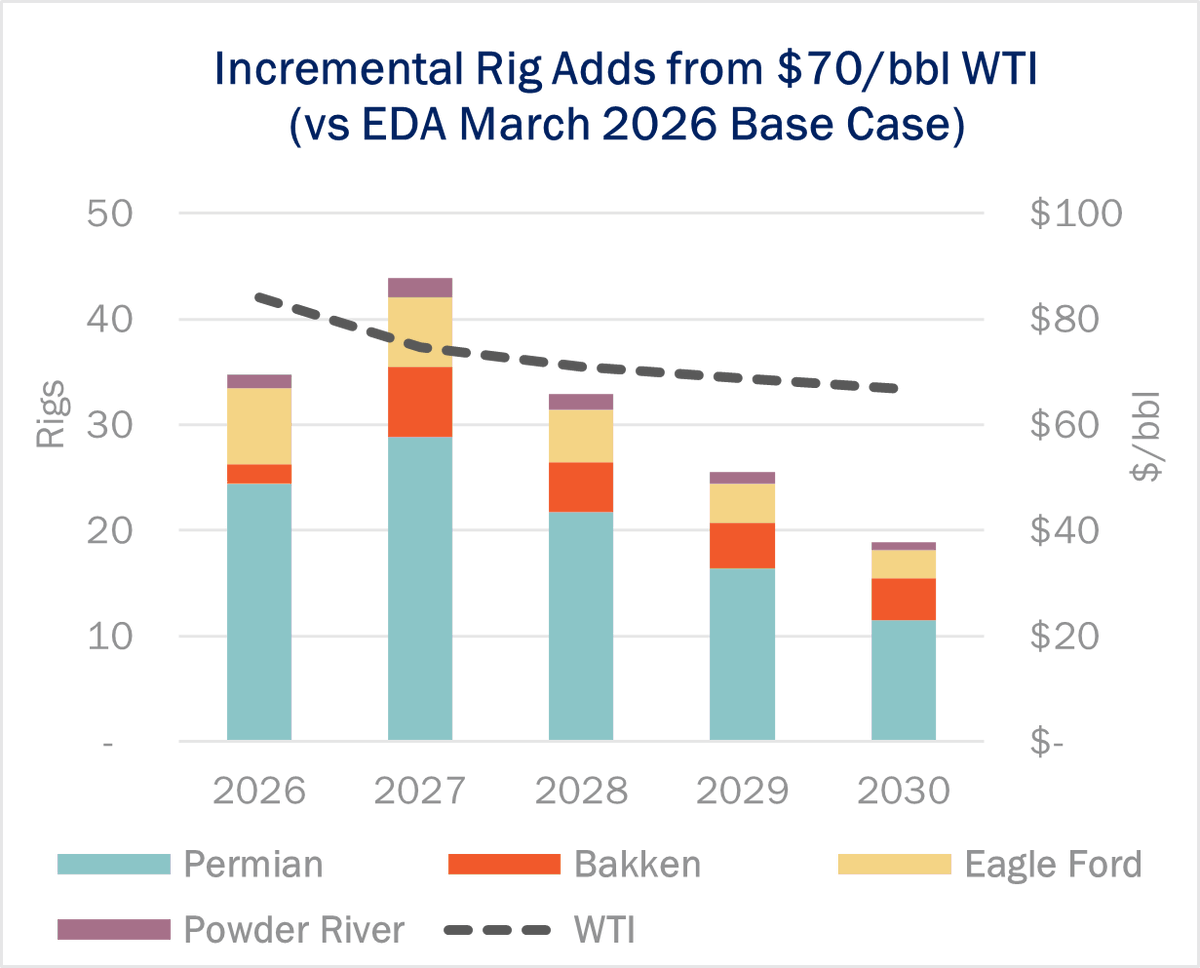
Higher oil prices may be bearish for gas.
More drilling = more associated gas = more pressure on prices.
Permian leads the move as new takeaway unlocks growth through 2030.
Join the conversation.
From our experts: @FryerJaxson@RentonJulian
Mont Belvieu is tightening.
~900 Mb/d of new fractionation capacity needed by year end 2037.
Balances tighten by year-end 2027.
EPD, ET, TRGP, OKE, PSX positioned.
Join the conversation.
#NGL#Midstream#EnergyMarkets #Eastdaleyanalytics #OOTT #MontBelvieu
The market is moving. The signals are getting clearer.
From our experts @RentonJulian and @FryerJaxson :
#Chevron and #Microsoft just validated a real shift in the #Permian. AI is becoming a structural demand driver for gas, not a future concept. Behind the meter power changes who captures value and Chevron is positioning early.
Elba Island’s export increase is small, but it says a lot. Global gas balances are tight and there is no cushion.
Commonwealth LNG is getting closer to #FID, but the infrastructure story is not there yet. Without defined transport and connectivity, the commercial momentum is ahead of reality.
Saudi disruptions are taking meaningful supply offline across production and pipelines. That is tightening #crude and #NGL balances and reinforcing near term price #risk.
If you are not tracking both demand shifts and physical constraints, you are missing the setup.
Join the conversation.
https://t.co/yTgH7RYR6s
#EnergyMarkets #OilAndGas #LNG #Permian #NGL #EnergyTransition #OOTT
Most #equity research starts with guidance, comp tables, and management’s version of the story.
#EastDaley starts at the asset level, where #EBITDA is actually made or lost. We build from the ground up, linking wellhead activity, pipes, plants, contracts, and bottlenecks to company-level financial outcomes. That is the edge: earlier signals, better risk identification, and a clearer view of what is really happening underneath the numbers.
A good example is #Kinetik ($KNTK).
Our call is that KNTK still has near-term earnings upside, but the market is treating that upside as far more durable than it should.
Today, wide Waha-Houston Ship Channel spreads are supporting outsized marketing margin, and that should keep near-term results elevated as Permian takeaway remains tight. But that strength is a function of scarcity, not a new earnings base.
Once new egress comes online and Waha-HSC compresses, that margin pool should shrink quickly. The real downside likely shows up in 2027, when the basis dislocation gets arbitraged away and KNTK’s marketing earnings reset materially lower.
The setup is straightforward: near-term upside while spreads stay wide, but meaningful long-term downside as normalization takes hold.
Questions? Reach out to our expert @FryerJaxson
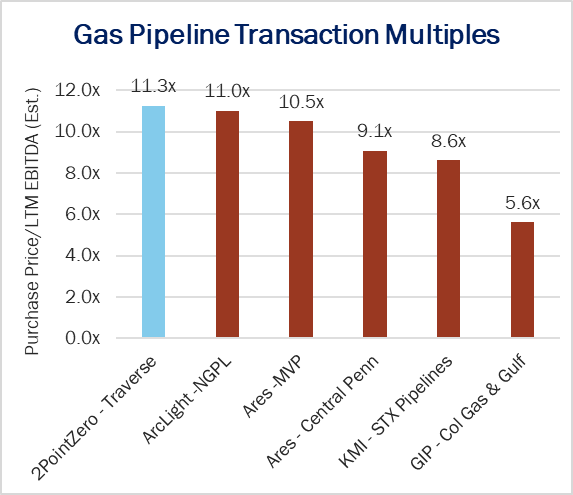
From EDA energy expert @FryerJaxson : Investors should watch the 2PointZero-Traverse deal as a possible signal that private capital is willing to pay peak multiples to gain exposure to US midstream. At $2.25B, the transaction values Traverse at about 11.3x 2025E EBITDA, a premium to recent comparable pipeline deals despite Traverse’s mix including ORS, a gathering asset that typically commands a lower multiple. East Daley sees limited upside in the portfolio, with Rover facing potential recontracting risk after 2033 and about $70MM of annual revenue exposure tied to weaker Dawn market pricing. The key question for investors is whether 2PointZero overpaid for a US foothold, or whether this deal marks a broader reset higher in infrastructure valuations.
#EBITDA #2PointZero #midstream #energydata