In the 1990s, Switzerland transitioned from a migration policy that only let in low-skilled labor that wouldn't compete with locals to one where migrants weren't restricted to being low-skill.
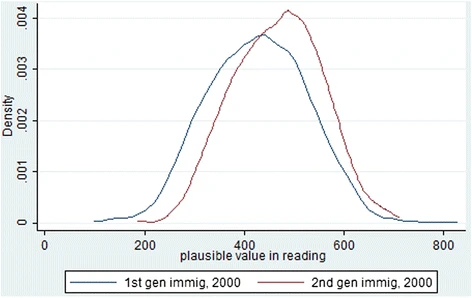
Accordingly, on the tail-end of the low-skill era in the year 2000, 1st-generation migrants' kids performed poorly on the PISA. You can see that poor performance very clearly:
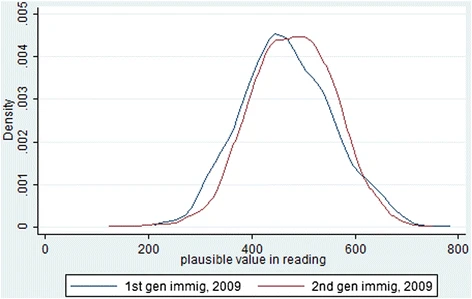
After the immigration reform, high-skilled immigrants started seeking entry to Switzerland, and they did manage to get in. As a result, by the next PISA administration, the gap between 1st- and 2nd-generation immigrants was greatly diminished:
In a 2015 paper, Cattaneo & Wolter performed an Oaxaca-Blinder decomposition of this change for 1st-generation migrants to see what was up. Their result was really something.
In the year 2000, immigrants' parents being from Germany, France, Austria, or Belgium predicted +24.80 points on the PISA (ns). If they were from Italy, Spain, or Portugal, -2.46 points (ns). If the immigrants were from Albania, Kosovo, or other parts of ex-Yugoslavia, the effect was -27.39 points. Immigrants from Turkey were associated with -38.35 points!
Moreover, a person's parent having a tertiary education was associated with a 30.84 point boost in PISA scores (ns), while compulsory education was associated with a decrement of -26.40 points.
But after Switzerland started letting in immigrants of all skill levels instead of just low-skilled immigrants, things changed. For example, if a person's parents were from Germany, France, Austria, or Belgium, that was associated with +51.41 points. Being from Italy, Spain, or Portugal was associated with just -0.18 points (ns), while parentage from Albania, Kosovo, and ex-Yugoslavia came with -11.48 points. Being from Turkey was also no longer a negative, as it was associated with +9.50 points (ns).
Not only that, but education also became less apparently meaningful. For example, tertiary education was associated with only +10.99 points, and compulsory education with +4.58 points (ns). Perhaps the increased diversity in migrants' qualifications helped erode the signal from this sort of variable.
Regardless of the reason, it seems that almost 75% of the 40-point increase in 1st-generation immigrants' scores was attributable to this unusual change in migration policy. Or, as the authors put it: "Better migrants, better PISA results."
Source: https://t.co/ISs00ue5Vg
"Many game-changing breakthroughs—stainless steel, microwave ovens, radio, radar, penicillin, X-rays, graphene, Wall’s Viennetta and the theory of evolution...emerged not through deliberate intent, but through the chance collision of unexpected data and a well-prepared mind." https://t.co/TuMalmR6dv
This ten-year-old Coke commercial (released only in Argentina), remains the single best minute-long argument for pro-natalism that I have ever seen.
@MoreBirths@BirthGauge
"in the Cultural Revolution, Mao used young people and their bad traits. They're prone to violence, to be destructive, sadistic. Any society has these people, but they were given license to indulge their bad instincts in the Cultural Revolution" https://t.co/L2qZ3GxKM9
This just may be one of the most powerful things you can learn for invention and creativity.
Thomas Edison kept it a secret and even had a statue he designed to be placed on his estate to memorialize it.
I began to studied it in the 1970s after visiting Menlo Park.