Event-driven trading is underrated in crypto. It's the most efficient market ever created, trades 24/7, info flows freely and is public way before it would in TradFi. Use it:
🧵on trades/plays (both long and short) we've recently covered in Pulse, @AleaResearch's weekly letter
1/ Threshold’s Q1 2026 Benchmark Report, prepared by @AleaResearch, is now live.
The quarter saw a protocol with a steady tBTC supply and deeper BTC-denominated DeFi deployment, with progressive liquidity positioning. The report also frames how the upcoming fee model can translate network activity into a broader revenue base, setting a precedent for institutional Bitcoin.
Crypto revenues are down, but Brazil's aren't.
Proud to see crypto-native funds valuing Brazilian companies, specially this one, which I'm close to key stakeholders, the opportunity is there for those who see it.
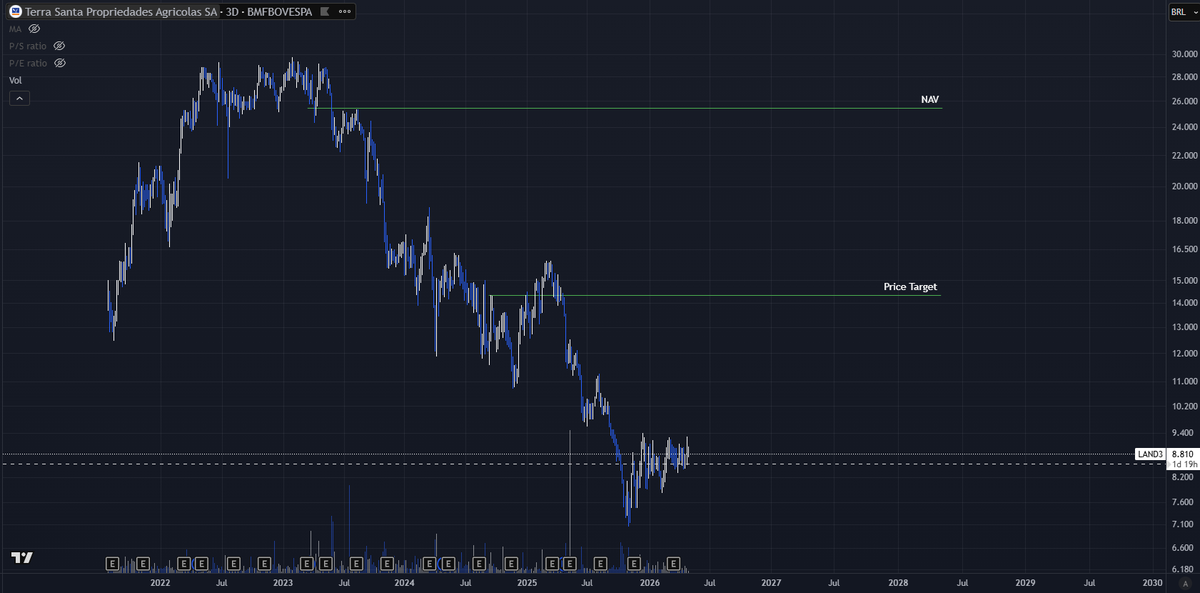
$LAND3 is a messy Brazilian microcap soybean farm owner with a 21 year lease to $SLCE3. It trades at a 69% discount to the value of its land for several justifiable reasons, but I think the discount is too wide.
Downloadable excel model at https://t.co/zceHgp90Ei
DeFi needs new high-yield, high-risk products onchain.
Everyone knows DeFi yields are too low for the risks we take, so while we reduce exploit risks on one side, we need new financial primitives for high yield.
The demand for these products already exists.
Despite the risks the demand for high yield products is high:
• High yield corporate: ~7-9%
• Private credit: ~8-12%, some strategies up to 15%
• Private equity: ~12-18% (7-10 year lockups)
In contrast, stablecoins yield between 3% to 5% and that's because rsETH hack temporarily increased yield.
Seriously, DeFi risk profile looks good when you compare to private credit: illiquidity, years of lockups, unclear valuations and now withdrawal limits.
But private credit still attracted $1.5T anyway because 8-12% on USD is hard to find elsewhere.
That could be our target group currently underserved onchain.
----
We had amazing yields but the old yield model was reflexive.
Bull markets push leverage demand up, which pushes yield up.
Bear markets run the loop in reverse: TVL leaves, leverage demand collapses, yields compress.
Emissions and points were really fun but temporary. The yield is gone when emissions stop, and mercenary capital leaves after TGE.
We need to leave this circular economy.
One innovation is undercollateralized lending but it's hard without identity.
Maple tried this in 2021 and got rekt with ~$36M in bad debt from 3AC, Alameda etc. They stopped it now.
Centrifuge loans also get rekt often but that's a risk lenders should be willing to take.
Anyway, seems that the current innovation is still at importing TradFi yield instead of building crypto yield.
Ethena's USDe with perps funding rates is truly unique. But even they are relying more on TradFi yields recently.
Another recent 'innovation' is RWAs wrapping emerging market stables paying 10% local rates (with USD delta-neutral strategies). E.g. Brix on MegaETH.
Tokenized stocks potential is also underdeveloped but will help:
Borrow against tokenized SPX500 without selling which brings crypto native borrower demand but with real world collateral.
Still early.
What's actually missing is crypto native yield primitives.
Something like:
• Uniswap LP pools were the OG (and ETHlend). Yield from swap fees, paid by people actually trading. Still relies on crypto cycles but should reduce if payments increase (due to multiple stablecoin swaps required)
• Fluid turns debt into LP positions. The borrowed liquidity also earns trading fees.
• Liquity's BOLD pays yield from stability pool deposits and liquidation discounts.
• Pendle splits yield-bearing assets into principal and yield tokens. Created a yield-trading market that didn't exist before.
• Perp DEX LP vaults like Hyperliquid HLP. LPs earn from trader losses and funding rates.
• Jito style MEV captured at the staking layer.
The risk profile of these products is higher than wrapped T-bills.
But they should give much higher yields.
Private credit teaches that institutions are good at selling degen yield to their customers. DeFi could do the same.
Hope we can find 10%+ yields from onchain mechanics soon.
This will attract a new group of people, pump TVL and our bags as a result.
Number of military interventions abroad since 1822:
🇺🇸 USA: +430
🇧🇷 Brazil: 0
Brazil is a safe haven in an unstable world, and provides the commodities the world needs.
update
just noticed within the past few minutes Aave has frozen the Core ETH market (no new deposits/borrows permitted) and set ltv0 (preventing new usage as collateral by existing suppliers)
this should probably help, but woudl also recommend setting ltv0 for USDT before people start using other markets as exit liquidity
📈BTC broke prior range highs. Beta is back in play. Two all-weather compounders to watch, sector leaders, each with clear, actionable catalysts:
📊Perps sector, HYPE: HIP-3 traction, HIP-4 launch, ETFs & DATs, and high beta to prices (buybacks with upside reflexivity). @HyperliquidX
Things you used today that were probably made in Brazil:
The coffee you drank this morning. Brazil has been the world's #1 producer for over 150 years. It grows more than the next two countries combined.
The orange juice at breakfast. Brazil supplies about 75% of the world's oranges used for orange juice. Florida's production has declined 92% in two decades.
The chicken in your lunch. Brazil is the world's largest chicken exporter. Approximately one out of every three pieces of chicken traded internationally comes from a Brazilian processing plant.
The steak at dinner. Brazil is the world's largest beef exporter. $18 billion in revenue in 2025. Up 40% in a single year.
The sugar in your drink. Brazil is the world's largest sugar exporter. It also converts that sugar into ethanol and blends it into fuel.
The paper towel you threw away. Suzano, headquartered in São Paulo, is the world's largest pulp producer. Brazilian eucalyptus grows to harvest in 7 years. Scandinavian pine takes 25.
The leather in your shoes. Brazil has approximately 232 million head of cattle. More cattle than people in every country in Europe.
The iron in the steel frame of the building you're sitting in. Brazil is one of the largest iron ore exporters on earth. It shipped over 400 million tonnes in 2025.
The niobium in the alloy that makes your car lighter and stronger. Brazil controls 94% of global niobium reserves. Primarily from Minas Gerais.
The soy meal that fed the animal you ate. Brazil exported 108.2 million tonnes of soybeans in 2025. More than any country in history has ever exported in a single year.
The airplane you flew on last week. Embraer E-Jets make up about half of all regional jets flying for American, Delta, United, and Alaska. Built in São José dos Campos, Brazil.
The phone in your pocket might have been assembled in Manaus, where Samsung, LG, and Panasonic operate factories inside the Amazon rainforest.
Brazil is in your morning coffee. Your lunch. Your dinner. Your clothes. Your buildings. Your car. Your airplane. Your phone.
It touches your life a dozen times a day.
You just never see the label.
The most influential country in your daily life is the one you think about the least.
Most onchain projects don’t make money.
We’re going to talk about why.
Onchain, Honestly.
Hosted by Alenka (@alenka_on_x) and Kaisa (@kaisakaisa_).
First episode soon.
Interesting perspective. As me and @AleaResearch puts it in the recent POLY Valuation piece, there's two routes that the team can pursue (if they do launch a token). One is a utility token and the other is tokenized equity. Despite the former being having a premium, the upside is shallower. Thread coming this week.
Use EtherFi, now in Portuguese 🎉
Just navigate to Settings > Preferences > Language, and select between English and Portuguese.
More languages coming soon!