This is exactly the problem Funds for Humanity was designed to solve.
Not the moving part, but the knowing part.
Think about what happens today when an NGO distributes funds across 50 beneficiaries in 3 countries.
The money leaves, and then the work begins.
~ Emails to field teams asking for confirmation.
~ Spreadsheets are being updated manually.
~ Finance managers cross-referencing bank statements with campaign records.
~ Leadership is waiting on a report that won't be ready until next week.
The team is working hard.
The system wasn't designed to provide clarity without effort.
So clarity becomes a deliverable, something you produce - through checking, confirming, following up... instead of something the system gives you automatically.
On Funds for Humanity, every distribution is recorded onchain the moment it happens.
No one has to ask what was sent, no one has to confirm what arrived, no one has to reconcile what was supposed to happen with what actually did.
The system carries that visibility by default.
Because at scale, an impact organisation shouldn't spend its energy tracking capital.
It should be spending it on the reason it raised the capital in the first place.
learn more about us here - https://t.co/8LwTP2TKEJ
The goal isn’t just to move capital.
It’s to know where it is at any moment, what it’s been used for, and what’s actually been completed, without having to ask anyone.
Because moving money is easy.
What’s hard is everything that comes after.
Following up, waiting for updates, trying to match what was supposed to happen with what actually did.
That’s where most of the friction lives.
And it usually doesn’t show up at the start.
It shows up as things grow.
~ More transactions.
~ More people involved.
~ More expectations around reporting and accountability.
Now every answer takes a bit longer to get.
Not because the team isn’t working, but because the system doesn’t give you that visibility directly.
So everything becomes a process of checking and confirming.
And over time, that becomes the real work.
Not moving capital, just keeping track of it.
That’s the gap.
The difference between a system that can send funds, and one that lets you see, clearly and immediately, what’s happening with them.
Because at scale, you don’t just need movement.
You need clarity that doesn’t depend on coordination.
The infrastructure that moves charitable money around the world was not built for the people receiving it.
It was built for banks, platforms, & intermediaries who sit between a donor's generosity and a beneficiary's need, and collect their fee at every step of the journey.
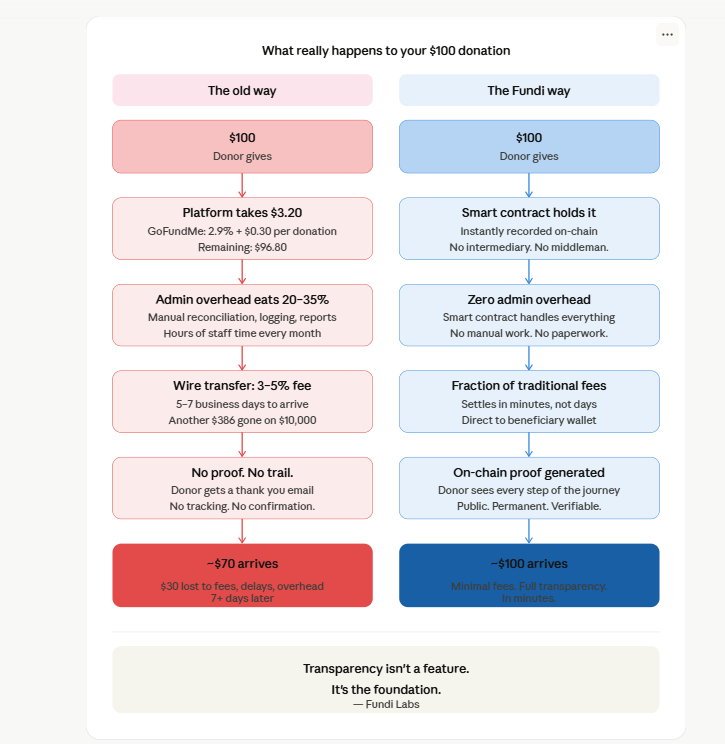
Here is what that looks like in practice.
A donor gives $100 to an NGO running a campaign for flood victims in a rural village in Uganda.
Before the organisation sees a single cent, GoFundMe has already taken 2.9% plus $0.30 on the transaction.
The finance team manually reconciles the donation, logs it, updates the donor database, and flags it for the quarterly report - a process that, across hundreds of donations, consumes 20 to 35% of the organisation's operating budget according to sector research.
Then the money needs to move internationally. The wire transfer costs another 3 to 5% in cross-border fees and takes up to 7 business days - assuming there's no compliance flags, public holidays, & delays at the correspondent bank.
By the time the money arrives, the family that needed it has been waiting over a week.
And somewhere between $25 and $35 of their $100 has quietly disappeared into a system that was designed long before the technology existed to do better.
This is not a story about fraud or negligence.
It is an infrastructure story, and what happens when the tools an entire sector depends on were never built with the end recipient in mind.
That technology now exists.
At Fundi Labs, every donation made through Funds for Humanity is recorded onchain the moment it is given.
Smart contracts route funds automatically. Fees are a fraction of what traditional platforms charge.
Beneficiaries receive funds directly, with no manual reconciliation, no wire transfer queues, no 7-day wait.
And every step of that journey is publicly verifiable in real time by anyone who wants to look.
Not because we built something complicated.
Because we built something that finally puts the cause and the people it serves at the centre of how the money moves.
The cause deserves 100 cents of every dollar donated to it.
Follow @FundiProtocol to see how we're making that the standard, not the exception.
And here's what that looks like in practice.
Most fundraising platforms automate the transaction.
Money moves from the donor to the platform to the organisation. That part works.
What doesn't work is everything around it.
The reconciliation still happens manually.
The wire transfer still takes 7 days, the donor still has no idea if their money arrived, and the organisation still spends 3 weeks preparing a report that should generate itself.
The transaction was automated, but coordination wasn't.
That's the gap Funds for Humanity is built to close.
Not just a faster way to collect donations, but a system where execution, verification, and accountability happen together, automatically, as part of the same logic.
The money moves, proof is generated, the report writes itself, & the beneficiary receives... All connected, all onchain.
That's what programmable coordination means for impact organisations.
And that's exactly what we're building.
A lot of people hear “smart contracts” and immediately think about automation.
But automation by itself doesn’t solve much if the incentives inside the system are still misaligned.
You can automate a broken workflow and still end up with delays, uncertainty, and coordination problems.
That’s why we think the bigger opportunity isn’t just smart contracts individually.
It’s what happens when contracts operate as part of a connected system.
Where:
~ execution doesn’t depend on constant follow-ups
~ incentives are aligned across participants
~ outcomes can be verified without extra coordination
~ and every action strengthens the reliability of the network itself
That changes the role of infrastructure completely.
Instead of systems being held together by trust and manual oversight, they start operating more like environments with built-in logic and accountability.
That’s the direction we’re moving toward at Fundi Labs.
Not just programmable contracts, but programmable coordination.
A lot of people hear “smart contracts” and immediately think about automation.
But automation by itself doesn’t solve much if the incentives inside the system are still misaligned.
You can automate a broken workflow and still end up with delays, uncertainty, and coordination problems.
That’s why we think the bigger opportunity isn’t just smart contracts individually.
It’s what happens when contracts operate as part of a connected system.
Where:
~ execution doesn’t depend on constant follow-ups
~ incentives are aligned across participants
~ outcomes can be verified without extra coordination
~ and every action strengthens the reliability of the network itself
That changes the role of infrastructure completely.
Instead of systems being held together by trust and manual oversight, they start operating more like environments with built-in logic and accountability.
That’s the direction we’re moving toward at Fundi Labs.
Not just programmable contracts, but programmable coordination.
EPISODE 1
In 2024, international humanitarian assistance fell by nearly $5 billion, the largest single drop ever recorded. X
By mid-2025, less than 17% of the $46 billion needed to meet global humanitarian needs had been received. Facebook
The UN's own Emergency Relief Coordinator said it plainly - "We have been forced into a triage of human survival."
That sentence stopped us cold when we first read it.
Not because it was shocking, but because it wasn't.
We already knew the system was breaking; we just didn't say it out loud.
Governments are pulling back, major donors are cutting budgets...
The platforms that were supposed to fill the gap charge 2.9% plus $0.30 on every transaction, fees that quietly drain the little that does get through.
And the organizations on the ground - the ones doing the actual work, are left holding the shortfall.
Running campaigns on platforms that can't tell them where their money is, sending wire transfers that take a week to arrive, writing reports that nobody can verify.
The infrastructure of giving is broken.
And the people who pay for that are never the donors, the platforms, or the governments writing the press releases.
It's always the 311 million people waiting on the other side.
That's why we chose Funds for Humanity.
Not because it's a clever product, or the technology is impressive, though it is.
But because the system is designed to help the world's most vulnerable, it is failing them visibly; the response cannot be another spreadsheet.
Another slow transfer, another platform taking its cut before the mission gets its money.
The response has to be infrastructure that actually works.
Funds for Humanity puts every donation on-chain the moment it's made. The smart contract holds it.
The release conditions are set in code before the first dollar arrives, the beneficiary receives funds directly...
And every single step is publicly verifiable, not in a quarterly report, not in an email update, but in real time, by anyone, anywhere.
We are not naive about how big the problem is.
$24 billion funding gap, 311 million people in need, Governments retreating, donors fatigued.
But here is what we know: when money does move, it should arrive whole.
It should arrive fast. And the people who gave it should be able to see that it got there.
That is not a radical idea. It is the minimum standard that the people who need this money deserve.
Funds for Humanity is how we build toward that standard, one transparent campaign at a time.
Follow @FundiProtocol. There is a lot more to show you.
https://t.co/SVoNNhOA4e
EPISODE 2
Nine years ago, a group of nonprofit leaders, fraud experts, and government officials had to gather in a room just to convince the sector that charity fraud was real.
The idea was met with disbelief.
Nine years later, 42% of charities were victims of fraud in 2024. And half of every fraud detected was committed by people already inside the organization - Staff, volunteers, & trustees.
The people donors trusted most with their money.
I want you to sit with that for a moment because this is not a story about scammers in basements posing as charities.
This is a story about the finance manager who has been with the organization for eight years, the volunteer coordinator everyone loves, and the trustee who sat on three boards and stole from all of them.
One fraud expert put it plainly: "People don't stop committing fraud in just one instance. If the charity does not report the behavior out of fear of attention, the fraud will be repeated at the next nonprofit that hires the person."
A sad, recurring theme. His words, not ours.
And then there is the case that stopped me cold when I first read it.
Women's Cancer Fund collected over $18 million from donors who believed they were helping women undergoing cancer treatment. Only about one cent out of every dollar donated actually reached those women.
The rest went to the charity's operator, to fundraisers, to people who had nothing to do with cancer and everything to do with the money.
One cent out of every dollar. And for years, nobody knew.
This is the part that keeps us up at night.
Not that the fraud happened. Fraud happens everywhere there is money and insufficient oversight.
What keeps me up is the donors.
The person who skipped lunch to donate $20. The diaspora family that sent $100 to help someone going through what their mother went through.
They had no way to know; the system was never built to show them.
But we are not in that era anymore.
The technology exists today to make trust unnecessary, not because people are bad, but because proof is better than faith when someone's survival depends on it.
That is what Fundi Labs is built on.
Every donation is recorded onchain the moment it is made. Smart contracts that hold funds and release them automatically based on conditions set before the first dollar arrives.
A trail that is public, permanent, and impossible to alter at 11 pm on a Tuesday quietly. Not an audit that arrives six months later. Or a report that includes a summary of what has already happened.
Real-time, verifiable proof for every dollar, every step, every time.
We are not building Fundi because we think impact organizations are dishonest.
We are building it because the honest deserve a system that proves it - automatically, continuously, without anyone having to take their word for it.
And the donors who give deserve to know their one cent became one dollar.
Every single time.
Follow us to stay in the know.
https://t.co/SVoNNhOA4e
@RWAFoundation_ It’s also why infrastructure matters as much as product.
If execution, visibility, and incentives aren’t aligned, even strong systems struggle to scale beyond early attention.
@0xseth_ Adoption won't be won by tokenization alone. It will be won by infrastructure that makes ownership, capital flows, and outcomes verifiable at scale.
The opportunity is massive. The next challenge is building systems institutions can confidently rely on.
The growth is impressive, but the bigger signal is what’s happening underneath.
As more assets move onchain, the conversation shifts from access to infrastructure, verification, and enforceability.
Tokenization is becoming less about experimentation and more about market structure.
EPISODE 2
Nine years ago, a group of nonprofit leaders, fraud experts, and government officials had to gather in a room just to convince the sector that charity fraud was real.
The idea was met with disbelief.
Nine years later, 42% of charities were victims of fraud in 2024. And half of every fraud detected was committed by people already inside the organization - Staff, volunteers, & trustees.
The people donors trusted most with their money.
I want you to sit with that for a moment because this is not a story about scammers in basements posing as charities.
This is a story about the finance manager who has been with the organization for eight years, the volunteer coordinator everyone loves, and the trustee who sat on three boards and stole from all of them.
One fraud expert put it plainly: "People don't stop committing fraud in just one instance. If the charity does not report the behavior out of fear of attention, the fraud will be repeated at the next nonprofit that hires the person."
A sad, recurring theme. His words, not ours.
And then there is the case that stopped me cold when I first read it.
Women's Cancer Fund collected over $18 million from donors who believed they were helping women undergoing cancer treatment. Only about one cent out of every dollar donated actually reached those women.
The rest went to the charity's operator, to fundraisers, to people who had nothing to do with cancer and everything to do with the money.
One cent out of every dollar. And for years, nobody knew.
This is the part that keeps us up at night.
Not that the fraud happened. Fraud happens everywhere there is money and insufficient oversight.
What keeps me up is the donors.
The person who skipped lunch to donate $20. The diaspora family that sent $100 to help someone going through what their mother went through.
They had no way to know; the system was never built to show them.
But we are not in that era anymore.
The technology exists today to make trust unnecessary, not because people are bad, but because proof is better than faith when someone's survival depends on it.
That is what Fundi Labs is built on.
Every donation is recorded onchain the moment it is made. Smart contracts that hold funds and release them automatically based on conditions set before the first dollar arrives.
A trail that is public, permanent, and impossible to alter at 11 pm on a Tuesday quietly. Not an audit that arrives six months later. Or a report that includes a summary of what has already happened.
Real-time, verifiable proof for every dollar, every step, every time.
We are not building Fundi because we think impact organizations are dishonest.
We are building it because the honest deserve a system that proves it - automatically, continuously, without anyone having to take their word for it.
And the donors who give deserve to know their one cent became one dollar.
Every single time.
Follow us to stay in the know.
https://t.co/SVoNNhOA4e
EPISODE 1
In 2024, international humanitarian assistance fell by nearly $5 billion, the largest single drop ever recorded. X
By mid-2025, less than 17% of the $46 billion needed to meet global humanitarian needs had been received. Facebook
The UN's own Emergency Relief Coordinator said it plainly - "We have been forced into a triage of human survival."
That sentence stopped us cold when we first read it.
Not because it was shocking, but because it wasn't.
We already knew the system was breaking; we just didn't say it out loud.
Governments are pulling back, major donors are cutting budgets...
The platforms that were supposed to fill the gap charge 2.9% plus $0.30 on every transaction, fees that quietly drain the little that does get through.
And the organizations on the ground - the ones doing the actual work, are left holding the shortfall.
Running campaigns on platforms that can't tell them where their money is, sending wire transfers that take a week to arrive, writing reports that nobody can verify.
The infrastructure of giving is broken.
And the people who pay for that are never the donors, the platforms, or the governments writing the press releases.
It's always the 311 million people waiting on the other side.
That's why we chose Funds for Humanity.
Not because it's a clever product, or the technology is impressive, though it is.
But because the system is designed to help the world's most vulnerable, it is failing them visibly; the response cannot be another spreadsheet.
Another slow transfer, another platform taking its cut before the mission gets its money.
The response has to be infrastructure that actually works.
Funds for Humanity puts every donation on-chain the moment it's made. The smart contract holds it.
The release conditions are set in code before the first dollar arrives, the beneficiary receives funds directly...
And every single step is publicly verifiable, not in a quarterly report, not in an email update, but in real time, by anyone, anywhere.
We are not naive about how big the problem is.
$24 billion funding gap, 311 million people in need, Governments retreating, donors fatigued.
But here is what we know: when money does move, it should arrive whole.
It should arrive fast. And the people who gave it should be able to see that it got there.
That is not a radical idea. It is the minimum standard that the people who need this money deserve.
Funds for Humanity is how we build toward that standard, one transparent campaign at a time.
Follow @FundiProtocol. There is a lot more to show you.
https://t.co/SVoNNhOA4e
EPISODE 1
In 2024, international humanitarian assistance fell by nearly $5 billion, the largest single drop ever recorded. X
By mid-2025, less than 17% of the $46 billion needed to meet global humanitarian needs had been received. Facebook
The UN's own Emergency Relief Coordinator said it plainly - "We have been forced into a triage of human survival."
That sentence stopped us cold when we first read it.
Not because it was shocking, but because it wasn't.
We already knew the system was breaking; we just didn't say it out loud.
Governments are pulling back, major donors are cutting budgets...
The platforms that were supposed to fill the gap charge 2.9% plus $0.30 on every transaction, fees that quietly drain the little that does get through.
And the organizations on the ground - the ones doing the actual work, are left holding the shortfall.
Running campaigns on platforms that can't tell them where their money is, sending wire transfers that take a week to arrive, writing reports that nobody can verify.
The infrastructure of giving is broken.
And the people who pay for that are never the donors, the platforms, or the governments writing the press releases.
It's always the 311 million people waiting on the other side.
That's why we chose Funds for Humanity.
Not because it's a clever product, or the technology is impressive, though it is.
But because the system is designed to help the world's most vulnerable, it is failing them visibly; the response cannot be another spreadsheet.
Another slow transfer, another platform taking its cut before the mission gets its money.
The response has to be infrastructure that actually works.
Funds for Humanity puts every donation on-chain the moment it's made. The smart contract holds it.
The release conditions are set in code before the first dollar arrives, the beneficiary receives funds directly...
And every single step is publicly verifiable, not in a quarterly report, not in an email update, but in real time, by anyone, anywhere.
We are not naive about how big the problem is.
$24 billion funding gap, 311 million people in need, Governments retreating, donors fatigued.
But here is what we know: when money does move, it should arrive whole.
It should arrive fast. And the people who gave it should be able to see that it got there.
That is not a radical idea. It is the minimum standard that the people who need this money deserve.
Funds for Humanity is how we build toward that standard, one transparent campaign at a time.
Follow @FundiProtocol. There is a lot more to show you.
https://t.co/SVoNNhOA4e
There's a reason donor retention rates in the nonprofit sector average just 43%.
People give once, wait for proof their money did something, and when that proof never comes, they move on.
It's not that donors are stingy. It's that most fundraising platforms were never designed to close the loop between giving and impact.
@FundiProtocol was built around one simple idea: every donor deserves to see the full journey of their gift.
From the moment it leaves their hands to the moment it changes someone's life.
When donors can see that, they don't just give again.
They give more. They tell their friends. They become advocates for your cause.
Transparent fundraising isn't just an ethical choice.
It's the smartest growth strategy an impact organization can have right now.
@lcx A lot of people focus on the token itself. But the bigger shift is what tokenization does to ownership, settlement, and verification at scale.
The real opportunity is building systems where assets move with more transparency, less friction, and clearer accountability.
@RWAFoundation_ infrastructure matures, institutions enter, and suddenly everyone realizes the market structure is changing underneath them.
That’s the phase tokenization feels like it’s entering now.
Most nonprofits ask their donors to simply trust that the money arrived.
No real proof, just a thank you email and maybe an annual report months later.
But donor trust is getting harder to earn, and easier to lose.
The organizations winning right now are the ones who can show their donors exactly where every dollar went, who received it, and when.
Not as a promise, but a verifiable proof.
That's what tokenized fundraising makes possible.
Every donation recorded onchain, visible in real time, impossible to dispute.
@FundiProtocol was built for impact organizations who are ready to stop asking for trust, and start earning it.